Monday, April 18, 2011

Bundesgrenzschutz T-Shirt with Sport Patch


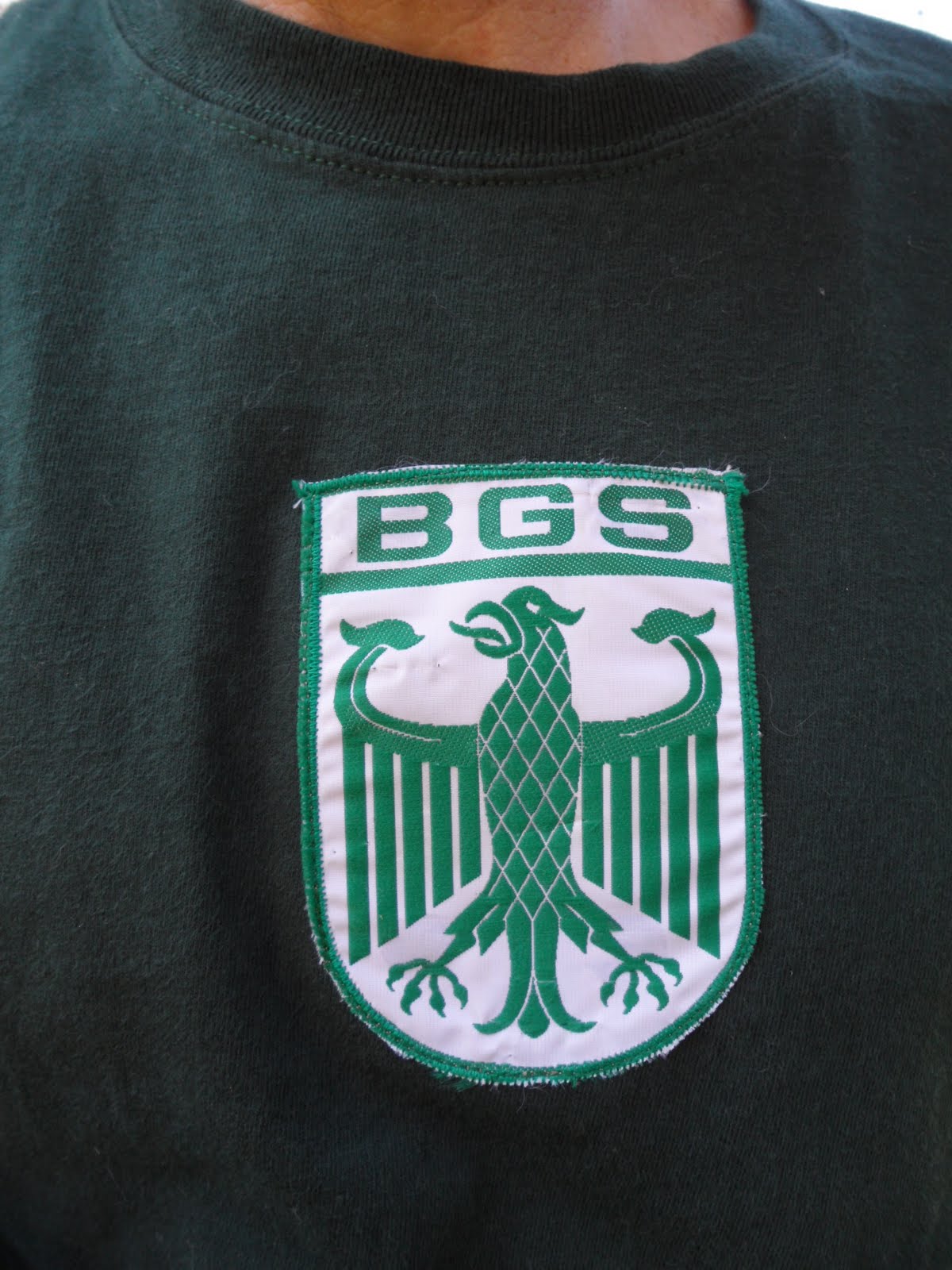
This afternoon I did a little sewing project and made up an "unofficial",  Bundesgrenzschutz T-shirt!  I picked up a "BGS Green" T-shirt over in Silverdale last week with the intention of sewing on my new BGS Sport Patch and creating my own version of a BGS shirt.  The project came out great.  I'll use the T-shirt for "casual cruising" on the Bundesgrenzschutz truppenfahrrad, ........... BGS bicycle.

Bundesgrenzschutz Flight Wings & Sports Patch

I picked up a couple of more Bundesgrenzschutz patches off of eBay the other day and they arrived on Friday........  The first patch is a set of cloth flight wings and the second is a sports-athletic shirt patch.  Both patches came from an older estate and had hand typed labels identifying each one.  I would guess that this would probably place the date on these as "pre-computer", but that is just a guess and an assumption only...... 1980's on back?  You will notice the remnants of some glue on the back of these two patches that are left over from the "display" in the original estate they came from.

I'm not sure how rare a set of the cloth flight wings are, but I know that the BGS aviation wing was pretty small and I have only found two examples on all of my internet searches, and both sets of wings were sewn to flight suits (sold, or with a VERY high price tag!).  My set of wings are machine embroidered onto a backing of felt.


The second patch is a BEVO styled patch that would have been sewn to the sport "T-shirt" used for physical training.  


As an interesting side note, here are a mix of Bundesgrenzschutz patches that show a wide variation of BGS Green colors.  I guess there really was no one standard green color used through the years or even at any one given time.


 UPDATE:  I received an email from a BGS veteran over in Germany this afternoon and he was able to give me some great information about the flight wings...... I would highly recommend his web site, it is full of great BGS information and photos of his uniforms and equipment, etc.       Bundesgrenzschutz Website

Here is the email that I received..... Thanks Christian! 

"Your wings are wings for NCO´s  worn on something like class A uniform jackets, on my website you can see a flight crew jacket, on this jacket you can see the officers wings and the rank insignia of a Polizeimeister ( my rank, like a sergeant). The NCOs with flight crew wings were on board mechanics and  co pilots, to be a pilot in borderpolice they had to be officers from Kommissar ( 2nd Lt). The Bundesgrenzschutz used four different wings one version for flight suits (you can see on my flight suit on my website) your version for NCOs, the version my flight crew jacket for officers and a version like this one on my flight crew jacket but golden. After the changed the name in Bundespolizei and they changed the uniforms in blue all the flight crew wings  are golden / yellow on blue."


 I don't have any archive pictures to present on these patches right now, so here's a couple of old BGS helicopter photos instead............... sort of ties into the whole flight wing thing:


Friday, April 15, 2011

Hemets of the ETO, A Historical & Technical Guide. US M1 Helmet Reference Book


I have a new book in the military reference section of my home library............ Helmets Of The ETO,  A Historical & Technical Guide.  One word describes this book:  FANTASTIC!  The book is both a technical guide to EVERY design variation of the M1 helmets used in WW2, and a virtual museum of actual helmets that were recovered from the battlefields and beaches of France.  The authors are both French and have been searching for and collecting battlefield helmets for years.  The helmets that are portrayed in this book range from the landing craft coxswains, to the paratroopers, to the engineers, and everything in between.  One of the most sobering sections of the book is the section on battle damaged helmets............... if you ever wanted to bring the war back down to a individual human level, then this section will do it.  Very sobering.

I had been eying the book for some time, but did not want to pay the full list price of $50.00.  I just happened to scan through the catalog from Edward R. Hamilton Bookseller Company, and found the book listed for $16.95, with free shipping, no tax!  I ordered one ASAP and have been enjoying the book ever since it showed up.......

The book is 192 pages long, contains over 700 color photos, and provides outstanding graphic charts detailing the technical aspects of the various M1 helmet variations along with photos of each of the different component variations.  This hard cover book was written by Regis Giard and Frederic Blais.


Here are few quick snapshots of a few of the pages inside the book to give you a little teaser of what this book has to offer:

Wednesday, April 13, 2011

Mercator Pocket Knives, K55K Kat

Today's posting will showcase three of my favorite pocket knives, all versions of the famous Mercator folding lock-back K55K, Kat Knife.  These knives have been made in nearly the same configuration and style by Mercator since around WW1.  They are still made today by Mercator in a small brick building, by hand, in Solingen, Germany...... each step of the manufacturing is done by a real person and not by an automated machine........... including the final inspection!


These pocket knives were the unofficial standard pocket knife of the German soldier during WW2 and became very well known here in the United States after the war, when many of these knives were brought back by American GI's as war souvenirs.  

Update 4-26-11:  I received an email from my uncle who told me that he has a Mercator pocket knife that his dad, my grandfather, brought back from WW2.  He said that he carried it as a kid as his "carry-knife" and used to love to partially open it and "flick it" like a switchblade.  I would imagine that my grandfather picked this up somewhere in France or Germany towards the end of the war.  I remember him telling me a story about how a number of German soldiers, "armed to the teeth", stepped out in front of his jeep with their hands up to surrender....... they were ready to quit.  He said that they took all of their weapons and then had them pile onto the jeep.  He said that they hauled them back behind the lines to the prisoner holding area.  This could very well be the time he picked up the knife.  You can read more about this knife on my more recent blog posting here:

http://sharky-fourbees.blogspot.com/2016/06/kat-k55k-mercator-knife-ww2-captured.html 

They may have started out as souvenirs, but they quickly became prized for their balance, durability, and ability to hold an amazing sharp edge.  These knives can still be purchased today and are actually well know in the paper mills out here in the Pacific Northwest as the best "paper maker's" knife ever.  In fact the knives are often given out by companies that do business with the mill's, as promotional give-away's for the machine crews and can often be purchased from the individual mill's by mill workers.  I carry one all the time at work and even have one with me when I'm out and about on my own time...... they're that good.

Here's a fantastic short video documentary that was filmed at the Mercator manufacturing shop in Germany several year ago.  It's about 3 minutes long and well worth the time to watch.......


To keep from loosing my knife while out on the boat, at work at the mill, or around town, I have devised a great carrying set-up.  I discovered that the nylon belt carrier for a mini-mag flashlight fits the Mercator knives exactly!  I add to this, a Czechoslovakian military surplus, belt "D" ring, with a leather cord and stainless steel fishing swivel.  It's a perfect combination, looks good and I always know were to find my knife.


Here's the photo showcase of my three knives.  The two black ones are plain Mercators and the white knife is a promotional Mercator knife from a paper mill supply company.  You will notice that one of the black handled knives has a shorter blade.......... I accidentally snapped the tip off years ago and had to re-grind it.  It actually turned out to be a great modification for a work knife.  Now the blade is really stout and tough!  That short one's my daily work knife, and trust me, I abuse that knife daily and it just doesn't seem to phase it (it just gets a bit more beat up).

Now for the pictures:

Grenzpolizei-Grenztruppen Der DDR, Sommer Uniform - Arbeitsjacke......................East German Border Police Summer Uniform Tunic

Here is the latest addition to my growing collection of items for the Bundesgrenzschutz bicycle set up.  I found this tunic down in California at a military surplus store (online) advertised as a "German Work Shirt".  I ordered one up and it arrived yesterday.  The tunic is actually an East German summer-weight uniform tunic that is unlined and, I  believe, is actually a field "work" uniform, something like the modern BDU fatigues worn in the field by today's soldiers.  I will be using this tunic to put together a replica Bundesgrenzschutz lightweight field uniform from the the 1950's.  I have the shoulder eagle already, but still need to find a set of shoulder boards.

East German Troopers in the Summer field uniform
The Bundesgrenzschutz adopted a lightweight work uniform in 1956 and used it until it was officially replaced in 1958 by the camouflage field uniforms.  The green work uniforms were used up through 1960, while the new camo outfits were phased in.  The uniforms were constructed of olive green moleskin fabric, not the normal brighter BGS green.  They were basically an olive drab BDU.


Here's a couple of pictures of the Bundesgrenzschutz work uniform being worn:


Here's the run down on the East German tunic I have............. This tunic is in brand-new and unissued condition.  This style of field tunic was used by the East German Border Police in the 1970's and 80's.  The tunic is made of a lightweight, green. cotton blend fabric with aluminum pebbled buttons.  There are smaller, pressed fiber buttons, that line the collar and at the sleeve cuffs.  The label code indicates that the tunic dates to 1981.  The seams inside the jacket have a loose-weave polyester binding that is very typical on DDR field clothing from the 1970's and 1980's.  The number 504-16 is stamped inside, on a number of the fabric panels of the tunic.  I'm not certain what the meaning of these number is, but they may identify a certain size of the cut pieces to aid in assembly of the tunic at the factory.  There are attachment eyelets and a a loop on each shoulder for the attachment of shoulder boards.  

This tunic actually looks pretty darn close to the WW2 Afrika Korps tropical uniform!  I'm sure it could be used to make up a pretty good replica uniform with the right insignia..........here's what the WW2 Afrika Korps version of this uniform looks like:


Here are the photos of the new Tunic:


To finish this posting up, here are a few period photos of this style tunic being worn by East German Border Police troopers:

Tuesday, April 12, 2011

Mauser Karabiner 98k, and Scho-Ka-Kola Airsoft Ammo Tin

I did a bit more work on the new Mauser 98k......  I finished up most of the aging of the gun metal, drilled and filled the butt stock with foam, added a last coat of Neetsfoot leather oil to the sling, and came up with the perfect ammo tin for the airsoft 6mm BB's.

Last year I made up a replica Scho-Ka-Kola candy tin to carry in the BGS bicycle saddle bags and had every intention at the time to use it to carry some sort of small parts, but didn't quite know what that would be.  Well, I figured it out.......... it makes the perfect ammo tin for the Mauser BB's!  The great thing about it is that a candy tin like this would have been carried by a soldier in the field, so it fits right in with the field kit and camouflages the plastic BB's quite nicely.  Here's a link to my earlier blog posting on the Scho-Ka-Kola posting:


Here's the Scho-Ka-Kola tin with the BB's.........


Here are some photos of the finished Mauser Karibiner 98k airsoft rifle  (Well finished for now at least.  I'm sure I'll find some more things to tinker with and perfect!):