Today marks the true closing of a dark chapter of our collective world history. The last surviving WW1 combat veteran has passed away today in Perth, Western Australia, at the age of 110 years old.
British born, Claude Stanley Choules, joined the British Royal Navy in 1917, just one month after turning 14 years old. He served on the the training ships HMS Mercury and HMS Impregnable and the battleship HMS Revenge, and it was from this battleship in 1918, that he watched the surrender of the German High Seas Fleet. His primary duty while on board the Revenge was lowering the seaplanes into the water for action against the German Zeppelins. After the war, he joined the Australian Navy.
 |
| HMS Revenge, 1939 |
During WW2 he served with the Australian Navy as a torpedo officer and demolitions officer.
He later transferred to the Naval Dockyard Police where he served until his retirement in 1956.
Claude Choules later grew to become a pacifist and refused to participate in anything that glorified war. He married Ethel Wildgoose in Australia in 1926 and they lived together for 76 years, until she passed away in 2003 at the age of 98. Claude Choules wrote in his autobiography that it was love at first sight.
For the complete story about Claude Choules, follow this link over to BBC News:
The Last WW1 Combat Veteran
While driving through Bremerton, Washington this past weekend, I noticed a couple of old 40mm Bofors Anti-Aircraft Guns in a tiny city park. I did a "round-the-block" and found a place to park by the side of the road. The park was a tiny little wedge of land, at a busy crossroads, with no public parking.........a few beer bottles here and there, and grossly neglected, unfortunately. The little park was a monument to the USS Bremerton, the namesake of the city. Two, quad mounted AA guns and a huge ship's anchor and chain from the original ship and a memorial plaque..... one set of quad mounted AA guns on each side of the anchor, nice framing, odd park.
USS Bremerton CA-130
The USS Bremerton was a Baltimore Class heavy battleship that was built at the very end of WW2, and launched in July 1944. She saw active combat in the Korean War in 1951 - 1952. She was decommissioned in 1960 and sold for scrap in 1973.
Here's a link to the Wiki page about the USS Bremerton.
The two guns at the park are US made versions of the Swedish Bofors 40mm anti-aircraft guns. During WW2, Chrysler of the USA, built 60,000 of the guns for US ships and land units.
Here is a link to the Wiki page about these famous 40mm Bofors Anti-Aircraft Guns.
And here are the photos of the two AA guns in the park.............
Here are a few photos of the AA guns in action during WW2:
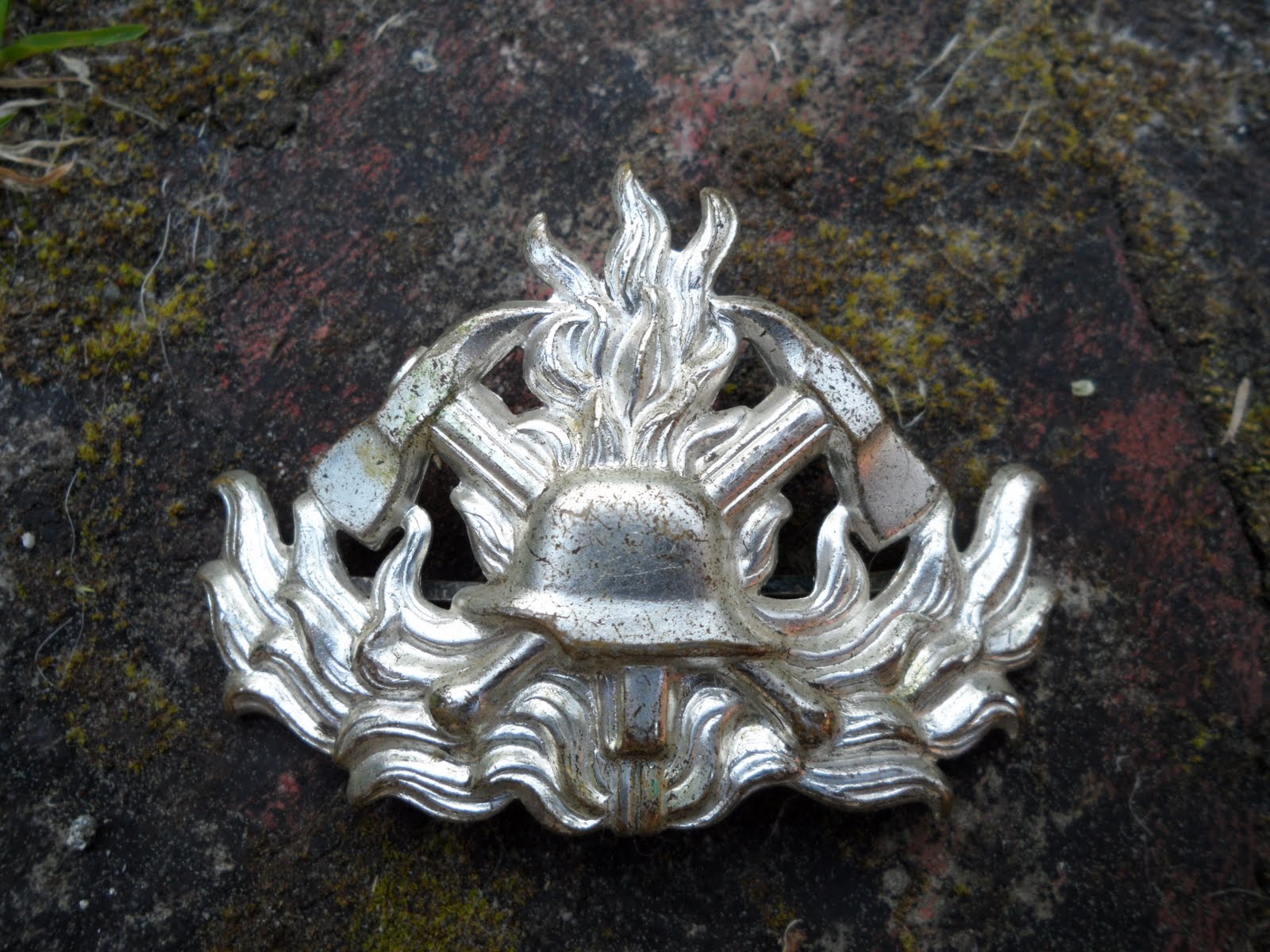
As a quick add-on posting to my previous fire department helmet posting, I'd like to add a shot of a West German hat pin that I received as a gift from a friend on the East Coast....... Thanks T.J.!
The pin is a uniform, peaked hat pin that would have been used for an unknown fire department in Germany. This particular pin does not have the device for the city the department was located in. The great thing about this is that I received both the pin and the helmet in the same week, from two different and unrelated sources!!
This weekend's posting is on a great helmet that I picked up off of eBay last week. The helmet is a West German Fire Helmet!
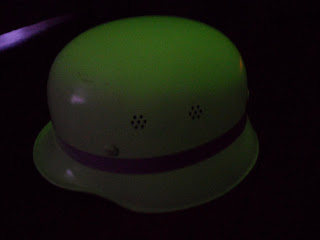
This is the "old style", civilian model, aluminum "stahlhelm" style helmet that was used from before WW2 until the 1990's. This particular helmet is marked with "DIN 14940 DD, which indicates that is is constructed to comply with the "Deutsche Industrie Norm", DIN, or in English, the German Industry Standard, of 14940 DD. This standard was instituted around 1964 and was rendered obsolete in 1997 with the introduction of the new Euro-standard requiring all fire helmets to be non-conductive. The helmet is stamped with the shell size of H2. this shell size is designed to fit head sizes 53-61. The manufacturer is JUNGER and this is also stamped on the shell. There is a letter "B" stamped as well, but I am unsure of what this indicates.

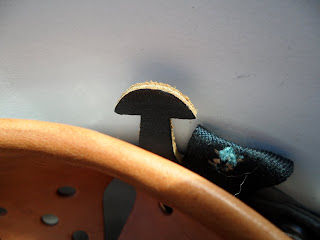
The liner that is in this helmet is EXTREMELY high quality and complex. It has a metal band with a thick felt material over that, with the leather liner attached over that. The liner is adjustable from size 56 - 59, by means of a knurled clamping bolt that slides in a long slot in the metal liner band. This allows the liner to fit every size between 56 and 59 by allowing the wearer to adjust it while the helmet is being worn, and clamping it to their exact head size. Above the leather liner, is a web of nylon suspension straps, just like the "construction hard hats" found here in the US. Around the perimeter of the liner, in the back, is a series of "T" tabs made out of leather. these tabs allow the attachment of a leather neck guard, called a "Nackenshutz" in German. You can see examples of this neck guard in the "action-archive" shots at the end of the posting. The leather liner is marked with the initials "CBM" inside a "leather hide" shape. I believe this is the manufacturer of the liner, but I am not sure.


The helmet is equipped with a strap system reminiscent of the old WW2 Fallschirmjager helmets (paratrooper helmets). The straps are leather with a quick release tightener, and two strap end keepers that have snaps to quickly and securely take care of the long end of the chin strap once it is on and tightened. The harness is attached to the shell at 4 points, crossing over in the back. They are attached with bolts.
Here are a couple of shots comparing this fire helmet to my post-war Bundesgrenzschutz helmet. The inner leather liners are similar, but the metal bands, attachments and size adjusters are completely different. The BGS helmet liner is very basic. You can see the distinct look of the civilian model helmet when it is next to the military version: The front edge angles of the skirt on the fire helmet are very angular and it has the salt shaker vents on the sides. The fire helmet also has a longer skirt and visor.
And now for some action-archive shots! Here are some German Firefighters in action, wearing this version of the fire helmet:
Here are a few German fire engines and a German Fire Department bicycle thrown in for good measure: