Sunday, October 16, 2016

MG42/ M53 Ammo Can, Yugoslavian Army JNA, Fao-Oviedo Spain, 8mm Mauser, MG1A1, MG3

Recently I had the chance to pick up a "MG42 / M53" ammo can from an online military supplier.  They had a batch of surplus ammo cans that they received as Yugoslavian surplus.  The price was right, and shipping was nearly free.......how could I pass up that deal?  I didn't!


After WW2, Yugoslavia pressed a number of German MG42 machine guns into service and then in 1953, they designed their own copy, the M53.  These Yugoslavian M53's were originally chambered in 8mm Mauser, just like the original MG42's.  Later they re-chambered them to .308 NATO.
The can I received is sized for the original 8mm Mauser rounds.

The MG42's and MG42/M53's  were widely used by the Yugoslavian Army (JNA).  After the break-up of Yugoslavia, these M53's and MG42's went on to continue their service with the Serbian Army.  Surplus MG42' s and M53's are still in use all over the Third World.


JNA Yugoslavian Soldier with MG42/M53.
The M42 / M53 ammo can in use! Post-War Yugoslavia.    
Yugoslavia continued the use of surplus WW2 German MG42 ammo cans and later manufactured their own copy of the cans.  My Yugoslavian can is quite unique.  

My can was obtained from Serbia by the importer, after use in the Serbian and Yugoslavian Armies.  It is dated 1967, however the manufacturer of the can is Spanish!

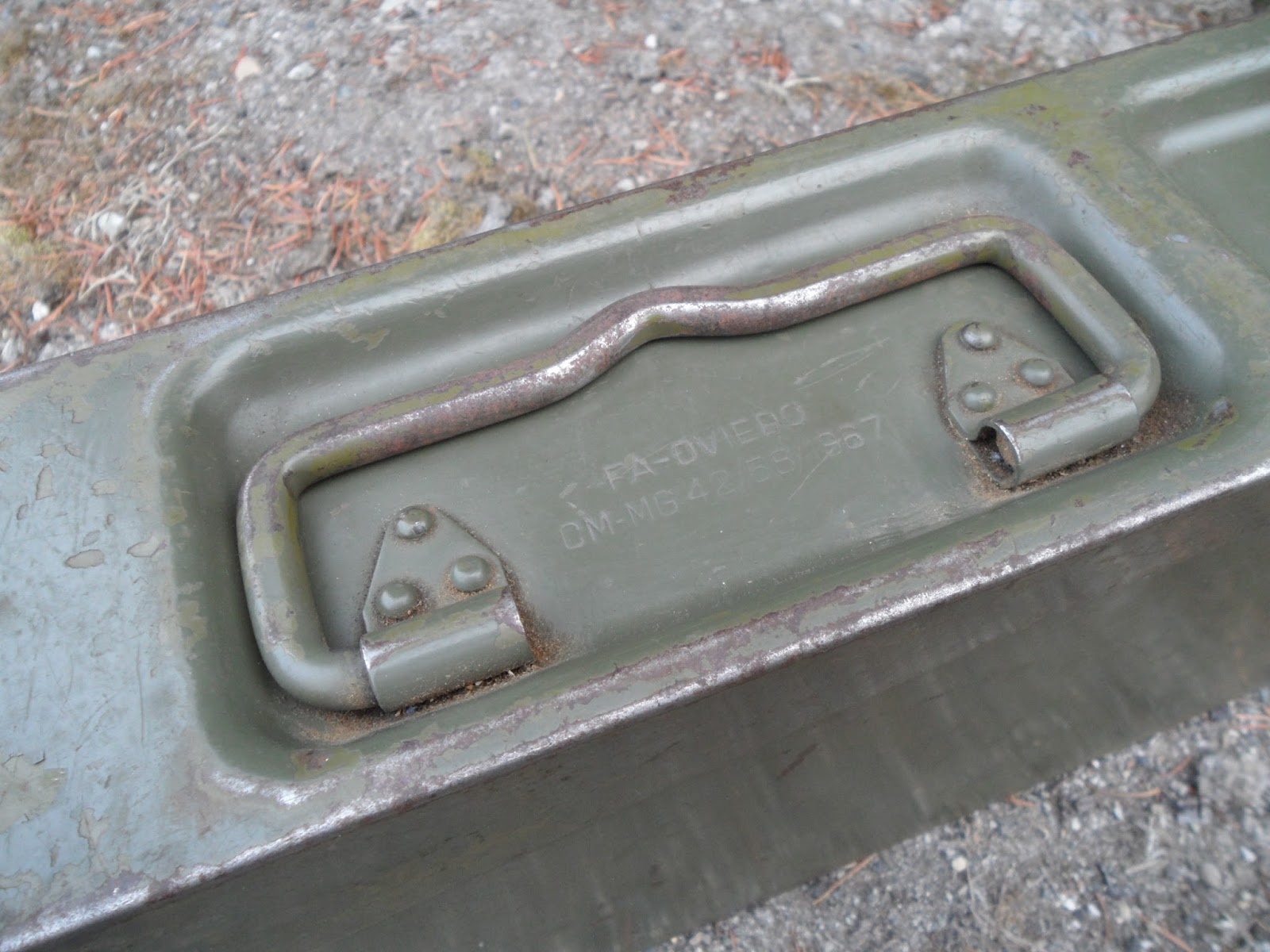
The can is marked "FA-OVIEDO  CM-MG42 / 58  1967".  MG42/58 is the designation of the post-war German version of the MG42, the MG1A1.  FA-OVIEDO is the manufacturer designator for the Spanish Arsenal Oviedo.  I checked the measurements of the ammo can, and it is definitely sized for 8mm Mauser ammo(8mm Mauser ammo is longer than .308 NATO).  The can is also painted in Yugoslavian olive green, as opposed to Serbian light green.


I am not sure what the "back-story" is on this ammo can, but somehow it found it's way from Spain, to Yugoslavia or Serbia, and then to me.

These post-war foreign made cans differ only slightly from the post-war German and WW2 German ammo cans.  There are rivets substituted for pinch welds on the handle and latch brackets, but other than that, they are WW2 knock-offs.  Very cool!

German .308 NATO can is on the left.  Yugo 8mm can on the right.

Now let's take a closer look at this ammo can.


Friday, October 14, 2016

Swedish Army Pick, Shovel and Axe in use with the Stridsvagn M38, M39, M40 Tank, WW2

While researching a few of my Swedish Army items, I ran across a bonanza of photos and information about the field use of my Swedish pick and shovel.

Here are the links to the original posts:

http://sharky-fourbees.blogspot.com/2015/11/swedish-army-pick-mattock-ww2-vintage.html 

http://sharky-fourbees.blogspot.com/2015/11/swedish-pioneer-shovel-pre-ww2-circa-ww1.html

http://sharky-fourbees.blogspot.com/2016/10/swedish-military-axe-kolefors-bruk-1942.html

Finding photos or references to many of the "ordinary" bits of equipment like pioneer shovels or picks, can sometimes prove to be quite difficult.  I had always suspected that both the picks, shovels and axes had been vehicle mounted, in addition to standard field troop issued, but never actually had the "proof".  That is until today!


I ran across a number of photos of the old, pre, and early, WW2 Swedish Army tanks with both the picks, shovels and axes mounted on them.  Nearly every photos of these old Stridsvagn Tanks showed the pick mounted on the right hand side, and the shovel and axe mounted on the left side.  They show up as standard issue on the M38, M39 and M40 versions.  They most likely were used on other pieces of equipment, but they are prominently mounted on all of the early tanks.

Here is a link to an informational sites about these tanks:

http://www.tanks-encyclopedia.com/ww2/sweden/L60_stridsvagn_M38-39-40.php

I love it when I can find such great photos of my old tools in use!  
Enjoy the photos.


Tuesday, October 11, 2016

Swedish Army Wire Cutters, Mini - Bolt Cutters, WW2 Issue

Today we'll be taking a look at another bit of Swedish Army, WW2 field equipment.  Every country that has sent an army into the field, from the WW1 era, until now, has issued their troops some form of wire cutters.  The Swedes were no different.  Today we'll be taking a look at the Swedish version of the military wire cutters.


These cutters are basically a very small set of bolt cutters.  They most likely would have been issued out to field engineers (Sappers), and on a more limited basis, to the regular field soldiers. 

WW2 era Swedish soldier with field tools on belt.

 Normally each squad of soldiers would be issued a few pairs of these cutters.  Not everyone would be issued them.  The idea being that if a squad needed a set, they would be passed them around as needed.


This particular set of cutters is stamped with the Swedish 3-Crowns, which dates it to 1942 or newer.  I can not find any manufacturer's marks or dates, but they may be there, under the thick, black paint.  


From what I can tell, these cutters were issued during the WW2 years and stayed in service well into the Cold War era.  This particular set appears to be in new and unissued condition.


Each set of cutters was issued with it's own leather head-cover, and leather wrist lanyard.  The wrist lanyard would have been used to keep the cutters from being dropped or lost while in use on the battlefield.  I have seen these leather covers and lanyards in various colors, everything from natural, to black, or green.   The leather head-cover on this set is stamped with the Swedish 3-Crowns property mark. 


I wish I knew more specifics about which units these cutters were issued to and their specific, intended use in the field was, but for now we'll just have to stick with generalities.  The research continues!

Let's take a closer look at these vintage cutters.


Monday, October 10, 2016

Swedish Military Axe, Kölefors Bruk 1942, KB42, WW2 issued

Today we'll be taking a look at the most recent addition to my Swedish Collection, a WW2 vintage Swedish Army Axe!


I have been wanting to add one these old axes to my Swedish Military gear collection for quite some time.  It seems that these axes are VERY popular with the "bushcraft crowd", and they sell out fast.  Last week I spotted a batch for sale by my favorite online surplus seller.  The price was super low and the shipping was free......I had to pinch myself to make sure that I wasn't dreaming!  I placed my order and the "new" axe arrived the other day.

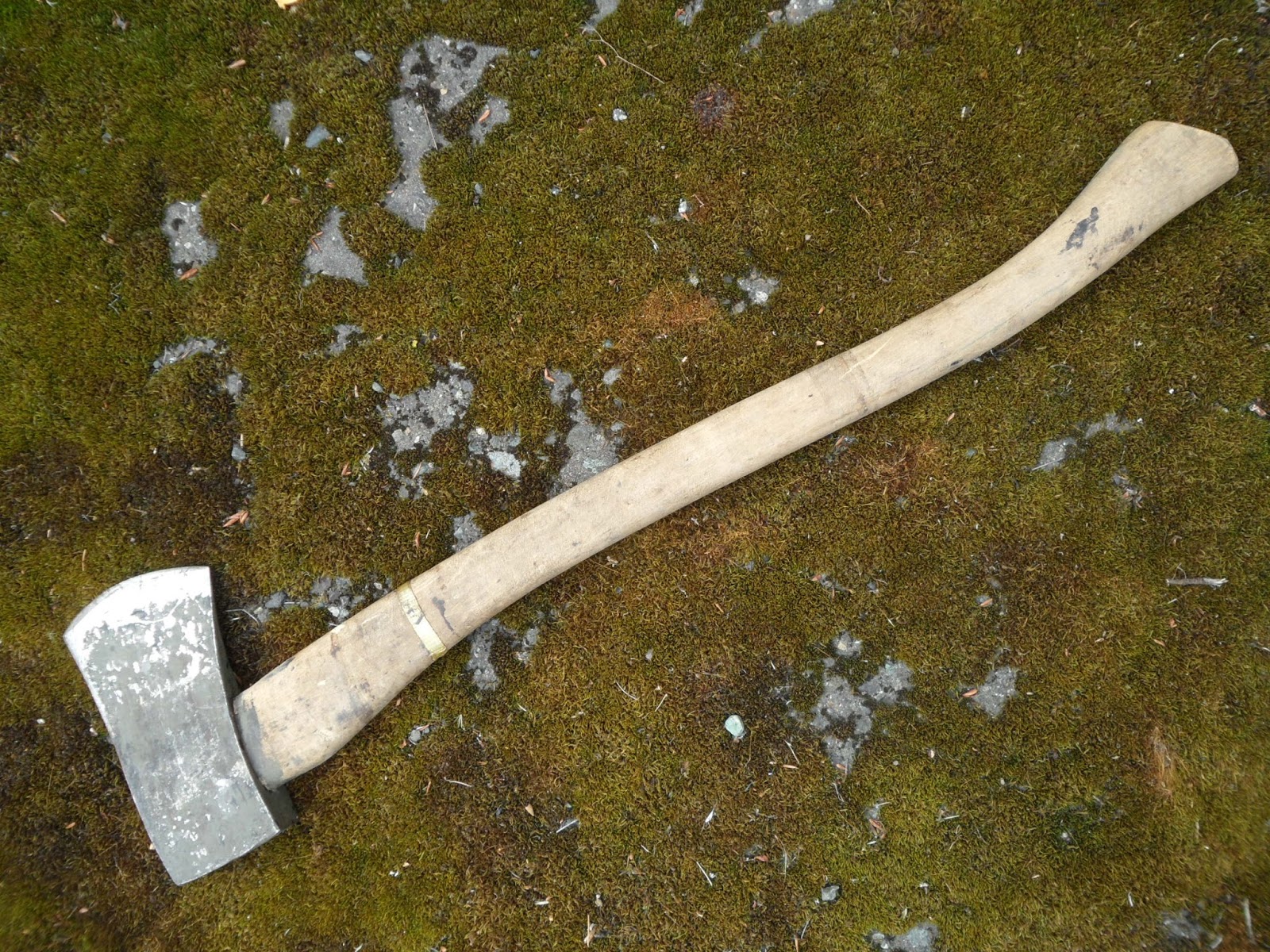
The axe I received was in wonderful condition for its age.  Could it get any better?  Yes!  When I inspected it closer, I saw that the head is stamped KB42 with the 3-Crowns under it.  HB stands for the manufacturer Kölefors Bruk, and the 42 is the year, 1942.  This axe is a WW2 issued axe.  Wonderful!

The KB42 / 3-Crowns stamping is a bit tough to see due to thick paint.

The wood handle is marked with a band of woven tape that appears to have been some sort of official identification mark.


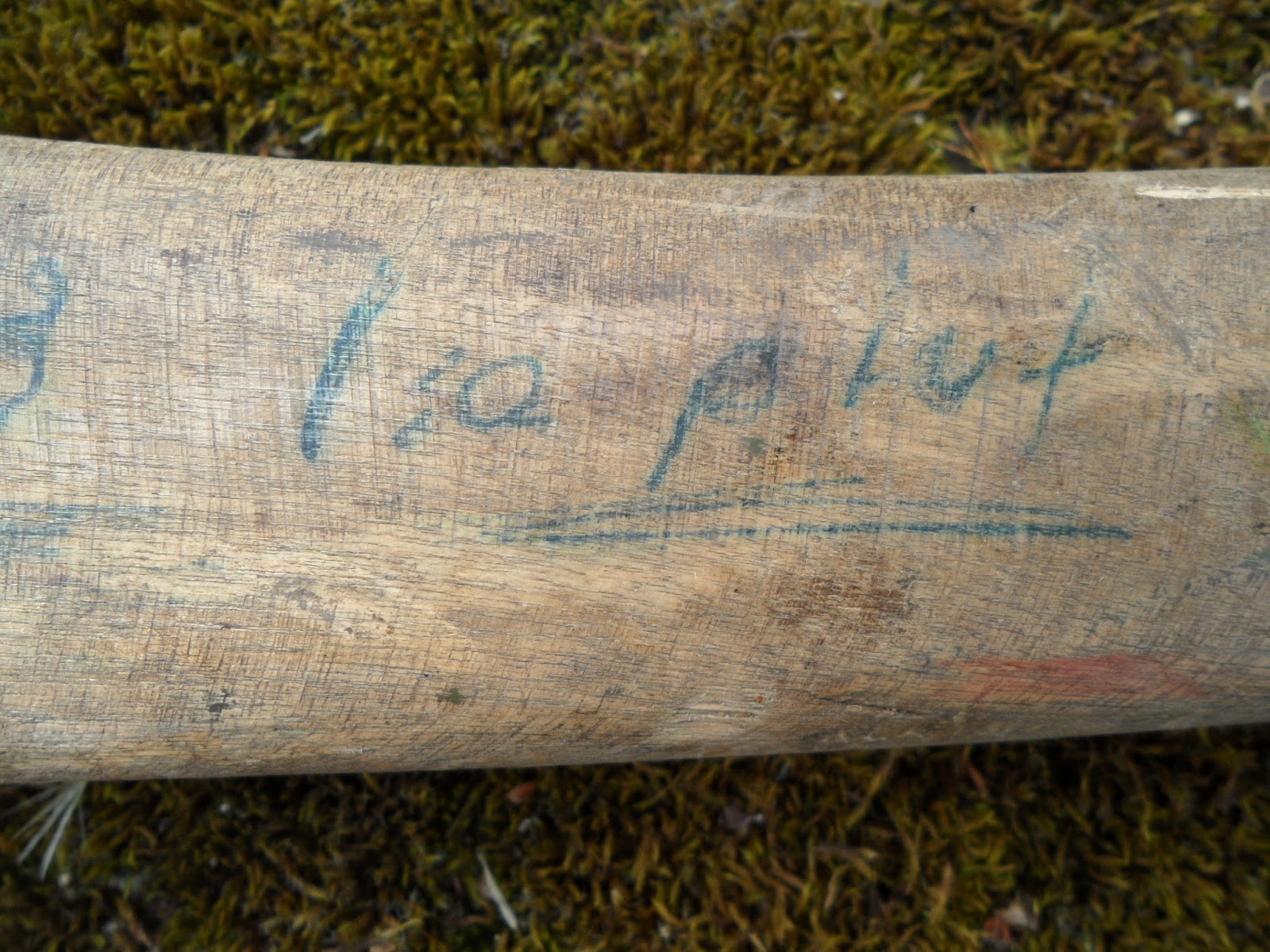
On the side of the handle there is a hand written notation that indicates that this axe belonged to Squad 3, 1st Platoon.  Unfortunately the actual unit ID was not noted.  The notation is in Swedish and reads "Grupp.3    1:a plut ".


From what I understand, these axes were issued out, one to a squad.  The Swedish squads consisted of 6-8 soldiers, and were lead by a Corporal or Sergeant.   They were also carried on vehicles, and the early Stridsvagn M39 and M40 tanks.  Here is a  photo of an axe mounted on the side of one of these tanks.  You can also see the Pioneer shovels alongside them.  


Here are two of photos of WW2 era Swedish soldiers in the field.  In the first photo, the soldier furthest away from the camera (at the right), has an axe strapped to the side of his pack.  In the next photo, you can see the handle of an axe that is strapped to the bottom of the pack, on the nearest soldier.


Near the butt of the handle, there is the classic "Swedish 3-Crowns" stamping.


Overall this is a wonderful example of a Swedish, WW2 era axe, that will only need conservation.  No restoration needed!  Let's take a closer look at this axe: