Saturday, October 17, 2015

Danish Army Engineers, Pioneer Spade circa 1940's to 1980's

Here is the next "installment" along our recent shovel and spade theme.

Today's spade is a very unique one indeed.  In fact, you may not ever run across one of these out there in the collecting and memorabilia scene. 


This style of full-sized, pioneer spade was issued and used by the Danish Army starting the early 1940's.  I am not certain how long they have been used, but since a small batch recently found their way onto the surplus market (and I do mean a small batch of spades!), I would assume that they are no longer being used, or have been replaced with a newer model.
NOTE:  Thank you to Niels who added this additional information about this shovel manufacturer:   DSI : Dansk Staal Industri = Danish Steel Industry 1915 - 1981. After 1981, it was taken over by Hultafors.

 NOTE: I have recently added two more of these spades to the collection.  You can read about them and see photos here:
http://sharky-fourbees.blogspot.com/2015/10/two-new-danish-army-engineers-pioneer.html
From what I understand this spade was specified, issued, and used with the Danish military version of the Mercedes "G" Wagon, 4x4, basically the European version of the US Jeep, beginning in the early 1980's.  I am not certain where on the Mercedes these shovels would have been mounted, but I would imagine it was most likely under the engine hood, or inside the passenger area somewhere.  I have not seen a single photo of pioneer gear (shovels, axes, picks) mounted on the outside of one of the Danish rigs.

Here's a comparative shot of the spade on the hood of my Jeep. (yes, that's me in the reflection!).  This will give you a better idea of the actual size of the spade.


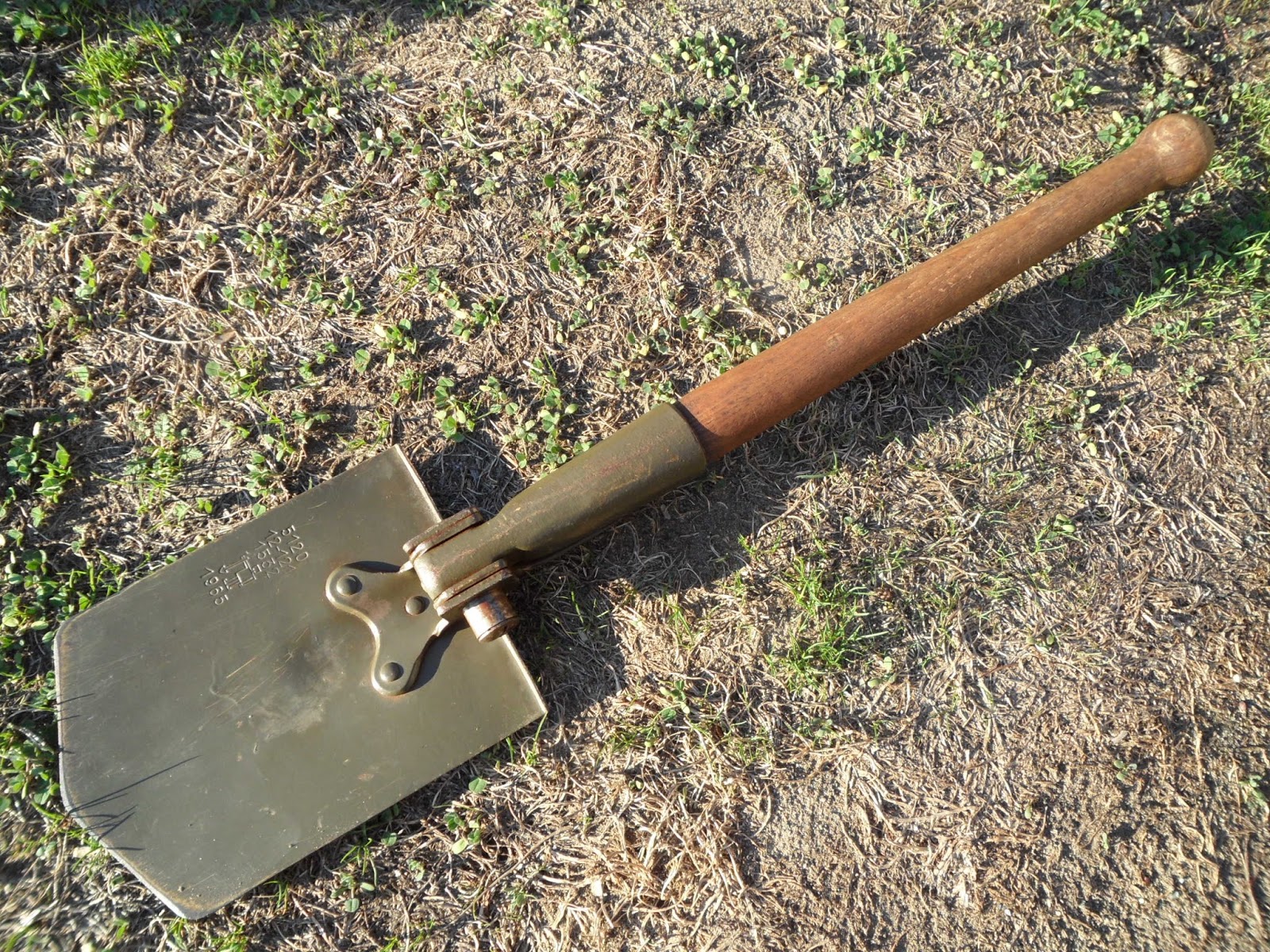
The spade is marked with the Danish Crown and ITT, on the blade.  ITT stands for The Danish Army Engineers ( Ingenior Teknisk Tjeneste). 


On the shank of the blade, it is marked DSI.  I am not certain what this stands for, but it may indicate the manufacturer.

UPDATE:  Thank you to Niels, who left the following information in the comments section.  "DSI : Dansk Staal Industri = Danish Steel Industry 1915 - 1981 where it was taken over by
Hultafors."


I think I'll let the rest of the photos speak for themselves. 


Wednesday, October 7, 2015

Imperial Russian, Finland Re-Issue, Trench Spade - Shovel dated 1915, Finnish SA Marked

As promised in my last posting, the shovel details are here!

Today I'll be showcasing the latest addition to the collection.  This shovel is an Imperial Russian, Finland re-issue "trench shovel", dated 1915.


This shovel would have been originally issued to the Russian troops that were in Finland during the WW1 years.  When Finland broke away from Russia in 1917, these shovels were taken as "captured" equipment and re-issued to the Finish Army.   This shovel would have been carried during the Winter War of 1939, and during the Continuation War for the remainder of WW2, and probably into the post-WW2 years as well.

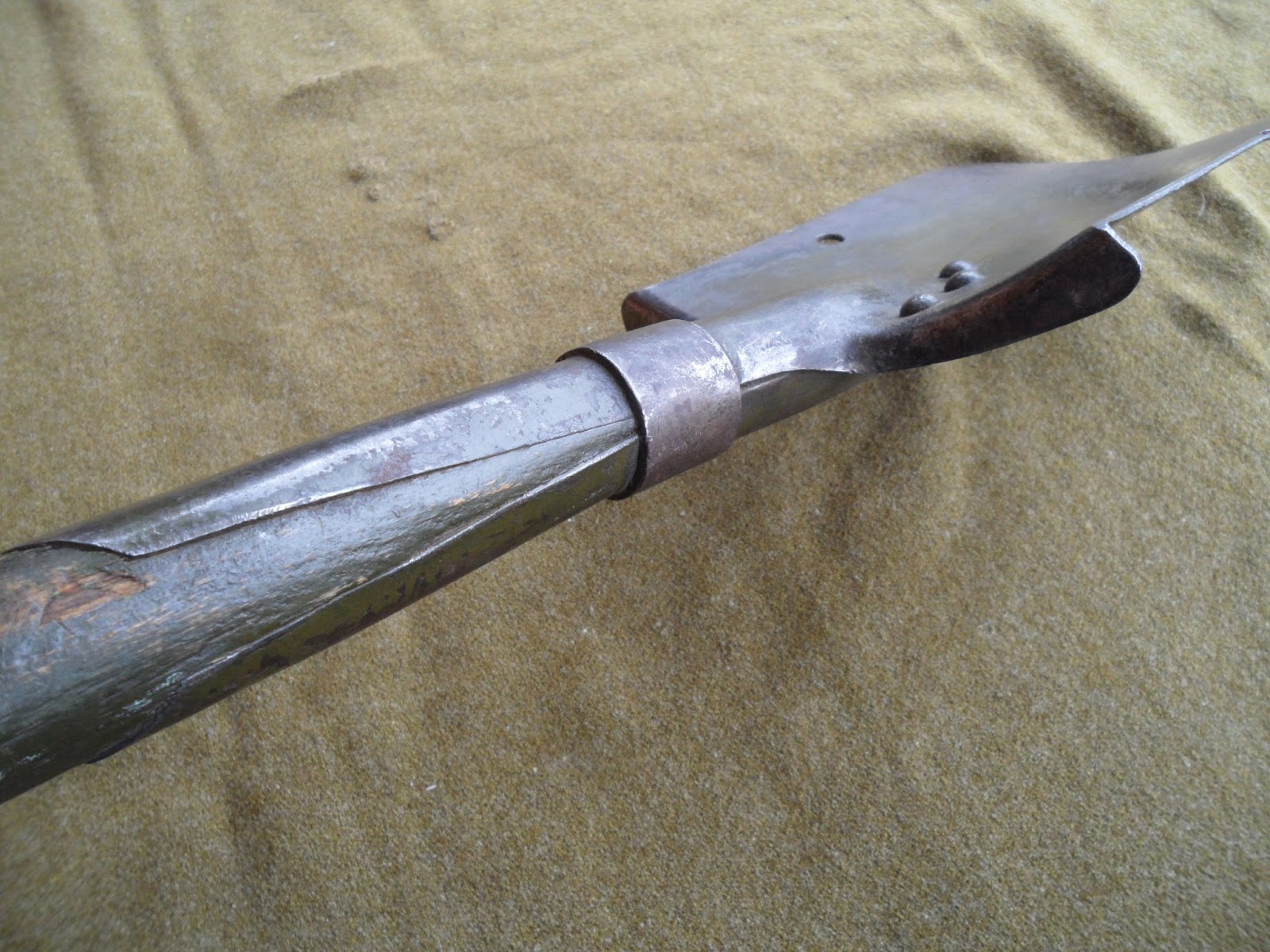
The shovels were repainted in "Finland Green" and a hole was punched through the blade so that the shovel could be carried on a belt hook.


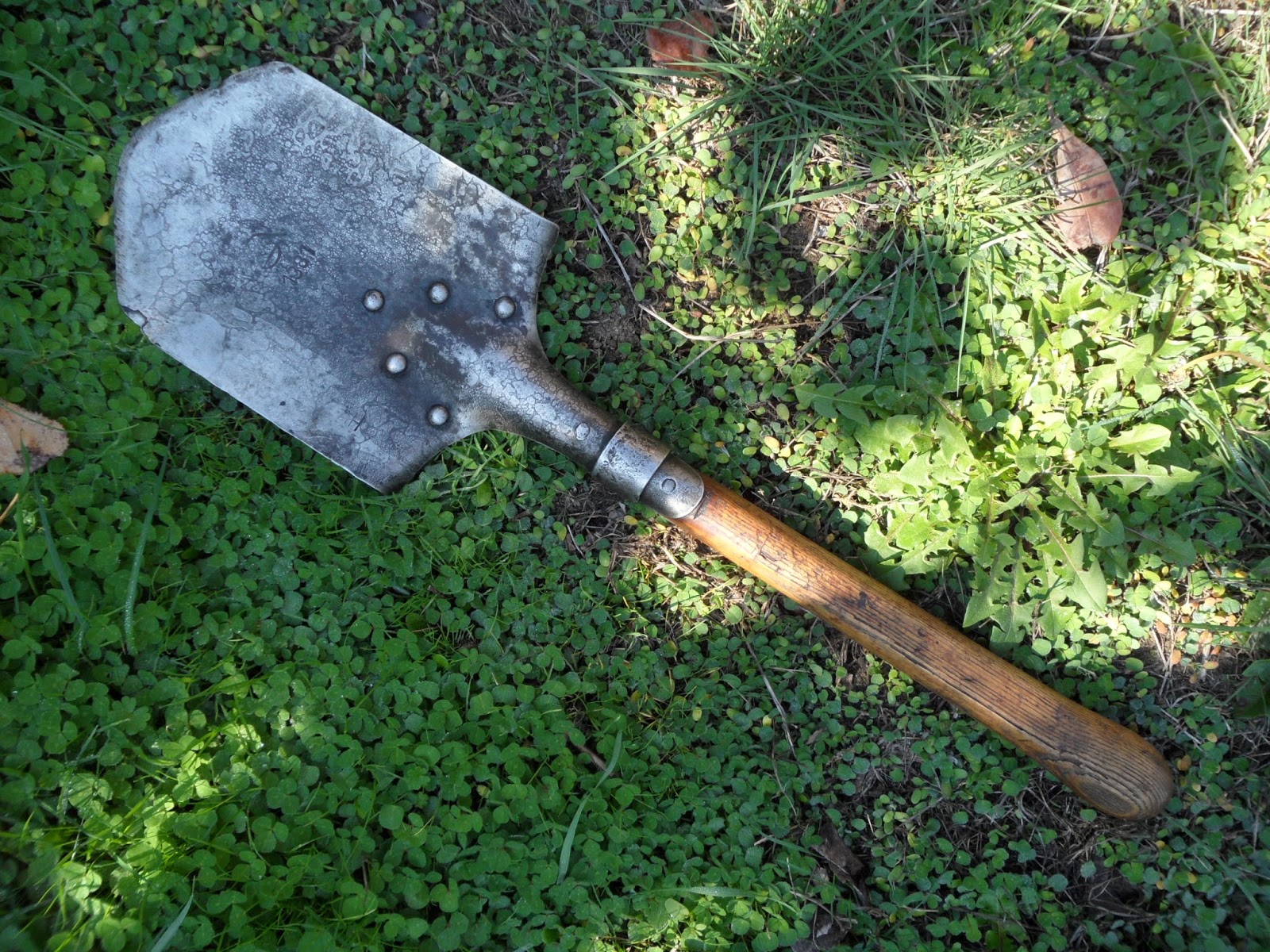
This particular shovel is stamped with the date 1915,   It also is stamped with the SA stamp which stand for:  Suomen Armeija Taisteluvälinehallinto, or in English, "Finish Army Ordinance Department".  There is a P stamped next to the SA stamp that represents Pioneerin, the Finland Engineers - Sappers.


The original Russian green paint is visible, as well as the Finish green paint that is a slightly more "olive drab" color.


To the left side of the SA stamp, you can see the very faint Imperial "Double Eagle" stamp from it's original Russian issue.  Under the SA stamp, there are the remains of some original Russian, Cyrillic letters.


There is even some "graffiti" carved into the handle by a prior owner!


UPDATE:  I have since added two more Finnish shovels to the collection.  You can see them here:
http://sharky-fourbees.blogspot.com/2018/04/finish-army-engineer-sapper-shovel.html 

http://sharky-fourbees.blogspot.com/2017/03/finish-army-engineer-sapper-shovel.html

Now let's finish things up with a few extra detail photos:


Monday, October 5, 2015

Shovels - Shovels - Shovels !

Well, it's been awhile since my last blog post, so I guess it's time to give everyone a "teaser" about my next string of future postings.

Here's the hint:  "Shovels, Shovels, Shovels, and more Shovels!".

After I picked up the leather shovel cover for my Swiss entrenching tool - spade, that I showcased in my last post, I hit pay-dirt in the shovel department, over and over and over...........  SIX shovels in all!

First off, I found a "free shipping" offer from one of my favorite surplus sources, which meant that I just had to order something.  I discovered that they were carrying a very rare, Danish Army, sapper shovel that was originally carried on the Danish Military version of the Mercedes "G", 4x4 Wagons, back in the 1980's.  It's marked for the Danish Engineers Department and in fantastic shape. Basically it is a "Danish Jeep Shovel".


Next off, I located a seller on eBay who had a few very crazy listings that all just happened to be inaccurate and in the incorrect categories.  Well, at the end of the bidding, I was the proud owner of two more shovels, another Swiss spade dated 1938 with a 1941 cover, and pre-WW1 Swedish spade that is unit-marked for the 18th Swedish Infantry Regiment.  If that wasn't enough, I also spotted a Bundeswehr folding entrenching tool dated 1965 with a 1969 leather cover, and an early model US, pre-WW1, T-Handle shovel!  Needless to say, I won the bids on both of those as well!


In the meantime, I received another "free shipping" offer and I ordered a post-WW2 Hungarian spade with canvas cover.  I already had one of these post-war spades, but I needed the canvas cover (very hard to find!).  It never hurts to have an extra spade or two in the quiver, so it was worth buying another spade just to get the cover............  Well, the order arrived and I was elated when I discovered that the spade was NOT a post-WW2 model as advertised.  It was in fact, a WW1 vintage, Austro-Hungarian shovel!  The canvas cover was a mint condition post-WW2 cover.  It was a total score in both the shovel and cover departments!


Not to finish things there, I spotted another shovel on eBay.  It is a WW1, Imperial Russian spade that is marked as a Finnish Army re-issue, Winter War vintage!.  It's in beautiful shape and in the mail as I type this!

No photos of the Russian-Finish spade yet....... When the shovel arrives, I'll take, and post, plenty of photos.

Stay tuned for future detailed postings on each of these new additions.  I'm completing the research and getting ready to post............

Thursday, September 17, 2015

Swiss Entrenching Shovel-Spade, Schweizer Klappspaten, with new leather cover! 1941

A few postings back, I showcased my batch of the rare metal versions of the Swiss shovel covers from late WW2.  Now I have one of the leather covers from the early war years to show off as well.


I was prowling eBay the other day and ran across a lone leather shovel cover for my the Swiss Entrenching Shovel-Spade.  I have been looking for one of these ever since I picked up my shovel that was missing the cover.  This is the first leather cover that I have ever run across that was available without a shovel.  I picked up this one for a fair price and it arrived today. 

The leather was a bit stiff from age, so I gave it a good coat of oil and let it soak in.  Now it's good-to-go and a great addition to what has become a Swiss Shovel Set!  I have the shovel and BOTH of the covers!  

This leather cover is dated 1941 and has crisp and clear leather stampings indicating the manufacturer as well as the Swiss Military acceptance stamp (cross).


The straps are riveted with copper rivets with aluminum washers and together, they make a beautiful combination.  The smaller, edge reinforcing rivets are all aluminum.  There is still a bit of "green corrosion" on a few of the copper rivet heads that will need to be buffed off.  All in all, this is a beautiful leather cover with no real flaws.  It is definitely built to last, using old-world craftsmanship and materials.  That is why I love these old Swiss surplus pieces.

As a comparison, I pulled out the rare metal cover so I could get a few side-by-side shots.  It is interesting to note that the metal covers are slightly smaller overall, and actually weigh less than the leather.


An now to finish things up, here is the traditional photo album:


Thursday, August 20, 2015

Turkish Mauser Bayonets, Model 1935 M-35

Today we are continuing along with our Turkish Mauser thread.  I have two very similar, yet very different, Turkish Mauser bayonets to show today.

Each of these bayonets are currently paired with one of my Turkish Mausers.  They are both "Model 1935" bayonets that were made by Turkey for their "Model 1938" Mausers.  The "Model 1938" Mausers cover all of the " Turkified" (converted and rebuilt), Model 1883, 1903, and later Mausers that were rebuilt to the "1938 standard".  This basically means that they will fit virtually any of the standard Turkish Mausers in use until the 1970's.

In the mid-1930's, Turkey started a program of rebuilding and converting all of their existing rifles to fire the new 8mm rifle round, and at the same time they standardized all of the Mausers to one standard Turkish configuration.  This configuration is known today as the "Model 1938". This model name was assigned by the US firearms companies that began importing the surplus Turkish Mausers starting in the 1970's.  "Model 1938" was never an actual Turkish designation.
Along with standardizing the rifles, Turkey also came up with a "standard bayonet".  This is known as the "Model 1935" Turkish Bayonet.

The "Model 1935" bayonets are anything but standard.  They all have very common features and dimensions, but they are definitely not all the same.  The Turks converted their existing stocks of their old 1890 and 1903 long bayonets, along with other captured foreign bayonets, and foreign purchased bayonets (often surplus) from countries like Romania, Czechoslovakia, Yugoslavia, Germany, England, Australia, many from the WW1 era............. The old bayonets were chopped, the parts often mixed and matched, the blades reground, the scabbards cut, chopped, modified.  After all of this, each bayonet resembled the two bayonets that I am showing today, more or less, often less.

Along with the converted bayonets, they began building their own version of the Model 1935 bayonet in their military arsenals.   Out of all of this converting and constructing, the Model 1935 bayonet was born.  But even the Turkish made Model 1935 bayonets had wild variations in construction and component details.  Basically, every Turkish bayonet is unique, providing nearly endless variety for the collector.

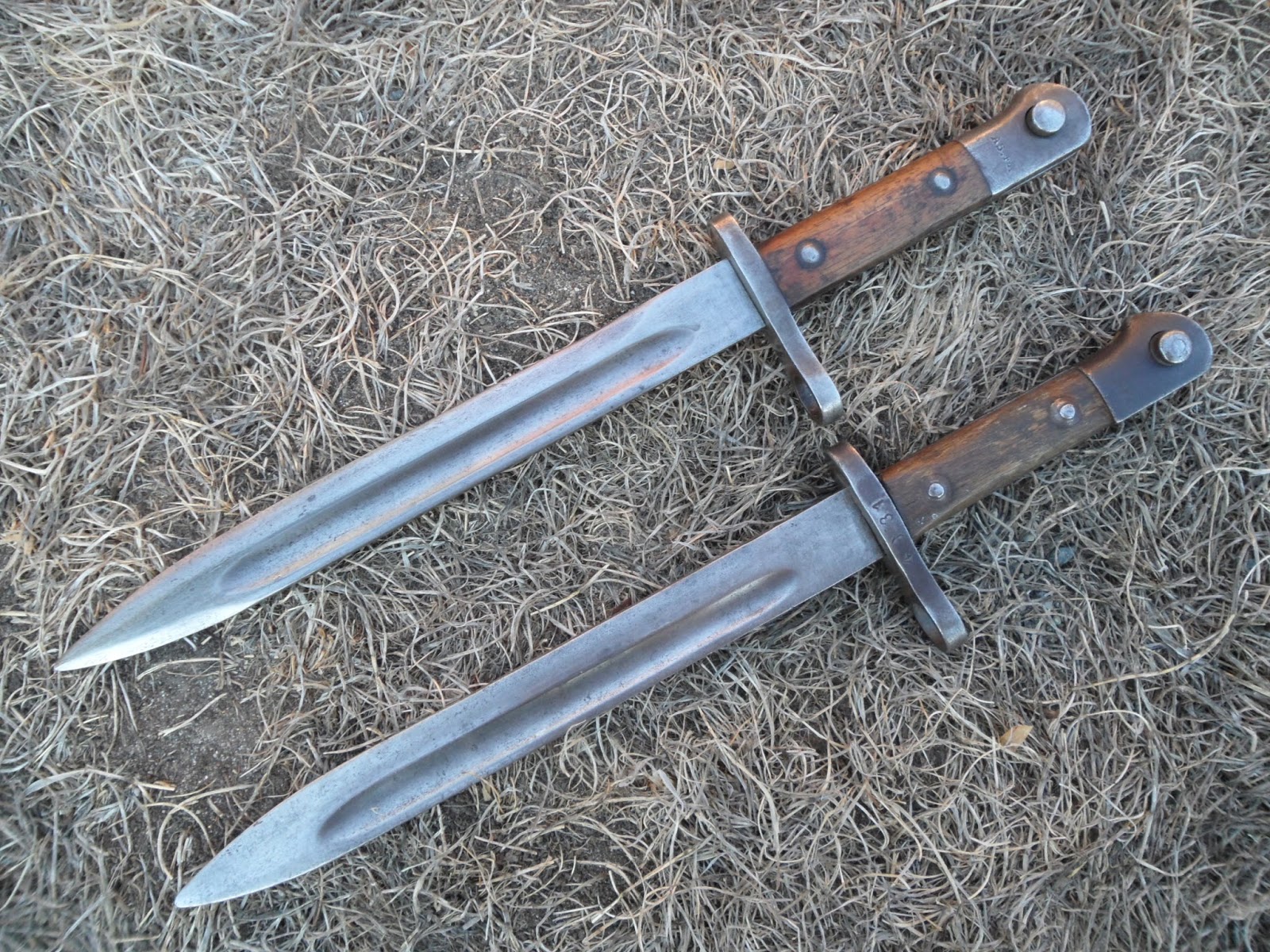
Both of bayonets are marked ASFA, which means "Askari Fabrika", or military arsenal/factory in Turkish.  The ASFA arsenal was started in 1929, so any bayonets that do not have this marking are pre-1929.  After 1929, all bayonets were stamped with ASFA.  Along with the ASFA stamp, both bayonets are serial number marked.  There was not a standard location for the ASFA and serial number stamps and both of my bayonets have them in different locations.

Both of my bayonets show "brass fill" in the area of the pommel and the tang.  It appears that the parts did not fit consistently or evenly and when the bayonets were assembled, any gaps were just filled by brazing,

Some bayonets had screws holding on the wooden grips and some had rivets.  

There are wild variations in the scabbards, and scabbard studs, found on the Model 1935 bayonets.  Many scabbards were made new for these bayonets, and many were converted from old scabbards that were much too long and made for older styles of bayonets.  The old scabbards were chopped cut, welded, etc. to fit the new pattern blades.  These conversions are usually quite crude looking.  The standard Turkish scabbard stud was the "single button" type that appears on the rougher of my two bayonets.  The bright black scabbard on my second bayonet, is a replacement scabbard, of the German type, that has been re-stamped with the matching bayonet serial number and is not original to the bayonet.

The roughest of my two bayonets is by far the "Classic Turkish" style bayonet.  It is "hammered", rough, heavily worn, showing signs of heavy abuse.  In fact, my bayonet is actually slightly bent in a slight curve, as if someone made a bayonet charge against a rock wall!  The hilt has signs of extended pounding, as if it had been used as a hammer for many years.  The "A" on the ASFA stamping has worn completely off.  The wooden grips have worn down to the point that the securing rivets are now well above the surface of the wood instead of being recessed!  The scabbard is heavily worn, cracked and has an extremely loose stud.  Inside the scabbard throat, you can see a deep groove that has been worn into the metal by having blade drawn across it thousands of times through the years.  The cross guard is very loose.  In short, this is a "typical Turkish bayonet"!

With all of that said, let's take a look at these two bayonets.  Enjoy!


BAYONET NUMBER ONE


BAYONET NUMBER 2