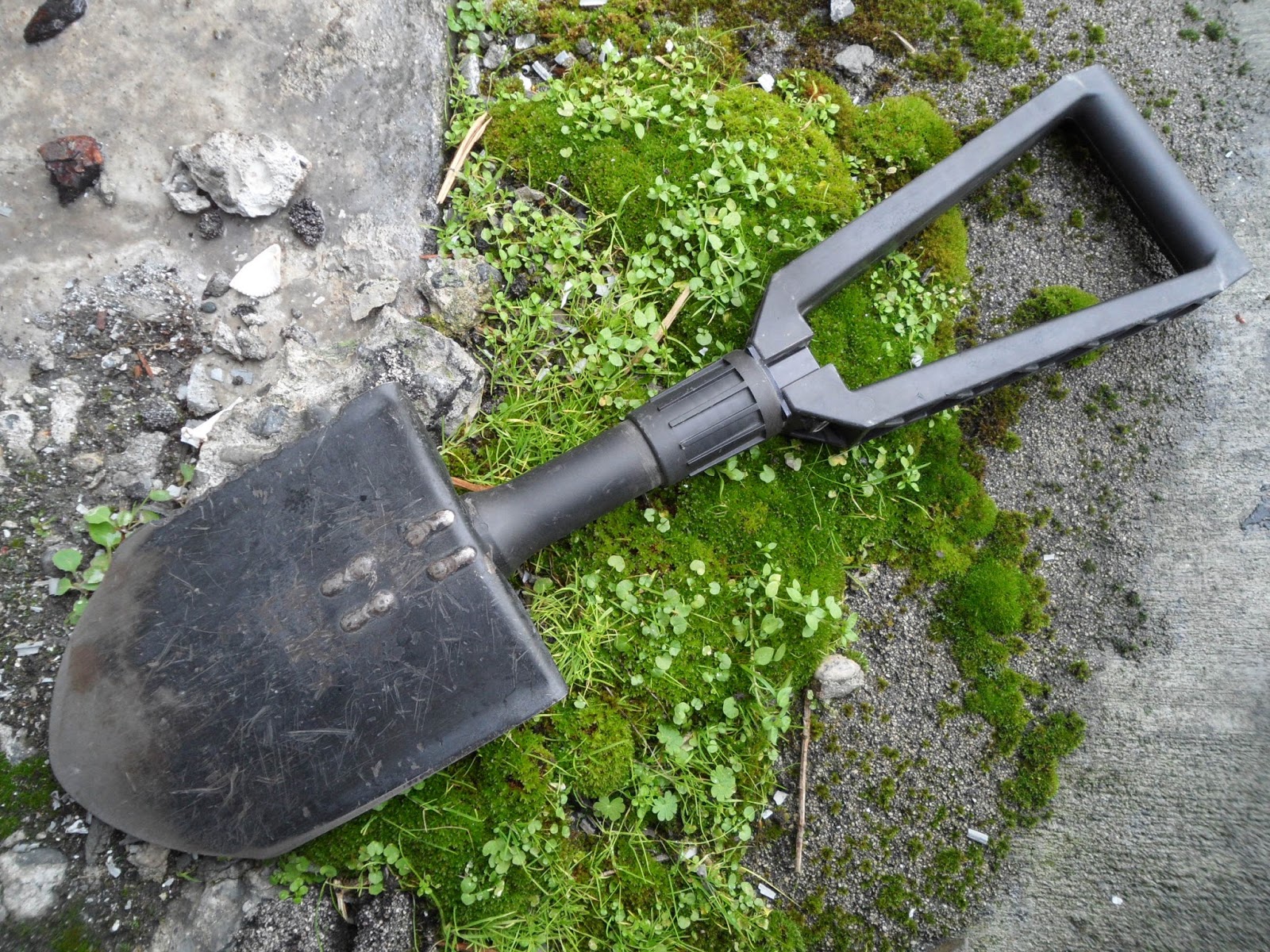
Last week I had the opportunity to pick up a "veteran" United States Marine Corps shovel at an amazing price. I snatched the shovel up and it is now resting honorably in the bunker!
This shovel is one of the first Gerber E-Tool shovels that were issued to the US Marines in 2000. This shovel is well used and shows considerable wear on the edge bevel, at the shovel tip, indicating this shovel saw some serious field use during it's military career. There is no telling what campaigns or theaters it served in, but I am sure it would have some stories to tell if it could talk!
In 1999, the US Marine Corps decided that it was time to investigate the current variety of folding entrenching tools that were available on the market, with the hope that a more modern, durable and lighter model could be found for the Marines. This new shovel would replace the old tri-fold, Ames shovels that were adopted into service back in the mid-1960's. You can see an example of the Ames shovel at my blog post here:
http://sharky-fourbees.blogspot.com/2011/03/us-m-67-e-tool-tri-fold-shovel-model.html
The task for evaluating and selecting a new shovel was given to the Department of the Army. In January of 1999 the Army opened up the application period for any company that wished to submit their shovel for a competitive analysis. The following requirements were specified by the Army.
Each submitted shovel must be:
- capable of operating in all terrestrial extremes and in all weather conditions.
- collapsible (folding or telescopic) with a curved blade capable of being used as a shovel or pick when locked at 90 degrees.
- made of corrosion resistant materials and durable to withstand use in a military environment.
- weighing less than, and being no larger when folded, than the currently fielded Ames entrenching tool (2.3 pounds), and have greater durability than the Ames tool.
Each contributor was required to submit a technical proposal of 3 pages, along with commercial product literature, past performance information, price and two shovel samples. After review by the Army, each selected competitor would be given a contract for 40 shovels. These shovels would then be assessed and field tested. Four proposals were received by the January 22, 1999 closing date. In addition to the four submitted shovels, the Ames Company submitted a one page letter, but did not fulfill any of the required submission documentation. Their "submission" was not deemed acceptable or complete. In their letter, Ames argued that they could not submit a shovel with a lower weight than the current Ames shovel, because they made that shovel.........essentially the Army cut them out of the process from the start!
The Army then did an initial screening of the applicants. The Army engineers determined that two of the submitted shovels would be removed from the evaluation list for various reasons. They were left with the Gerber shovel, an additional brand's shovel, and the Ames shovel. The Army decided to field test all three shovels with 94 Marines, over 6 weeks, with the Ames shovel being used as a "control shovel".
In September of 1999, after the field testing was complete, the decision was made to award the contract for the new US Marine Corps shovel to the Fiskars Company, maker of the Gerber Shovel. There was a slight problem though..... Fiskars was from Finland and all of the shovel components were made in Finland. To be awarded the US contract, the shovels needed to be made in the USA! Fiskars agreed to ship all of the shovel parts to a new assembly plant in Oregon where they would be assembled into completed shovels. The deal was done, Fiskars got the contract, and Oregon picked up some new jobs, and the US Marines got a new shovel! It didn't end there though. Ames was seriously NOT happy about the selection (and loosing the contract), so they filed a protest and appeal with the US General Accounting Office. In short, they lost the appeal on all counts. It was official, the Gerber Entrenching Tool would be the official, new shovel of the USMC. The first shovels were delivered in 2000.
At this point it should be noted that the Gerber Entrenching shovel was first made for the Finland Army, then adopted by the Dutch Army before adoption by the USMC. The Gerber shovel is NATO approved for issue to all NATO forces.
The Gerber shovel is a big improvement over the old Ames shovel, even though the two are very similar. The three parts of the Gerber are fastened together with two bolts and nuts, making them very easy to repair and maintain in the field. The shovel is still configured in the traditional tri-fold style, making it compact and easy to carry when folded.
It is designed to be used as a straight shovel, or with the blade locked at 90 degrees as a pick-hoe.
The "tightening nut" is located next the the handle, instead of down next to the blade, as found on all previous folding shovel models. This keeps dirt and muck out of the nut and places it closer to the hands when using.
The handle is made of fiberglass reinforced nylon and is much lighter than the previous, all metal, Ames shovel. It is also more ergonomically comfortable to use.
The shovel shaft is aluminum with a fiberglass reinforced tube cover and tightening nut.
The blade is made of hardened carbon steel with cutting serrations on one side.
The Gerber shovel is also lighter than the Ames shovel, with a total weight of less than 2 pounds!
Since 2000, the Gerber shovel has been a "field favorite" of the Marines in the field!
Now let's take a closer look at this modern shovel.
The newest additions to the "Cold War Collection", is another helmet! This newest one is a very unique one, to say the least........
This helmet is an aluminum, Swiss, "Civil Defense Helmet", Model 1918/46, also known as the M18/46 helmet. Model 1918 refers to the original helmet shell style designed in 1918, and the 46 refers to 1946, the first year of issue for the Aluminum shells that were made for the National Civil Defense Forces.
These aluminum helmets were first made in 1946, in response to feedback from firefighters and civil defense responders in the field. Their complaint about the steel military version was the weight. The weight problem was solved by choosing a lightweight and very strong aluminum alloy know as Duralumin. You can read more about this alloy here:
https://en.wikipedia.org/wiki/Duralumin
The majority of these M18/46 helmets were painted yellow, some completely, and some with just the exterior painted. Yellow was the official "National Civil Defense" color. Some of these helmets that were put into service with full time fire departments, were painted other colors like black or red.
The liner in my particular helmet is the late style, that was instituted sometime in the 1960's.
The three pads are riveted directly to the Darlumin shell. The outer layer of the pads is a synthetic "leather", with a removable fiber pad inside. This is a very distinct departure from the steel helmet liners that had pads attached to a metal band.
The chin strap is a single piece of webbing with a single sliding adjuster.
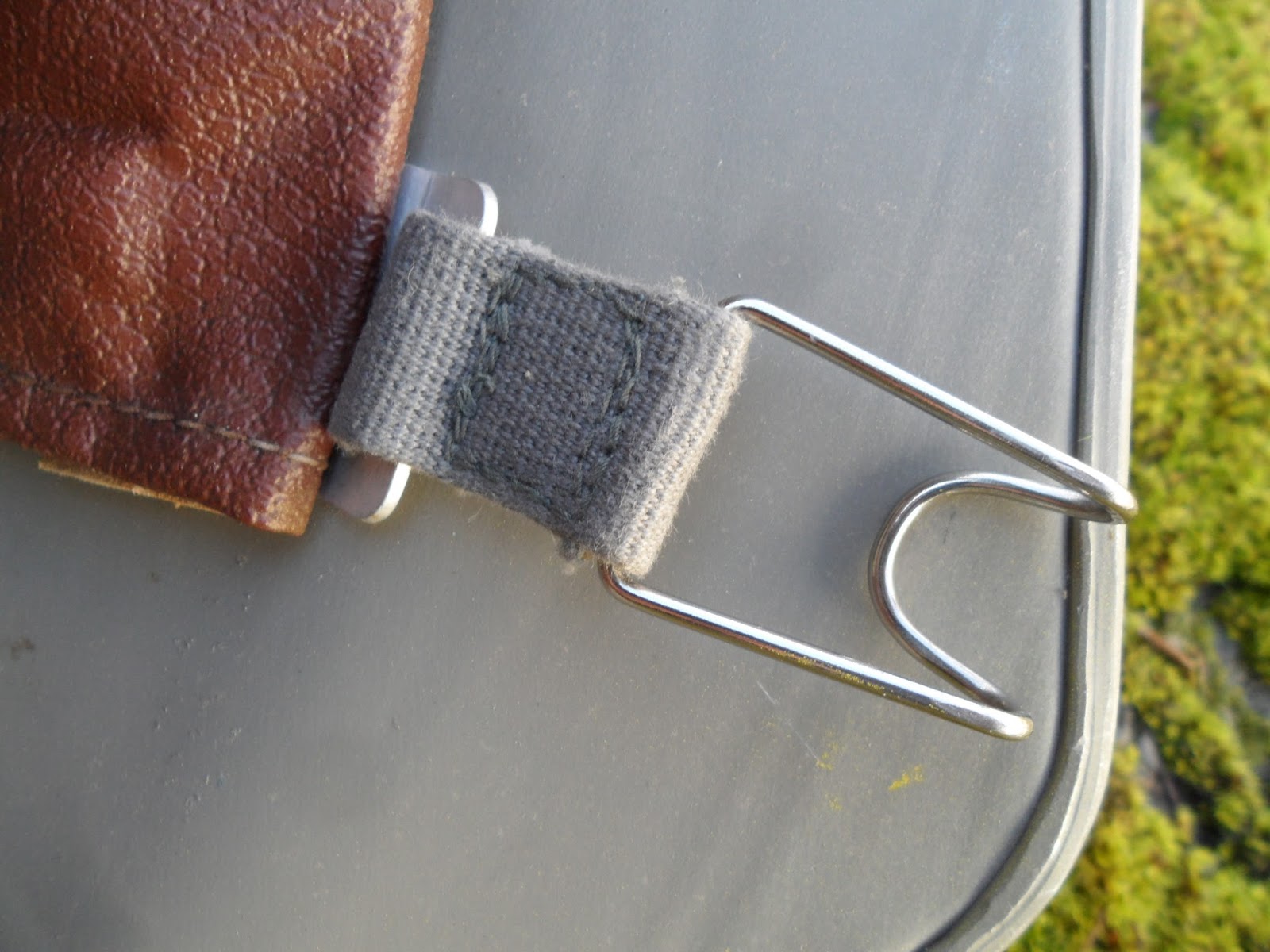
The strap connector is a basic wire hook and loop type design.
All in all these look like they would make very effective, lightweight field helmets. Even though the liner is a basic 3-pad style, they are quite comfortable and secure to wear.
These M18/46 helmets were used into the 1970's, until the new synthetic, modern, fire and rescue helmets were issued. There are no dates or makers marks on my helmet, but the synthetic style liner pads date this helmet in the the 1960's to 1970's time frame.
There were also a very small number of M18/46 helmets made out of plastic for use in electrical environments, but these are very rare and seldom encountered.
As an interesting comparison, you can check out my previous blog posting on my WW2 vintage, M18/43 Swiss military helmet.
http://sharky-fourbees.blogspot.com/2011/10/swiss-model-191843-helmet-m1843-m40-43.html
And now to finish things up, here's the photo album of this wonderful Swiss helmet.
I felt inspired to finish up the work on the Swiss Reserve Hatchet yesterday, and knocked out the entire project in one afternoon. Here's the update.
You can see the "Before" write-up and photos in my last post:
http://sharky-fourbees.blogspot.com/2016/12/swiss-military-reserve-hatchet-circa.html
I started out by sanding the metal head with 150 grit wet/dry sandpaper, then polished it up with some 600 grit wet/dry paper. The wood handle was sanded out with some of the 150 paper as well.
I cold blued the head with some Birchwood Casey Perma Blue cream, and then buffed the dark blue finish back to a dull gray with a purple 3M scouring pad. The wood handle was stained with a coat of "Colonial Maple" stain, and then I finished that out with several coats of Danish Oil.
The hatchet turned out great! With that little bit of work, I turned a "new" hatchet into a classic, with the look of a well cared for seasoned veteran.
Without further delay, here are some photos of the finished hatchet.