Tuesday, June 9, 2020

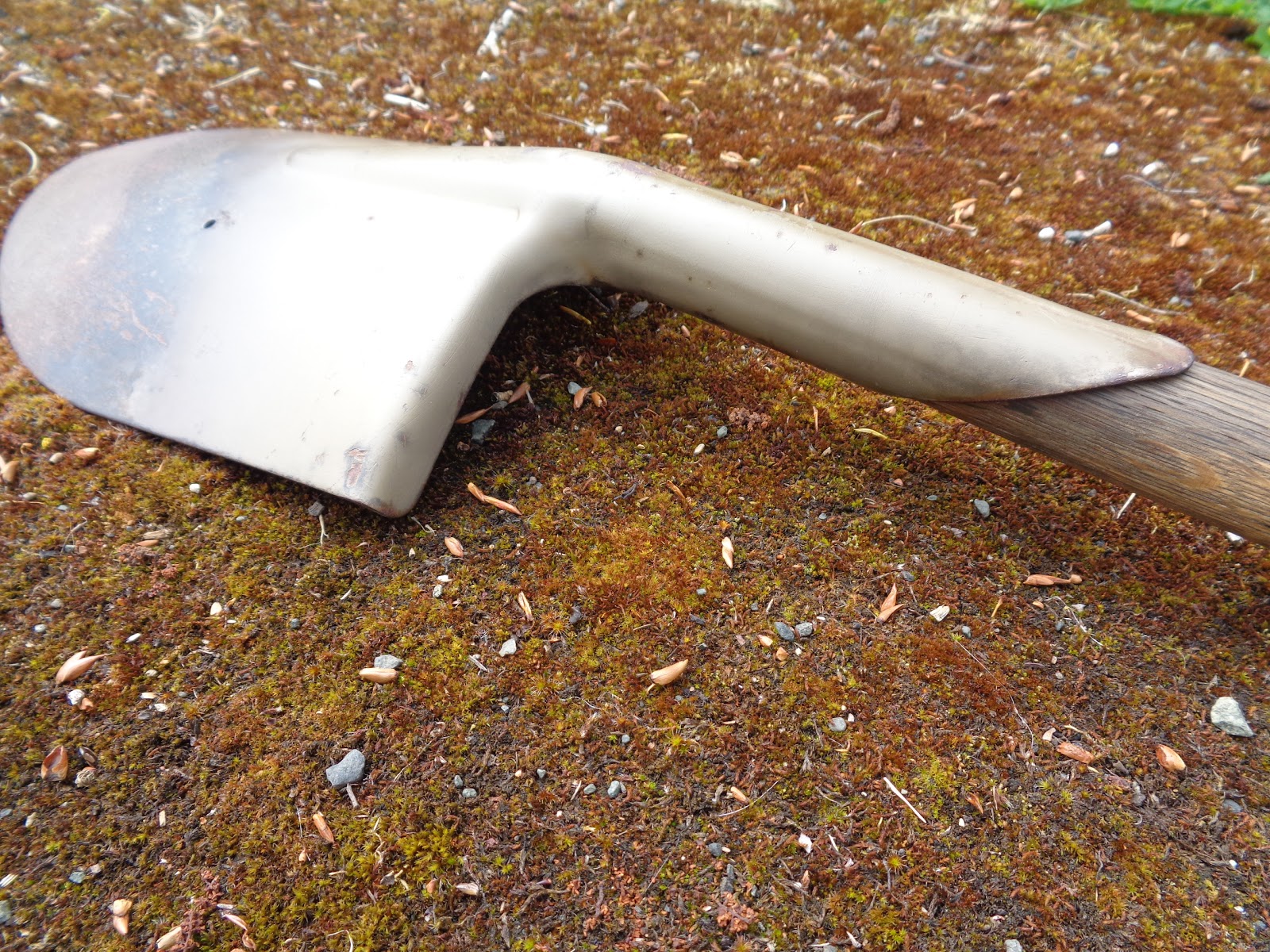
Model 1898 German Shovel Entrenching Tool, M1898 Schanzzeug, Finnish Army Re-Issued with Russian style handle, WW1, Winter War, Continuation War, SA and P marked

Well, here we go with another shovel!  I keep thinking that I'm getting to the end of the shovels to show, and I end up with another beauty.  That is exactly what we'll be taking a look at today.


I love the "odd-ball", unique shovels, in particular, and this one is exactly that.  This shovel is a Model 1898 German "Schanzzeug", or entrenching tool, also known as the "Kleines Spaten für Infanterie", or Small Infantry Shovel.  I said that this was a Model 1898 shovel, but that is not quite all that it is............ As we work our way through the details, you'll see just how unique this particular shovel actually is.


I purchased this shovel from a seller who was clearing out items that were found in her father's barn, after he passed away.  This shovel was found alongside an Imperial Russian Army spade that had been reissued to the Finland Army.  The Finnish shovel had the punched hole in the blade, along with "SA" and "P" stamps on the blade, as well as a healthy coat of Finland Green paint.  It's brother, my Model 1898, was not as obviously marked, as Finnish issued, but it did hold a few unique clues that pointed to it's previous service with the Finland Army. 


This shovel has the blade of a German, Model 1898, with an Imperial Russian style handle, and the faint blade stampings of the Finish Army.  Which I guess, sort of makes this a "German-Finnish-Russian" Model 1898 spade!

The earlier German spades were the Model 1874.  These M1874 spades did not have folded over "ears" and had a retaining ring around the metal shank. In 1898, the Germans altered the design by folding over, and riveting, the blade "ears, and eliminating the shank retaining ring.  Instead of the ring, the blade-shank, top metal was wrapped around and welded on the back side.  This formed a a sort of "hybrid ring".  This new design was designated the Model 1898. Many German shovels of the WW1 era, did not have any maker's marks.

This style of shovel construction remained in German service up until WW2, when the Germans again changed the construction a bit.  The "wrap-around hybrid ring" was eliminated, as well as the folded over ears that were riveted.  Many of the older M1898 shovels remained in service, but next generation shovels were constructed to the new style, beginning some time in the late 1930's.  At this time the Germans also eliminated the rivets on the blade, and instead started spot welding them.

Earlier I stated that this shovel was a "German-Finnish-Russian" shovel.  Well, here is the story this particular shovel tells, and how I came to figure that out.

The blade of the shovel is uniquely, a Model 1898 pattern, German shovel.


The handle is a bit shorter than shovels of this era, by a little over an inch or more.  The handle is also an Imperial Russian style handle.  The German handles had a "ball end" and the Russian handles had a taper, without ball end.  Finland repaired old captured shovels, and surplus shovels, using the "Russian" style handles, and as far as I know, they were the only country to do so.


The blade is stamped with a partial "SA" stamp that matches the Finland Army shovel stamps used on re-issued shovels.  It also has the distinctive Finland, "P" stamp, indicating "pioneer".  The blade is not punched with a hole though, like most Finland re-issues.


So, with those clues, we can deduce this shovel's story.  Here is how I see it.

This shovel started out its service in the German Army, before, and definitely during, WW1.  After the war, in the 1920's, Finland acquired a large amount of old WW1, German surplus equipment, mostly helmets, ammo pouches and shovels.  This shovel would have been one of those 1920's acquisitions.
After the German surplus shipments arrived in Finland, they went to a refurbishment and repair facility.  This shovel must have had a damaged handle, and it was replaced with a new handle, or a handle salvaged off of an Imperial Russian shovel.  Finland was using Imperial Russian shovels acquired from their break with Russia in 1918 at the time, so a Russian style handle would have made sense for a repair like this.  After the shovel was refurbished, it was stamped with the "SA" acceptance stamp, and the "P",  for pioneer unit use.  It would have then been issued out to the "new" Finland Army (Finland was expanding, "modernizing" and reequipping, her army with "new" equipment during this time).
In 1939, Russia invaded Finland, and the Winter War was on.  This shovel would have seen service in that war.  Shortly after the Winter War, the Continuation War with Russia began, and this shovel would have seen continued service during that time as well.  After the war, the Finland Army continued to use, and issue, the old equipment that was acquired during the 1920's, from the old German WW1 surplus, and from Russian captures from the 1918 break, The Winter War, and Continuation War.  So, this shovel would have seen service after the wars, during the Cold War.  Some time in the 1970's to 1990's, most of the old small equipment was sold as surplus.  A lot of it found it's way to the USA, and was sold in military surplus stores.  It was during it's layover in a US surplus store, that it was acquired by the seller's father, and then came to rest in his barn.  The shovel then found it's way to me after the previous owner's death.  And that is the "shovel story" as I see it, based on the "reading of the clues"!  Of course we will never know the exact details of its story, but I am 99% certain that the story I am telling fits.  We call that "Historical Interpretation".

Just to recap, here is a list of the "Finland" clues:
  • WW1, German surplus shovels were acquired by Finland in the 1920's.
  • The handle has been replaced with a Russian style handle, typical of Finland repairs.
  • The blade is stamped with the Finland "SA" and "P" stamps.
  • The shovel was found in the US, paired with a positively identified Finland reissue shovel.
It should be noted that a portion of the early shovels that Finland acquired in the 1920's were never punched with a hole in the blade.  Most of them were, but quite a few were not.  This lends a little bit more evidence that this shovel was part of the 1920's, WW1 surplus acquisition by Finland.

You can check out some of my other Finland reissue shovels here:

https://sharky-fourbees.blogspot.com/2020/01/finland-entrenching-tool-shovel-re.html

https://sharky-fourbees.blogspot.com/2015/10/imperial-russian-finish-re-issue-trench.html

https://sharky-fourbees.blogspot.com/2019/12/finland-entrenching-tool-spade-shovel.html

Now let's take a closer look at this very unique shovel.  I hope you enjoyed the "story"!


Sunday, May 17, 2020

Imperial Japanese Army Type 98 Entrenching Tool, Shovel - Spade, 1917 Wood Shaft Handle, 1941 - 1945, WW2, P.T.O Pacific Theater of Operations, South Pacific, IJA Japan


Today we'll be taking a look at one of the most unique military entrenching tools that, in my opinion, has ever been issued to an army at war.


This shovel is the Imperial Japanese Army, Type 98, entrenching tool.  It may appear to be simple, but as you will see, it is actually quite unique and clever!

Initially, back in 1887, Japan introduced their first entrenching tool.  It was a copy of the German, Model 1874, square bladed, feldspaten spade of the time.  
In 1888, Japan introduced a round bladed, Engineer's Shovel.  This shovel had a removable blade that was held in place with a wooden peg.  After a short time of field use, it was soon realized that there were some serious problems with this "peg method" of attaching the handle and blade.
The shovel was redesigned to use rings and a rope to attach the two together, and several handle lengths were trialed.
In 1917, a final design was settled on and the new method of attaching the two parts together was a length of rope, with a hole in the blade corner and a hole in the handle.  The wood handle also took on a very "German" style, with a ball end.

After Japan's invasion of China, the Imperial Japanese Army again reevaluated the shovel design.  From 1937 - 1938, some very unique changes were made, and the new shovel was designated the Type 98 Entrenching Tool.  Starting in 1941, and into 1945, these Type 98 shovels were produced and issued.  They were used alongside the earlier versions in the field.

The most obvious change to the Type 98 was the addition of two small "eye holes" in the blade.  The handle profile was also changed.

You can read a very detailed history of the Imperial Japanese Army (IJA) entrenching tools here.  This reference includes details from the Japanese archives, illustrations, measurements, Japanese terms, and design details that you will not find anywhere else.  In short, it's the best I've seen!

http://www.warrelics.eu/forum/japanese-militaria/evolution-japanese-infantrymana-s-entrenching-tool-1887-1945-a-753444/

Before we get started with a detailed look at my shovel, let me point out the most unique features of this entrenching tool.  The two "eye holes" and the angled cut to the handle socket on the blade.

 These IJA shovel blades were intended for digging, and as a form of personal armor.  That's right, armor!
To use the blade as armor, it was removed from the handle and driven vertically into the ground, using the shaft socket as a the "spike". 


The soldier could then lay prone, flat on the ground, behind the blade, and use the two eye holes to look through.   Getting hit with a rifle round or shrapnel, while looking through the "eye holes" would give a whole new meaning to getting your "bell rung"!
It is interesting to note that while looking through the holes, your nose tucks perfectly into the hollow at the base of the socket.  A very unique design to say the least!


My shovel was obtained from an estate liquidation sale down in Southern California.  I will never know the story of how it ended up in an old California barn, unfortunately, but it is more than probable that it was used in the Pacific Theater of Operations, the South Pacific Islands, during WW2.  These shovels were popular with the British troops, and probably with a few of the US troops as well.  It may very well have come home with a US soldier, as a souvenir at the end of the war.  Who knows, maybe it was an Iwo Jima or Guadalcanal battlefield pick-up.

My shovel is a combination of a Type 98 blade, and the earlier, 1917 handle style.  The original rope is missing, so a display replacement will have to be fabricated.

The shovel blade appears to have had a bit of fire damage on the end portion of the blade, and then was subjected to some rusting after the paint burned off.  


The handle was weathered gray, and had seen it's fair share of exposure, and drying.

The only "restoration" that I did to the shovel, was to remove the loose rust from the blade, oil the metal, and apply a nourishing coat of Danish Oil to the wood handle. 


My shovel is unmarked, so I compared the weights, and measurements with known originals.  Mine matches the measurements perfectly, and the weight was within a gram or two.  Perfect match, an original!  The replicas that have been produced all weigh significantly less than originals.  You can get details on the reference link I provided above.

Before we get into the photo album of my IJA Type 98 shovel, I thought I'd do a little, side-by-side comparison of the Japanese, US, and British entrenching tools.  These were the three tools that saw service in the South Pacific Islands.  It is easy to see why the British troops often picked up the IJA Type 98 shovels.  The small size, and awkward stye, of the British "pick-hoe-shovel", just couldn't compare to the usefulness of the IJA shovel!  


The US entrenching tool was similar in style, but lighter and smaller.  The US soldiers seemed to prefer their own issue shovels, unlike a number of their British counterparts.


I know this has been a lengthy post, so let's get on with the photo album. Enjoy.


Saturday, April 4, 2020

Portuguese Entrenching Tool, Model 1909, Model 1911, Portugese Expeditionary Forces, CEP, Corpo Expedicionário Português, Model 1940 Cover, WW1, WW2, Theriaga, Portugal Army Shovel

It's the beginning of April, and we find ourselves confined to our homes here in the beautiful Pacific Northwest, due to this horrible Corona Virus (COVID-19).  Since I've been sequestered, I figured I ought to make a new blog post or two.  So here it goes.  Enjoy!


I have had my eye out for one of the early Portuguese "pick-shovel" entrenching tools for quite some time.  They show up, here and there, but the prices are usually quite high, and they are rarely in the USA.  While taking a break from some recent research, I decided to "kill some time" by doing some random searches on eBay.  Apparently that was a very good idea because I spotted one of these tools for sale by a seller in Portugal.  The price was right, and it was a "buy it now".  I couldn't pass it up!


These Portuguese tools are quite unique in the field of military entrenching tools.  They appear to be the first tool issued to a European army that could be used as a shovel, a hoe, and a pick, all with one metal head and a handle.  No moveable, hinged, or articulating parts, just the head and handle.  This is accomplished by having two handle mounting sockets in the handle mount.


The wood handle is tapered to slide down into the head from the top to use the tool as a hoe-pick.


To use as a shovel, the handle end is inserted into the horizontal mounting holes.  The taper of the handle end locks it nicely in place.


The one unfortunate thing about this particular tool purchase, was that it was missing the original wooden handle.  I did a little research, inspected quite a number of old photos, and deduced the proper shape and measurements for the original handle.  I spent a couple of days in the shop, and the end results were more than satisfying.  The handle turned out perfect (actually, the second handle turned out great). Perfect dimensions, shape and fit.  (Handle wood is Hickory, in my reproduced version).


I finished off the handle with a "stamping" on the top end.  I had recently purchased a couple of pre-WW1 letter stamps at our local "junk store", and I pulled them out to use on the new shovel handle.  


The letters are random, and don't actually mean anything in particular.  I have found that adding numbers and letter stampings, to reproduced items like this, give them a bit more of an "authentic" look.


I finished off the new wood handle with some stain, and a few coats of Danish Oil.

Information on the history of these tools is very limited.  I relied on research and documentation that was forwarded to me from two other collectors in France, and some research of my own (Thank you Pavel and Pierre!).  I'll try to give the most accurate telling of the history of these tools, and their leather carriers, that I can, but please understand that most of the "facts" are deductions, and observations, and were not pulled from published documents.  Published information may exist, but it is most likely hidden somewhere in the Portuguese archives.  If anyone knows were these documents can be found, please let me know!

Based on some uncovered patent information, it appears that these tools were first patented in 1909, and later again, in 1911.  They were know as Theriaga tools.  

 
The first carriers used with these tools were made of simple khaki webbing for use in WW1, and a similar style made of leather that presumably was used at home and in the Portuguese Colonies in Africa.  The photo below shows one of the Portuguese soldiers during WW1, using the web carrier.


In 1940, a much more substantial, leather carrier was designed to replace the originals.  This is the type of carrier that is on my tool. 

It is interesting to note that the idea of a "multi-tool" type of entrenching tool was widely experimented with in the early 1900's, and up to WW1.  There are a number of different patents, from different inventors, during that time.  They all seem to have worked on the idea of a pick-shovel with removable handle.  There are very similar versions of these "pick-hoe" tools that date back to the Roman era, so the concept has been around for quite some time.
By WW1, a number of countries had adopted this style, most notably the United Kingdom, and Portugal.  The UK's version is significantly smaller, and does not convert into a shovel like the Portuguese tool does. 

The head on this tool is very heavy, and unmarked.  It is riveted to the pick-mounting piece using the same rivet style used on the spades used by most other countries at the time.


Here is a quick, side-by-side, comparison of the British tool and the Portuguese tool.  You can see that the Portuguese tool is much larger.


Here is a side-by-side, comparison with a WW1 era, Imperial Russian, entrenching tool.


Here is a comparison of all three, side-by-side:  British, Portuguese, Russian.


The leather carrier is constructed of heavy harness leather.  The leather carrier is unmarked.  It has a built-in bayonet frog on the left side, and two straps on the right hand side.  I am not sure what the straps were meant to be used for, as they are too long and don't have the correct buckle hole positions to be used to carry the wood handle.  The straps are permanently attached to the leather carrier.  It appears that these straps are the same length on other examples that are owned by collectors (as observed in contemporary collection photos).  I have tried to wrap the strap a full 360 degrees around the handle and then buckle it, but that does not work with that method either.  For now, the straps are a mystery, and how the handle was officially carried is also a mystery.  The research continues!

UPDATE 4-28-2021:   I received additional information from a colleague and fellow collector in Portugal, about this style of leather carrier.  This particular style of carrier was adopted into the Portuguese military in 1940.  This replaced the older, and original style that was basically a bayonet frog with two long straps that held the tool head and handle.  The original carriers were made with canvas for use with the Mills style equipment, and a leather version, for use with the leather equipment.  This later, Model 1940 version, was used from 1940 and into the post-war era (unknown at this time when they were removed from service).  The research continues.  Thank you Ricardo for your additional information!


Well, this has been a LONG posting!  Much longer than most of my postings, but I think it was worth it.  There is so little information out on the internet right now, I can only hope that when someone is trying to find out what that "interesting tool" they have is, or when they are researching one of these tools, that they find this blog posting.  I also hope that anyone who has additional information on these tools, will contact me so that I can include this additional information on the blog.  Additional information, and corrections are always appreciated, and I often go back to older posts and update them accordingly.

Let's wrap things up, and take a closer look at this amazing tool.