Monday, October 10, 2016

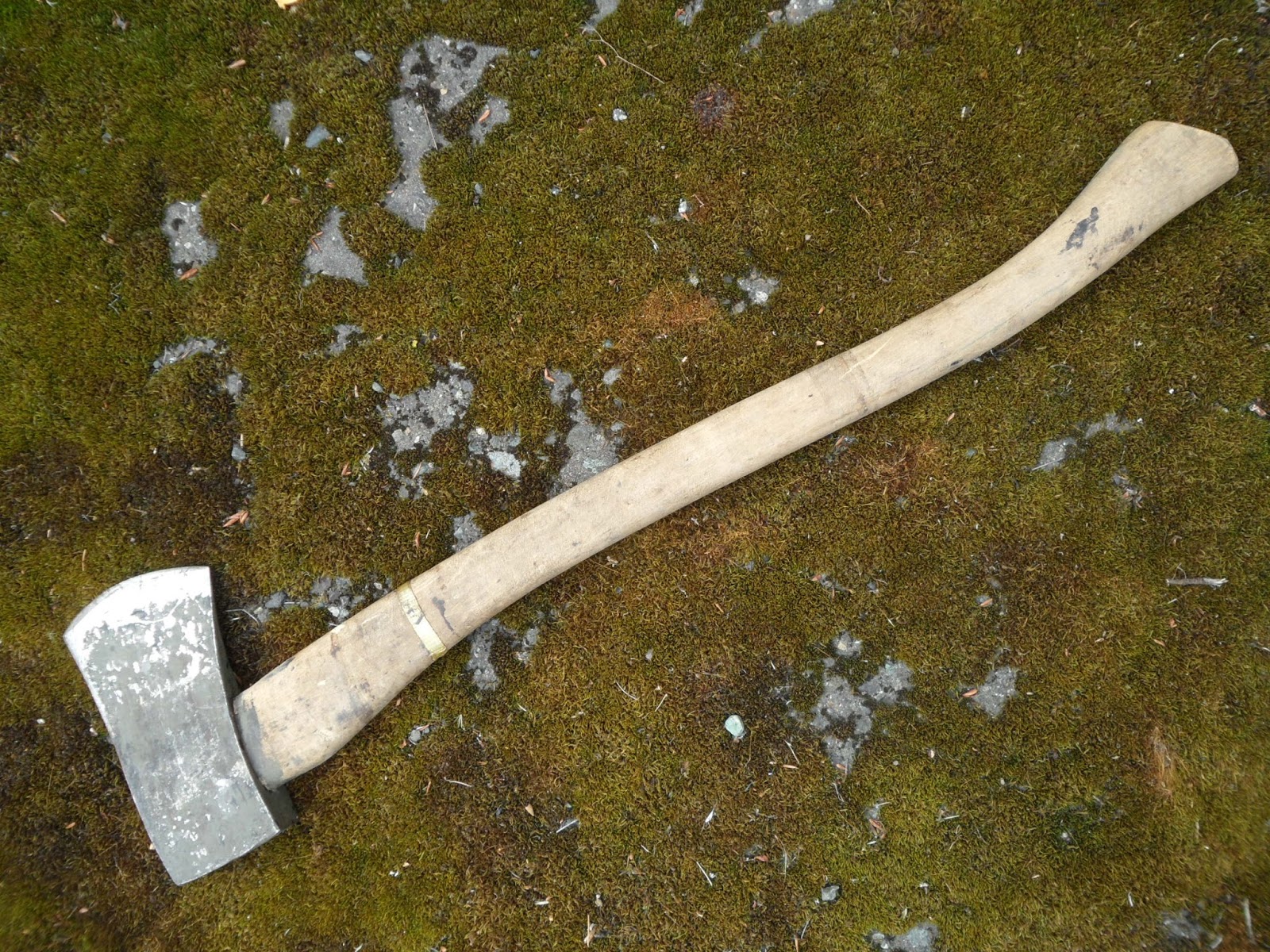
Swedish Military Axe, Kölefors Bruk 1942, KB42, WW2 issued

Today we'll be taking a look at the most recent addition to my Swedish Collection, a WW2 vintage Swedish Army Axe!


I have been wanting to add one these old axes to my Swedish Military gear collection for quite some time.  It seems that these axes are VERY popular with the "bushcraft crowd", and they sell out fast.  Last week I spotted a batch for sale by my favorite online surplus seller.  The price was super low and the shipping was free......I had to pinch myself to make sure that I wasn't dreaming!  I placed my order and the "new" axe arrived the other day.

The axe I received was in wonderful condition for its age.  Could it get any better?  Yes!  When I inspected it closer, I saw that the head is stamped KB42 with the 3-Crowns under it.  HB stands for the manufacturer Kölefors Bruk, and the 42 is the year, 1942.  This axe is a WW2 issued axe.  Wonderful!

The KB42 / 3-Crowns stamping is a bit tough to see due to thick paint.

The wood handle is marked with a band of woven tape that appears to have been some sort of official identification mark.


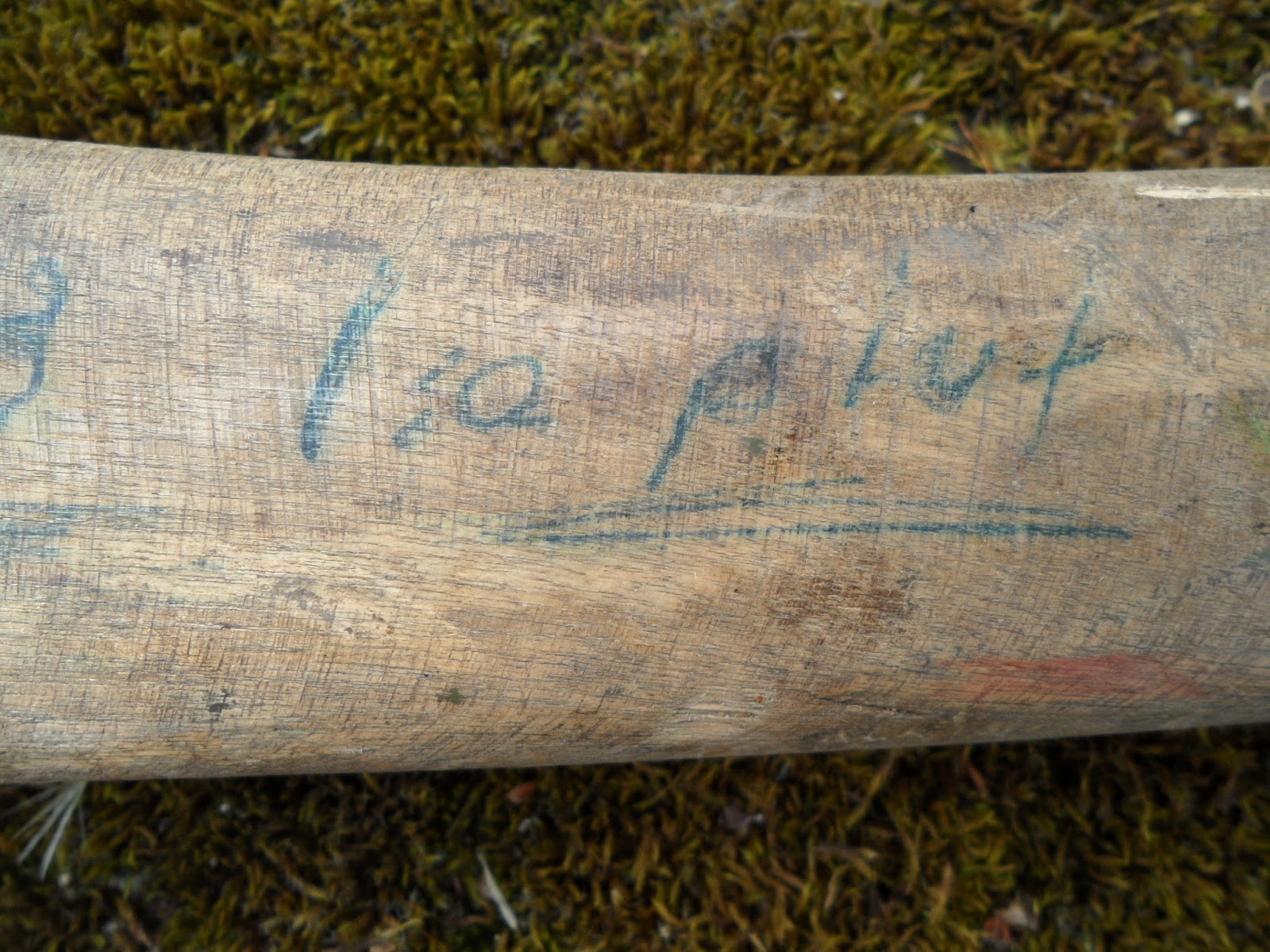
On the side of the handle there is a hand written notation that indicates that this axe belonged to Squad 3, 1st Platoon.  Unfortunately the actual unit ID was not noted.  The notation is in Swedish and reads "Grupp.3    1:a plut ".


From what I understand, these axes were issued out, one to a squad.  The Swedish squads consisted of 6-8 soldiers, and were lead by a Corporal or Sergeant.   They were also carried on vehicles, and the early Stridsvagn M39 and M40 tanks.  Here is a  photo of an axe mounted on the side of one of these tanks.  You can also see the Pioneer shovels alongside them.  


Here are two of photos of WW2 era Swedish soldiers in the field.  In the first photo, the soldier furthest away from the camera (at the right), has an axe strapped to the side of his pack.  In the next photo, you can see the handle of an axe that is strapped to the bottom of the pack, on the nearest soldier.


Near the butt of the handle, there is the classic "Swedish 3-Crowns" stamping.


Overall this is a wonderful example of a Swedish, WW2 era axe, that will only need conservation.  No restoration needed!  Let's take a closer look at this axe:


Tuesday, September 20, 2016

Bulgarian Military Pick-Axe #2, Pick-Mattock, WW1, WW2, or Cold War era Entrenching Tool Pickaxe

There's another Bulgarian pickaxe in the collection! 

The company I bought the previous pickaxe from, went ahead and sent me another pick as compensation for a "product not as advertised", (it was supposed to be "like new").  As you will see in the photos, this replacement pickaxe was not anything close to new, but it was in much better condition than the first one I received!  And besides, how could I possibly complain when I got two for the price of one!


It appears that this new pick is a combination of an older pick head, and a newer replacement handle.  The pick itself appears to have been in this configuration for quite some time, and based on the wood, I would imagine the handle was replaced some during the Cold War era.


I have no way to know for sure, but I suspect that the pick head dates back to the WW1 or WW2 era.

I have talked about these picks in my previous Bulgarian Pickaxe posting, so I won't repeat myself here.  You can read more here in my first posting:

http://sharky-fourbees.blogspot.com/2016/09/bulgarian-military-pick-axe-pick.html

Before we get too far along, I'd like to show some photos of both of these pickaxes, side-by-side.  The New pickaxe is on the left, and the much older, first pickaxe, is on the right.


When I received this "new" pickaxe, it was covered in the old "Com-Block" hard tar preservative.  This hard tar coating was usually applied before these tools were placed into long-term storage.  
After an hour or so of soaking and scrubbing with a scouring pad and mineral spirits, It had all of the surface tar removed.  There is always a residual amount that has soaked into the wood, but I think that gives it a great "vintage look" and still lets it retain some of its Cold War history.  You can see the contrast with the "old" pickaxe that was never preserved.
I finished off the wood handle with some teak oil and let everything dry out well. The finish turned out great!

I also did some restoration work on the "old pickaxe" from my first posting.  
As you may recall, the wood on the handle was damaged from post beetles and there was some dry rot.  I used a penetrating polyurethane and saturated all the wood until it would not soak up any more of the poly.   I used a syringe to slowly inject polyurethane into each post beetle hole to fully saturate the interior of the wood.  By injecting the polyurethane into the holes, I preserved, and sealed any rot inside the handle.  It took about 1/4 cup to reach maximum saturation.  The handle turned out a bit darker than it was originally, but at least now it is fully preserved and strengthened.  I left the metal head untouched.    For an old pickaxe that is probably near 100 years old, it now has a new lease on life!

Here are a few shots of the restored "old pickaxe"......... As a "before and after" comparison, you can hop back over to the first post to see the "before" shots.
http://sharky-fourbees.blogspot.com/2016/09/bulgarian-military-pick-axe-pick.html


As an interesting comparison, lets take a look at three photos from the the three eras that these old picks were used, WW1, WW2 and the Cold War.  In the first photo, you will see one of these old picks being carried on the belt of the soldier closest to us, with his back towards us.  The soldier to the left and in front of him, is carrying a "trench spade" on his belt.  This is the only photo that I have been able to find that shows one of these picks in use.

World War One

World War Two

Cold War
Now let's take a closer look at this new Pick Axe.  Enjoy.


Thursday, September 15, 2016

US M-1910 Pick-Mattock with US Ordinance Corps stamping, WW1 M1910 Pickaxe Entrenching Tool

This post is a follow-up to my previous posing on my M-1910 Pick-Mattock Entrenching Tool.  This is a "mini-mystery story".


While going through my documentation photos on that pick for the previous post, I noticed that there was a very small, partial stamp of some sort on the pick end, near the US stamping.  Sometimes when you look at photos on the computer "big screen", little details get noticed.

You can see the very small marking on the left side of the pick.  It's small, look closely!

I pulled out my magnifying glass and gave the pick a closer look.  I was surprised to see that it was not just a "random marking", but was actually part of an intricate stamp mark!


It appears that the pick had been stamped with the small mark, and US, and then at a later time, the pick had been "cleaned up" with a wire wheel or mild grinder.  It appears that the "grind marks" were exposed for quite some time and had rusted before a later coat of dark olive paint was applied.

From what I can tell from the "clues", here is what happened:  The pick was manufactured and stamped US, and then sent to the field unpainted.  The pick was then used for a period of time, then "wire wheeled" to clean it, then it saw more service in the field.  This previous bit was probably in the 1910 to the end of WW1 era.  At some point, the small stamp mark was applied, and then ground away when it was "cleaned up".   During either WW1 or WW2, the pick was painted olive green and then saw more field use.  The paint slowly wore away and chipped off and eventually the pick found its way to the "civilian world", and ultimately into my hands.

So the question is, "What exactly is the little stamp mark?".  At first I was a little baffled. It did not look like any manufacturer's marking I have ever seen on an entrenching tool.  It did however look like some sort of inspection or acceptance marking.  My first guess was that it could be a Quartermaster's Corps marking, but it wasn't quite right for that.

I "photographed" the mark using my scanner on the highest dpi setting.  I then was able to look at the marking much closer and in much higher detail on my computer screen.  I still couldn't identify the mark.  I could however see that it had been hand stamped as there was a faint "double image" from the punch hopping when it was struck.


I posted the question and photo of the mark online for any collector - experts who may be able to assist.  Within a few hours I had my answer!

The mark is the crest of the US Ordnance Corps!  


It appears that the stamping is "upside down" compared to the US stamping.  You can see the flames on the edge of the pick stamping.

It was confirmed from anther collector and expert, that the Ordinance Corps stamp was indeed hand stamped at the unit level.  He also said that these stamps were applied as an acceptance stamp when the item was accepted from the original contractor.  The acceptance stamp was applied by the direction of the commanding officer of the unit that received the original item.  The stamps were not required, but could be ordered by a commanding officer at his discretion.  Not all items were marked like this, indicating that not all commands required an acceptance stamp.  I am fortunate that my pick received one!  It adds another interesting detail to an already interesting pick.

I have no way to know exactly when the pick was punched with the Ordinance Corps marking, but it would have been when it was first received into Government Service, during WW1 or before.  I am guessing that the pick was sent to the Ordinance Corps by the original contractor, stamped, and then issued out to one of their engineer units.  I know that during the early years of WW2, the Ordinance Corps organized, trained and implemented the first Ordinance Disposal Units (EOD).  It is possible that this pick had something to do with that...........  We will never know for sure though.

Us Ordinance Corps,  Ordinace Disposal Unit, 1942.
http://www.goordnance.army.mil/history/history_index.html

It is the little mysteries like this that give me so much pleasure in collecting!  Things with a history always have layers and clues to uncover.  Now I can add a little bit to this pick's story.

Here is a link to the original blog posting about this pick-mattock:
http://sharky-fourbees.blogspot.com/2016/09/us-m-1910-pick-mattock-entrenching-tool.html