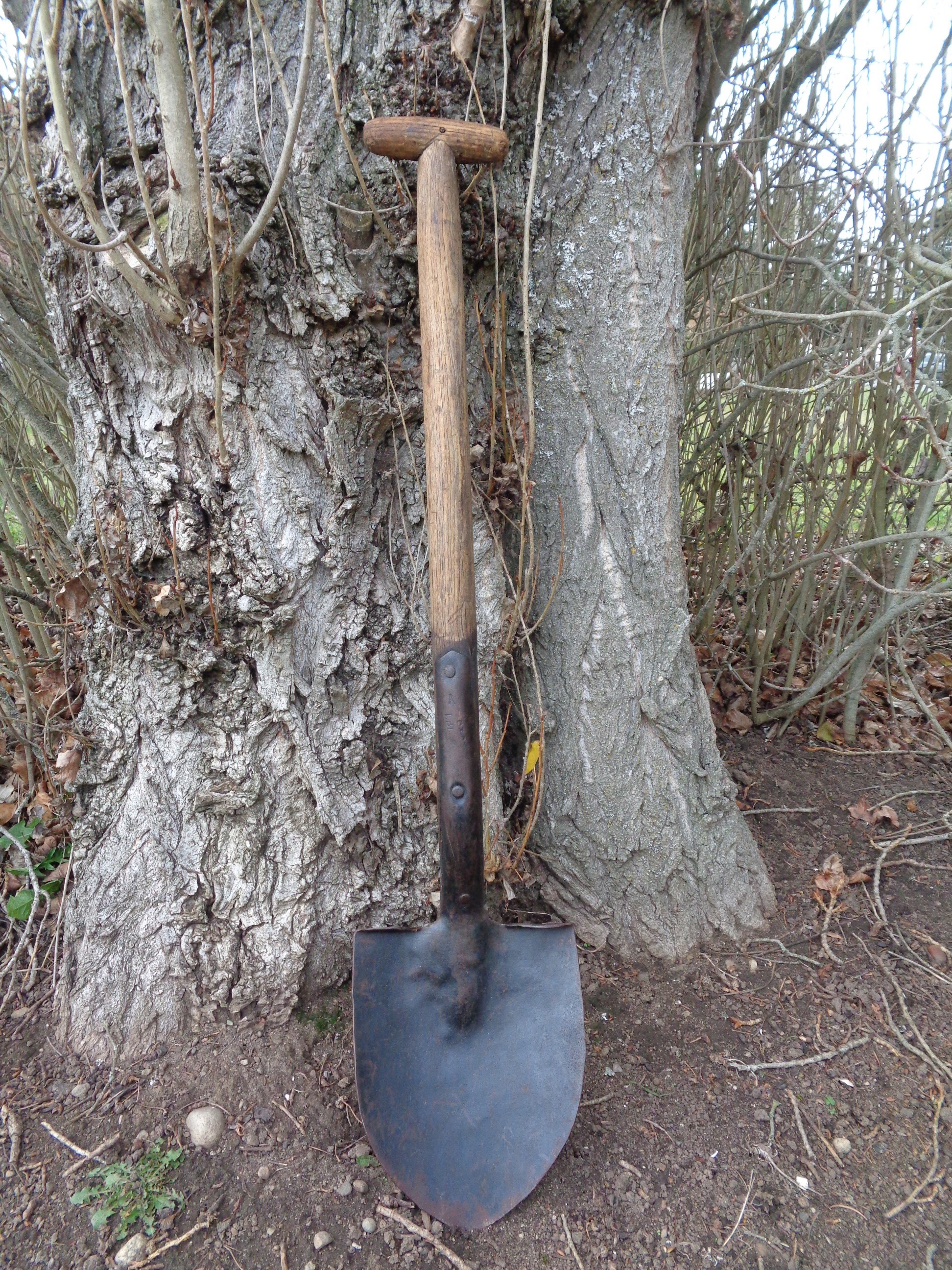
I had the rare opportunity to pick up a trio of British General Service Shovels from a seller in the US. All three were slightly different, with one of them damaged. The price was amazing, so I bought all three! One is dated 1943, one 1954, and the third is undated, but Broad Arrow stamped.
I'll be showing off each one separately in the next three blog postings. For today, we'll start with the undated, damaged shovel. I'll also show the restoration of the damaged handle.
This style of British, GS, or General Service Shovel, was the standard issue, full-sized shovel that saw use from WW1 (or possibly before), through the 1950's. The GS Shovels were found in nearly every theater of operation, in service with almost all units, and mounted on nearly every British vehicle. In addition to their mundane, uses around camps and bases, they were the preferred combat entrenching tool carried by the soldiers in the field during WW2.
Before we get too far along though, here is a shot of the restored GS Shovel that is pictured above. I'll go over the restoration, a bit later in the blog post.
The standard issue, British, entrenching tool during WW2, was the Pattern 1939 spade, and then the Pattern 1937, "combo-tool". Both of these tools were very unpopular with the troops, and as a consequence, the field soldiers, unofficially, adopted the GS Shovel as a substitute.
In many of the old photos, it is common to see the smaller, official Pattern 1937 tools being carried on the belt, with a full sized, GS Shovel carried in the pack, or tucked cross-wise in the front belt. Basically, if the soldier needed to dig a hole, the GS Shovel could be counted on to actually get the job done, unlike the diminutive Pattern 1937 tools. There was also the belief that the heavier, and larger, steel blade of the GS Shovel offered a bit of "armor plate" protection when carried (an extra, and potentially lifesaving bonus, in the soldier's eyes!).
In 1958, the British Army adopted a new entrenching tool, the Pattern 1958 Light Infantry Shovel. This was a GS Shovel with a slightly shorter handle (29 inches), with a hole drilled through, near the T-handle. The hole was for mounting it on a carry-stud, on the Pattern 58 web harness.
You can read more about the Pattern 1958, short handle shovel, here: https://talesfromthesupplydepot.blog/2016/05/09/short-general-service-shovel/
The GS Shovels are still used by the British Army, but I believe they may be a slightly different style.
From the beginning, the GS Shovels were basically a civilian, T-handle shovel, that had been accepted into British Military service. The military shovels all had a British Broad Arrow stamp. The civilian shovels are missing this stamp, but are otherwise the same.
The British military specifications for the GS Shovel, call for a blade that is 8 inches across. There was another British shovel called the Round Edge Shovel, or RE Shovel, that had a blade that was more rounded and 10 inches across. To save weight, the sides of the RE Shovel were trimmed straight, shaving almost a pound off of the weight. The resulting, lighter, shovel became the GS Shovel. You can read more about the wider RE Shovel here: https://talesfromthesupplydepot.blog/2017/10/17/ww1-royal-engineers-shovel/
During WW2, there were quite a number of slight variations of GS Shovels. All handles and shafts were made of wood, but some had reinforcing metal straps over the T-Handle, and some did not. Some of the "T's" were slightly curved, and some were straight. I think that basically, if it was a T-handle shovel, that fell within the blade dimensions, and overall dimensions, it was accepted into service, without all needing to be exactly the same. There were even slight variations in the metal blade construction. In fact, these shovels were made by literally hundreds of manufacturers during WW2. Some were well established shovel makers, and some were smaller shops and factories that only made the shovels during the war. Some shovels were dated, with manufacturers marks and names, and some were unmarked, with only the Broad Arrow stamp.
Now that we have covered some of the history and specifics of these General Service Shovels, let's take a closer look at this first of three, GS Shovels that I have.
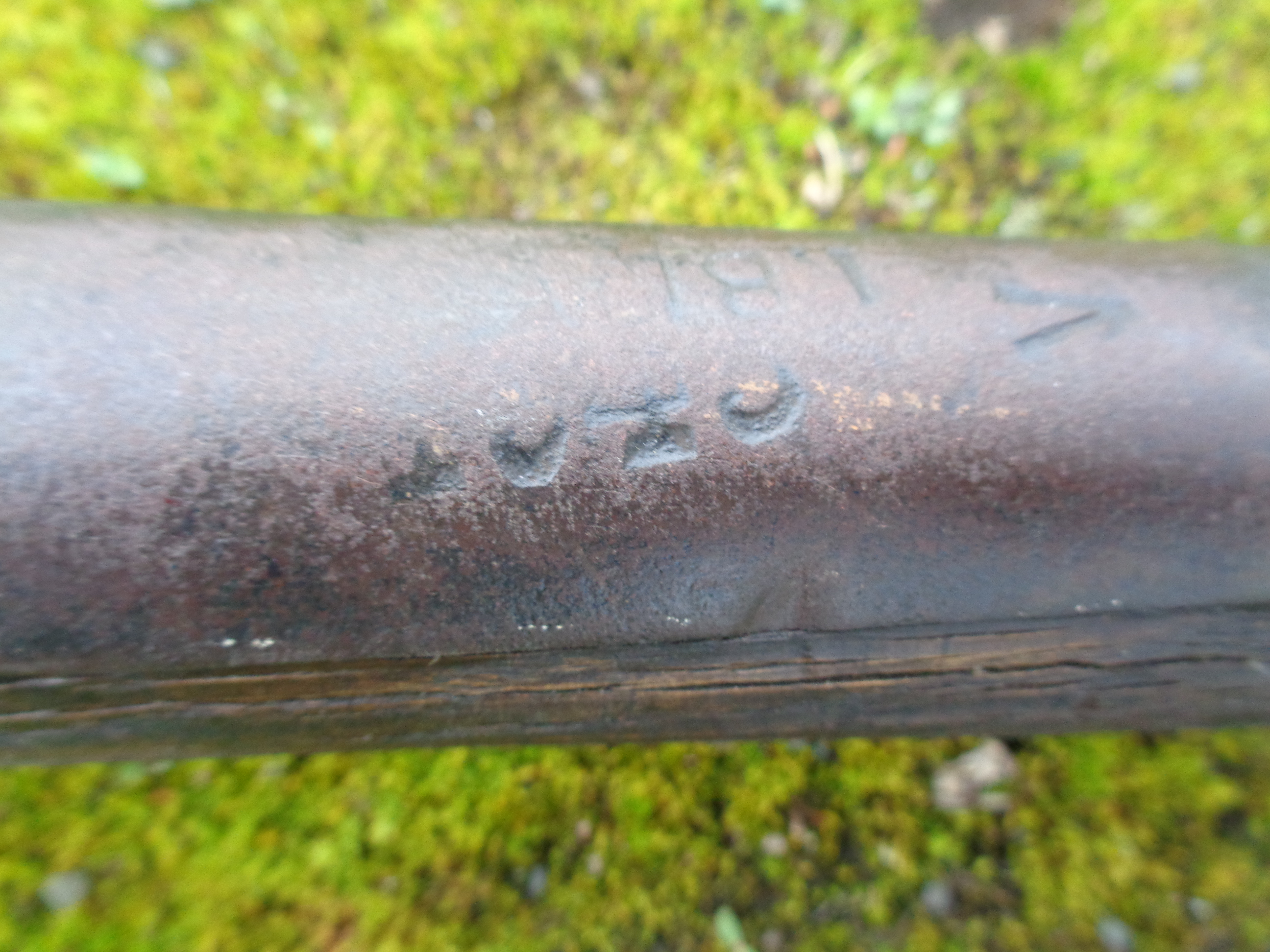
This particular shovel has only one marking. It is stamped with the Broad Arrow acceptance stamp. There is no date or manufacturer's name.
These WW2 vintage shovels are also painted black on the metal blade, and up the wood handle a short distance.
This shovel is the typical, WW2 style shovel, and almost certainly dates to WW2 due to it's rougher construction and the fact that it is unmarked and undated. These unmarked and undated examples are nearly all from WW2, and most likely were made by smaller contractors. It is just a guess, but I believe these more basic, and unmarked shovels, may have been produced later in the war.
You can see the Broad Arrow stamp in the photo.
When I received the shovel, the T-handle was missing. The handle had snapped off at the base of the T-handle, diagonally down the main shaft. The top edge of the shaft, where it butted up to the T-handle was still present on one side, so I was certain as to the original length of the shaft.
After photographing the shovel in it's original, damaged state, I headed down to the bunker to restore it back to its former glory (well, as close as possible!).
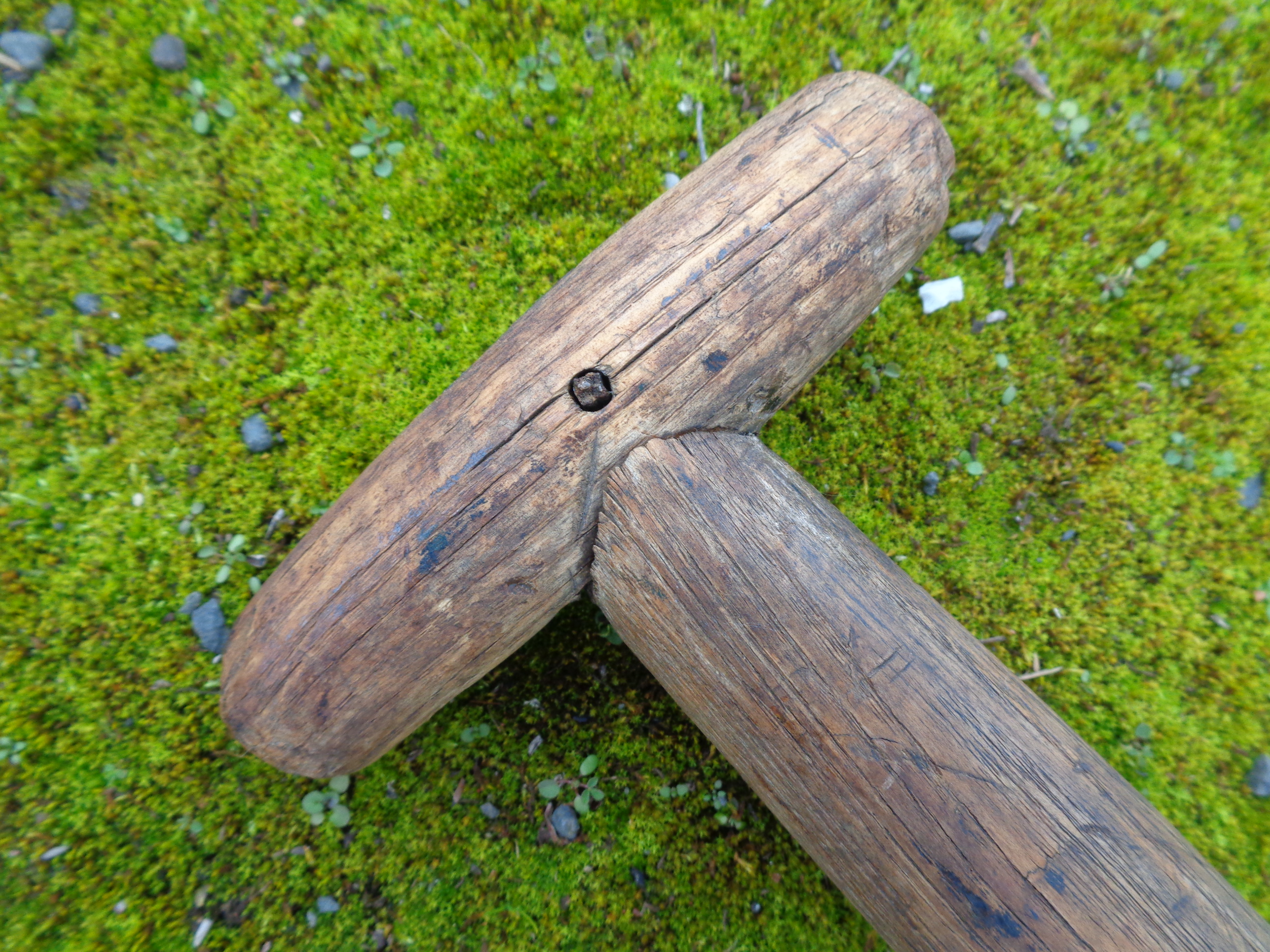
Here is the basic process I followed to restore the handle. To make the repair, I cleaned up the break surface, by making a clean, straight, diagonal cut. I duplicated this angle on a new piece of handle shaft, and glued the two together. After gluing, I shaped the grafted portion to match the original shaft. Next I drilled and installed a long, brass, wood screw, from top to bottom, inside the wood shaft. This serves to reinforce the glued joint internally. After the screw was installed, I carved and shaped the top of the shaft to accept the T-Handle. I then made a T-handle and installed it on the carved shaft, pinned everything in place, and finished the new, bare wood with stain.
Here is a side-by-side photo of the repaired handle next to another WW2, British T-handle shovel (before stain). The left shovel is a WW2 vintage GS shovel, and the right shovel is the repaired shovel.
I finished up the repair with several coats of stain, and then coated the entire handle with Danish Oil. The final color is still a bit off, so I will have to do a bit more matching later. It is very difficult to color match new wood to the original old, and weathered, wood, in this type of repair. It will never be a perfect match, but it will do just fine for display. This is what I consider a "museum restoration".
Here is the finished product. Let's take a look at the fully restored, WW2 vintage, General Service Shovel.