Thursday, March 1, 2018

WW1 Trench Art Matchbook Holder, 6th Battalion, Queens Regiment, Royal West Surrey, Private Raymond William Revill, Matchbox Slip

As promised, here is another new posting on yet another interesting piece that I recently picked up.

While I was cruising around town, and hitting my local "junk store" haunts, I noticed this little gem in the back corner of a display case.  After a bit of back and forth, bargaining with the shop owner, this beautiful bit of WW1 history was mine!


This little brass box is a matchbook holder that belonged to a British soldier from West Surrey, in the UK.  It is an original item brought back from the Trenches of France during WW1.

These little covers are quite amazing, and many of them give quite a bit of history about the original owners.  This holder is what is commonly known as "trench art", or rather an item made by a soldier in the field for personal use, or as a war souvenir.  This holder falls into both of those categories.  It is both a personal use item and a personal souvenir of the war.


This cover was crafted by hand, from a piece of old artillery shell brass.  The artwork on the surface was also done by hand, with a small stamping tool, probably a sharpened nail, or something of the sort. I can picture the soldier now, sitting in the trenches of France, and passing the time making this little holder.

During the WW1 Years, nearly every soldier smoked, and boxed matches were the most common way of lighting up your pipe or cigarette.  To keep your box of matches from getting crushed in your pocket, a matchbook holder was used to hold and protect it.  The soldiers had a ton of time to kill, so that time was often filled with eating, sleeping, and making some bits of trench art.  One of the more common items to make were these little matchbook holders.


The front of this holder is marked:

18558
R. W. Revill 
6.=Batt Queens

The back is marked:

Somme
Arras


Inside the matchbox, was a little note from a prior owner, giving a few more details.  This gave me a good place to start my research.  I contacted Surrey History Center and Museum to see if they could help in tracking down some history on R. W. Revill and his unit (I could find nothing on Revill in my searching).
They were quick to get back to me, and this is what they had to say:


Thank you for your e-mail of 15 January concerning a matchbox cover inscribed R W Revill of 6th Battalion, Queen’s (Royal West Surrey) Regiment.

According to R W Revill’s medal index card and the medal volumes for the First World War, both of which are available on the family history website Ancestry, his full name was Private Raymond William Revill, his regimental number was G78558 and he served just with the 6th Battalion.

The 6th Battalion was formed in Guildford in August 1914 and was designated a Service Battalion, which was raised for just the period of the war. Unfortunately, Raymond William Revill is not mentioned in our rough recruitment register of those who enlisted at Guildford, reference no. QRWS/1/3/3. Neither do his service papers appear to have survived (an estimated 60% were destroyed during the Second World War). However the G prefix to his number means that he enlisted between August 1914 and about December 1915 for three years or the duration of the war.

He does appear to have survived the war since he is not mentioned on the Commonwealth War Graves Commission website.


Battalions of the New Armies

6th (Service) Battalion
Formed at Guildford in August 1914 as part of K1.
August 1914 : under command of 37th Brigade, 12th (Eastern) Division.

6th (Service) Battalion (QRWS/14/-)


The two names on the back of the cover reference two of the major battles that the unit participated in, The Battle of the Somme, and The battle of Arras.  Both were bloody and terrible.

I did some extensive digging through some old UK photo archives, and ran across a couple of beautiful photos of a few men from the 6th Battalion in the trenches.  Who knows, one of them might be our soldier Revill !  Both photos are from the Imperial War Museum Archives.


6th Bat. Queens Royal West Surrey Reg. Arras, March 1917

6th Bat. Queens Royal West Surrey Reg. Arras, March 1917

Since I picked up this little holder here in the US,  it could be a safe guess that he may have emigrated after the war, or possibly it was brought over by a relative.  There is no way to know for sure, but at least we have a bit of Raymond Revill's wartime story to go with it.
Here is the photo album.  Enjoy.


Monday, February 26, 2018

WW1 Victory Medal, United States with Transportation Bar, and New York State Militia Long and Faithful Service Ribbon

Here is a VERY unique WW1 medal that I picked up at a little junk store on Orcas Island, Washington, a couple of weeks ago.


It is a WW1 US Victory Medal, with a Transportation Bar, and the ribbon from a New York State Militia Long and Faithful Service Medal.  Very unique, and I believe, an authentic, veteran modified, medal from WW1.  Here is the "story" as I see it, as told by the "clues".  But first, let's look at some details.

When I purchased this medal, it came in the old jewelry box, in the condition you see here.  


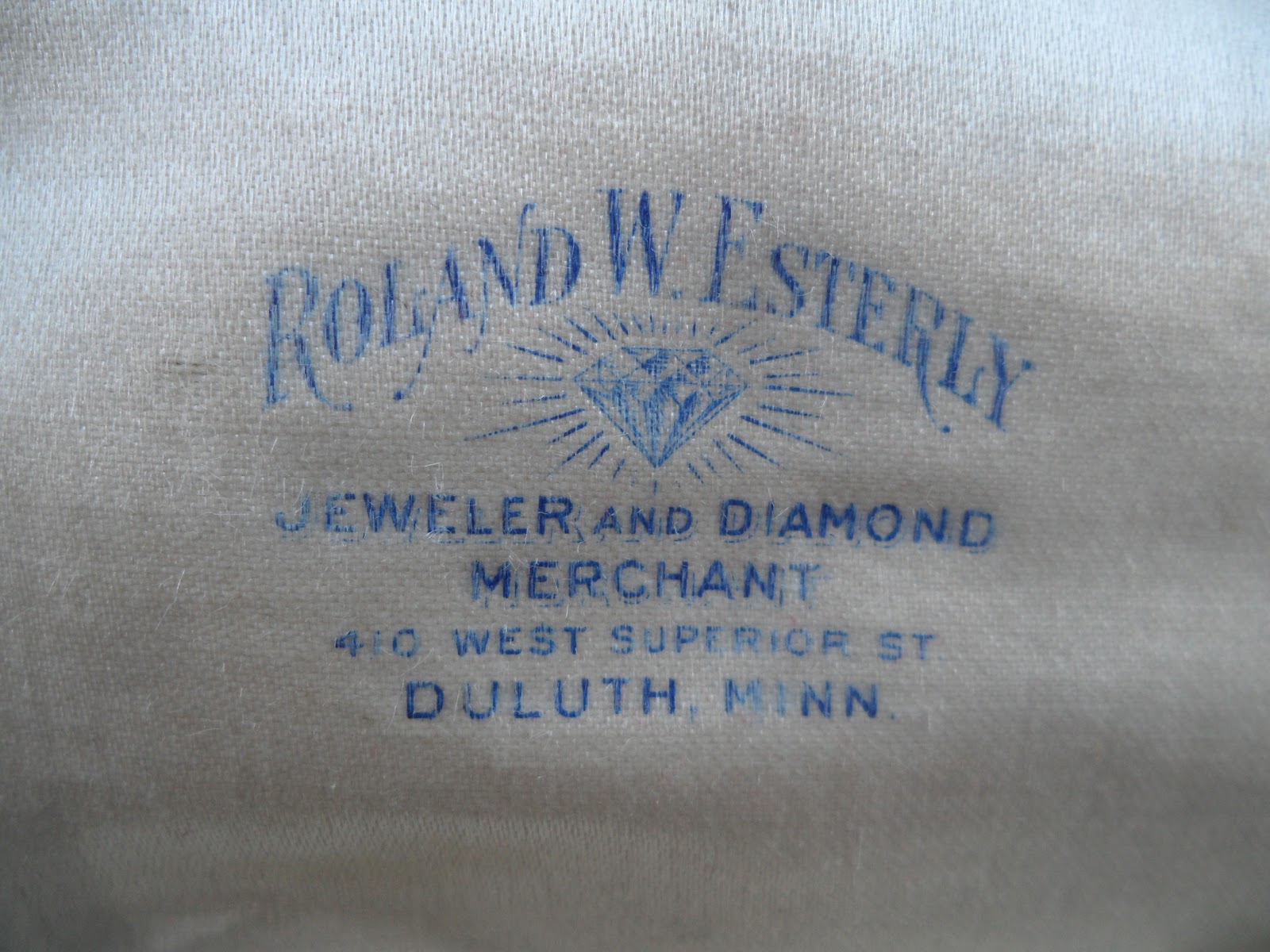
The jewelry box has the name of a very prominent and respected jeweler of the time, Roland W. Esterly, of Duluth Minnesota.


Roland Esterly opened up his jewelry store in 1918 and continued to do business there, at least, well into the 1920's, if not longer.  His name and associated business is referenced more than once in the old journals as one of the top jewelers of the city.  

From NY State Militia Div. of Naval & Military Affairs.

The ribbon on the medal is from a New York State Militia Long and Faithful Service Medal.  Originally this medal would have been issued to a militia member after serving for a set number of years, and then "retiring".  New York had a State Naval Militia as well as land forces at the time of WW1 (they still do in fact!).  The original medal would have been suspended on a neck ribbon.  There was a small "year" charm that the the neck ribbon passed through.  (These old medals with neck ribbons and the year charms, are now obsolete, and no longer issued or allowed to be worn).

The Transportation bar at the top of the medal ribbon would have originally been a "Slide On" device and not sewn in place.  There also appears to be a professionally drilled hole on the middle, bottom edge, of the bar, with a small suspension ring.  This hole was added later, after the Victory Medal was awarded.


The Transportation bar was added to the WW1 Victory Medal for veterans who served on board transportation or cargo ships, and made at least one trip across the Atlantic, between April 6, 1917 and November 11, 1918.

Now, here is my version of the medal's story, as told by my research and clues.  Mind you, it is only a "best guess and explanation" based on the medal itself, and my research, but I feel it is probably correct.

 The original veteran was a long-time member of the New York State Naval Militia at the time WW1 broke out.  When the US went to war, the NY Naval Militia members were transferred to the US Navy.  This veteran then served his time aboard a US Navy ship and after the war was over, he was awarded the US WW1 Victory Medal with Transportation Bar for his service in the Atlantic.  At some point after the war, he was awarded the New York State Militia Long and Faithful Service Medal and ribbon, with the associated year charm.  It was normal for WW1 veterans to wear their medals to civic events, on formal occasions, parades, etc., after they left military service.  It is my guess that the veteran had the jeweler in Duluth, Minnesota, combine his two medals into one WW1 service medal. 
The Jeweler used the neck ribbon from the New York Militia medal, the medal from the WW1 Victory Medal, and the Transportation slide from the Victory Medal as well.  The Transportation bar was drilled and the "year charm" from the Militia Medal was then suspended from it.  The Transportation bar was then sewn in place at the top of the newly created medal.
In the years since the "New Medal" was created, the charm was lost, but the suspension ring and bar with hole remained.

The back side of the medal is quite worn and polished on the high points, lending credence to the story that the veteran wore this medal regularly after the war.  Since the medal was such a treasured item, it was preserved in the box that the jeweler had provided with it, all of these years.


I wish I knew the actual veteran's name and his individual story, but at least we have this amazing little medal and the story it suggests.

Here is the medal (or medals?).  Enjoy.


Sunday, February 25, 2018

RH PAL 36, WW2 US Fighting Knife with Customized Sheath, PAL RH-36, The Original Ka-Bar

I'm back!  After taking a longer than anticipated break from the blog, I'm finally sitting down to tackle my enormous back log of researched items.  So stay tuned for a flurry (hopefully!) of blogging activity!


Today we'll be taking a look at an often overlooked piece of WW2 equipment.  The early war, RH PAL 36, US military fighting knife.  This is the "original" Ka-Bar fighting knife that all the other US fighting knives evolved from (WW2 - Present Day).


When war broke out between the US and Japan, in December of 1941, the US military was woefully under supplied and the equipment they were using, was mostly WW1 vintage gear.  The only official, US military fighting knife was the old "trench knife", the Mark I Trench Knife.  This was the old "brass knuckle", short bladed, dirk that was issued to US soldiers in the Trenches of France back in WW1.  The Mark I was a great trench fighting knife, but not a good, survival / fighting knife. 

https://en.wikipedia.org/wiki/Mark_I_trench_knife

With the US calling up thousands of new soldiers and sailors, the need to immediately equip them presented more than a slight problem.  There wasn't enough of the old vintage gear available, and the gear that was available was out dated.  So, the US turned to readily available, "over-the-counter", gear to supplement official GI Issue until a new manufacturing and supply system could be established.

Enter the RH PAL 36 fighting knife, made by the PAL Blade and Tool Company.


The RH PAL 36 was a civilian made knife that was manufactured by Remington, and then by the  PAL company, and sold extensively on US Military Bases to soldiers and sailors.  It was a VERY popular, private-purchase sheath-knife for soldiers at the time war broke out in 1941.  The US Military immediately scooped all of the available knives from the base exchanges, and immediately put out an order for as many as PAL could mass produce.  PAL was already tooled up and manufacturing, and the US military needed them NOW.  It was a perfect match!

 Originally the blade and overall design of this knife, was designed by the Remington Cutlery Company.  It was sold by Remington as the Model 36.  After PAL bought out the Remington Cutlery Company in January of 1941, before the outbreak of war with Japan on December 7,  PAL continued production of the old Remington Model 36, but renamed it the RH-36.  RH stood for Remington Hunter, and the 36 was the old Remington model number.  From what I understand, PAL was up and producing the RH PAL 36 knife under their own name, sometime in March of 1941.  Production of the knife continued for the "War Years", 1941-1945, and then ceased some time after the war, probably in the first few post-war years.  Remaining old-stock and "parts knives" were sold by PAL up to about 1950, in very limited numbers.


Since these old RH PAL 36 knives were only produced during WW2, it makes it quite easy to identify them as a true "war era knife".

These knives were civilian knives that were issued and then ordered by the US Military, and as such, they were never marked with US or with a US model number.  They remained a "hunting styled knife", just as they were before the war.

The first batches of these knives were issued to the US Marines that were headed to the South Pacific to fight the Japanese.  A large portion were also issued to the US Naval aviators that were headed there as well.  In many of the early (and quite a number of later) photographs from the South Pacific Theater of Operations, you will see these RH PAL 36 knives on the belts of marines, and naval pilots.  A number of these knives found their way into the European Theater, and were also carried by WW2 veteran soldiers who went on to serve in the Korean War as well.  These knives really got around!

After the war really got going, and the US started to refine their equipment specifications, official orders were put out  for the "official versions" of the old PAL knives, with some slight changes.  These later knives were known by various military model numbers, such as, the USN Mark I, Mark II, and the now famous USMC "Ka-Bar".

There were two blade finishes that were found on the old PAL knives.  The first was a bright finish, and later in the war, a parkerized finish.  My particular knife may have the faint remnants of parkerization on the blade, or maybe it's just a very aged patina on the original bright blade.  It is hard to tell.


I spotted my knife in the display case of a local "thrift store".  It was being sold as an old hunting knife, with a price to match!  That is one of the wonderful things about these old PAL knives, they don't look "military"!  Since this knife found its way to me via a thrift store, I will never know the true history of it, but you can be sure that this knife was a well loved and long carried knife by someone out there!

The knife itself is in very good condition overall.  The blade has lost a bit of its original parkerized finish, and there are some signs of edge grinding, but all in all, it's weathered and complete. 


The pommel is rough cast zinc or aluminum.  Later knives can be found with wood pommels when metals were being diverted for war production.

The sheath is sewn and riveted, with the punched hole in the tip for the classic "leg tie".  The sheath on my knife has been customized and hand tooled by the previous owner.  The work is beautiful and well done.  It was pretty common for the soldiers and sailors to customize the leather sheaths keeping up the long tradition of American Individualism........we were a "Citizen's Army" after all!


The rivets on my sheath are well worn on the back side, and the leather has been polished smooth and glassy.  This indicates this knife was carried extensively, polishing smooth against a soldier or sailors BDU's or Dungarees (or so I can imagine).


The grip is composed of leather discs and it is worn, but in great shape.


This knife is a wonderful, early war, USMC or US Navy style knife that most likely saw service somewhere in the South Pacific, or in the cockpit of a Naval Fighter Plane.  It's a true piece of classic WW2 equipment!

So next time you are checking out the local thrift stores and yard sales, keep your eyes peeled for one of these classics.  They are out there just waiting to be re-discovered!  But until then, you can check out the album of my classic RH PAL 36 knife.  Enjoy.