Monday, July 25, 2016

Zivilschutz Helm, West German Civil Defense Helmet, Schuberth Type ZS, 1970's-1990's, with ZS ZB Headlamp

Today we'll be taking a look at another unique Civil Defense helmet, (and headlamp).  This time the helmet is from West Germany.


This helmet was one of the official Civil Defense helmets for all of the German Civil Defense Agencies during the 1970's,1980's, and into the 1990's.  

The German Civil Defense Organization was spilt up into quite a number of sub-departments that were each assigned their own special duties and responsibilities.  The German philosophy was to have many specialized units and organizations, instead of just a few "do everything" organizations like we find in the US.

This style of helmet was first made in 1973 and production, and use, continued into the 1990's.  The helmets were based on the old 1945 Wehrmacht "Thale B/II" helmet that was designed at the end of WW2, but never issued due to the abrupt ending of the war.  This helmet also is VERY similar to the standard East German Army helmet!  The similarity in appearance to the East German helmets  made this a very unpopular helmet in West Germany.

Two East German Soldiers in their East German combat helmets.

Officially this helmet was called the "Type ZS" helmet.  ZS stands for Zivilschutz, or Civil Defense.
These helmets were worn by the THW, Red Cross, the various Civil Defense units (ZS), Volunteer Fire Service, etc.  It was a "do everything" helmet!  
The helmet is constructed of plastic, and is designed to mount a headlamp. The helmet includes a molded-in front mount with a rear cord-routing clip for the light.


Inside the helmet, there are tabs used to mount the leather or reflective neck protector.  


There are also slots on the front-interior for mounting a wire mesh face shield that was designed as a "heat deflector" for firefighting. (The "heat deflector" screen was quickly abandoned as it was not effective).


The liner is adjustable from size 53-61 cm, and is marked in both metric and US sizing.  The chinstrap is equipped with a "break-away" wire latch, and is rigged like the metal fire service, and paratroop helmets.


This particular helmet is marked as made by Schuberth, and is dated 1998 (if I read the molding circle-stamp correctly). 


It is stamped with the name of the helmet as well:  "Type ZS".  There are also a few hand marked numbers, but the helmet appears to be unused (not surprising as these helmets were so unpopular!).


Here are a couple of shots of the helmet being worn (by "yours truly" again!)


Here are a few detail shots of one of the headlamp types that were  used on this helmet.  This lamp is missing the sliding U-handle, but otherwise is complete.  When worn with the helmet, the light's battery pack-base would be clipped to the belt.  On the front of the light, there are slots so different colored filters can be installed or a light-visor.


And now let's take a closer look at this unique West German helmet.  Here's the photo album:


Saturday, July 23, 2016

Swedish Fire Fighter's Helmet, circa 1960, Brissman, Halmstad Sweden, Brissmans Brandredskap

Today we'll be taking a look at a fairly rare fire fighter's helmet (at least here in the US).  This helmet is a very early model , fiberglass helmet, made by the Swedish fire equipment and helmet manufacturer, Brissman.


The helmet I have shows it's age, from storage, but does not appear to have been used, or was used very little.  It does not have any department decals or numbers and shows no damage.  I wish I knew how it found it's way to the USA, but I am afraid I will probably never know (it came to me via a VERY odd listing on eBay............)  When I received this helmet, it had been spray painted on the outside, with black paint.  It was a terrible paint job with many sags and runs.  A bit of careful stripping using acetone thinner and a rag, and I was left with the original white fiberglass finish.

This helmet was made by Brissman, of Halmstad Sweden.  


The Brissman company started up in the 1920's after a local fire chief, Fritz Brissman, realized that there were not very many options for quality fire fighting equipment in Sweden.  He decided that he would start his own company and produce high quality helmets and other fire equipment.  His signature product was the classic Swedish fire helmet.  Originally this helmet was made in aluminum, roughly based on the German fire helmets of the era.  In 1960,  Brissman's switched their production from aluminum to polyester fiberglass. 
Here is a link to another collector who has quite a few examples of these old Brissman helmets, both in metal, and fiberglass:

http://derfeuerwehrhelm.de/land.php?land=93

As a comparison, here is a link to my blog page showing the German version of this helmet:

http://sharky-fourbees.blogspot.com/2011/05/deutsh-feuerwehrhelm-west-german-fire.html

It appears that none of the old Swedish helmets were dated, but based on the liner construction of my helmet, it appears to be one of the early fiberglass production helmets.  
The liner is made of leather, and is adjustable by changing the overlapping area of the rear headband. 


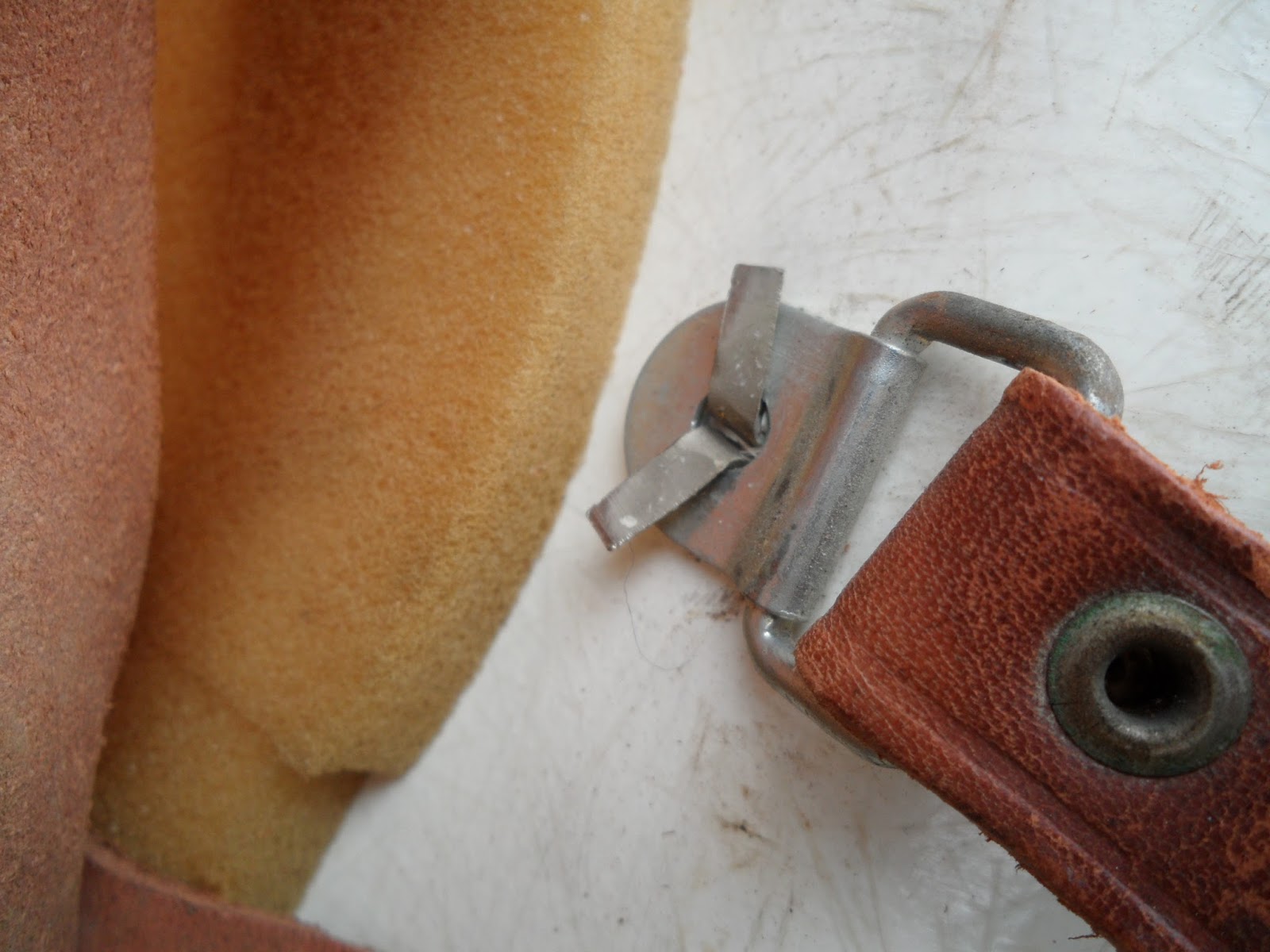
The adjustment is secured with a "shoestring tie".  The liner and chin strap are attached with "paperclip" rivets, that are very similar to the old German steel helmets.  


The outer, exposed portion of the rivet is protected and insulated with a plastic cap.  


There is a fitted foam pad that fills the crown of the helmet, under the liner.


I find it quite interesting that these Brissman helmets are nearly identical in shape as the old Model 1936, Bulgarian steel military helmets......coincidence, or influence.......who knows!  
Here is a link to my blog page about my old Bulgarian Model 1936:

http://sharky-fourbees.blogspot.com/2010/11/bulgarian-model-36c-helmet-kaska-36c.html

These Brissman helmets are still made, and used, in Sweden, with only minor changes to the liner and chin strap!  I must say that these "old helmets" are very comfortable to wear!  (modeled by "yours truly!")


Here are a few shots of these Brissman helmets in current use in Sweden:


I am still undecided as to whether I will leave this helmet "as-found" or obtain a Swedish fire service, front decal and side numbers, so I can display it as a "seasoned veteran replica".  I hope to contact a few of the fire departments in Sweden to see if they can help me out with the correct emblems.  

Now let's take a look at this beautiful old piece of Swedish, fire fighting history!


I believe this stamping on the liner indicates "Shell Size 2" & head sizes 56-59 cm.


Wednesday, July 20, 2016

British Brodie Helmet MkI, WW1, manufactured between 1916-1918, Mark 1, Mk1

Today we'll be jumping back in time a bit and taking a look at one of the first modern, British helmets and the predecessor of the first US steel helmet.  This beautiful, old helmet is a WW1, British 
Mk 1 Brodie helmet.


This helmet came into my collection via my uncle, who picked this up in his travels here in the US.  It was first thought to be a US Model 1917 helmet from WW1, but on closer inspection, it turned out to be British.  The two WW1 Brodie Helmets, British and American, are nearly identical.   Only a few very minor details set them apart from each other.

These original British Brodie helmets were designated the Mk 1 Steel Helmet, and nicknamed after the inventor who designed and patented them in 1915, "John Leopold Brodie".  Production of the Mk 1 Brodie helmets began in 1915 and continued through the end of the war.

British soldiers in the trenches.
When the United States entered the war in 1917, the US soldiers were not issued helmets.  They shipped out from the US, and landed in France, with the standard felt, US Campaign Hat as their field head covering .  In June of 1917, the US placed an order for 400,00 British made helmets and issued them to the US troops in France.  At about the same time, production was started on the US version of the Brodie helmet, named the US Model 1917 Steel Helmet.  In November of 1917, the US produced helmets were available in significant numbers and were being issued to the US soldiers before they shipped out for France.
With this in mind, my helmet could just as easily have been issued to some of the first US soldiers in France, or it could have been issued to a British soldier.  The fact that it was picked up in the US almost 90 years after the war, might indicate that it came back over with the US soldier it was issued to, but we will never know for sure.

My particular helmet is in pretty good condition considering it went through one World War and has survived for 100 years!


My helmet is stamped H.V. / 349 on the underside of the front rim.  The "H" indicates that the helmet was made by Hutton and Sons Ltd. of Sheffield (they produced helmets beginning in 1915).  The "V" stands for the steel supplier, Vickers Ltd. of Sheffield (they began supplying steel in 1916).  The "349" is the heat treating lot number of the steel used to press the helmet.


One of the easiest features that distinguishes a British Helmet from an American helmet, is how the chinstrap bail is attached.  The British helmets used a spit pin rivet, and the American Helmets used a solid, peened rivet.   My helmet has the distinctive British split pin.

The glossy finish is from the varnish I used to seal the old asbestos!
The liner of the helmet is attached with one rivet in the center, top of the helmet.  This rivet originally went through a liner support strap, and then the top pad, that consisted of an asbestos fiber pad that was sewn to a wool felt pad, with a ring of rubber tubing sewn between the two.  The felt pad and rubber tube ring have disintegrated from age and only the asbestos pad is left (there are some small spots of orange adhesive that may have been used to glue the pad in place by a previous owner).  I coated the asbestos pad with varnish to encapsulate it due to the danger of having decomposing, raw asbestos exposed!  I will manufacture a replacement, replica, wool pad and rubber ring to cover the asbestos pad (not permanently attached, for display purposes only).  You can still see some of the old wool and stitching on the old asbestos pad.


The remainder of the liner was sewn from a coated "oil cloth" with a ring of mesh support netting.

The chinstrap is leather with a stamped sliding adjuster.  The American helmets used a cast sliding adjuster.

On the backside of the oilskin liner, there is a faint printed area in red ink that is no longer readable.  This is where the information about the "Brodie Helmet" is printed.  This red printed label is only present on the British helmet liners. This is what the printed label looks like, if not faded out:

BRODIE’S STEEL HELMET
Registered No. 081,990.
WAR OFFICE PATTERN
PATENT No. 11803/15

The faded red printed label on the backside of the oilskin liner.
It is amazing to see how far "helmet technology" has come since 1915.  These old WW1. MkI helmets were nothing more than "stamped tin", and they soon evolved into the heavy steel MkII helmets of WW2.  Very interesting to see the difference that 25 years made.  Here is a side-by-side comparison of my British MkI and MkII helmets.  Very interesting!  (the MkII helmet is shown in the previous blog posting).


And now we've come to the traditional Photo Album!  Enjoy!