Wednesday, March 16, 2016

East German Rg57 Cleaning kit for AK47, Reinigungsgerät 57, 7.62 x 39 MPi-KM rifle

Today we'll be taking a look at another German rifle cleaning kit. This time it is an East German version of the old Rg34 cleaning kit that dated to the WW2 years.


This cleaning kit was officially designated the Rg57, or Reinigungsgerät 57.  It first went into production in 1957 and was intended for the East German version of the AKM, or AK47, better known in East German Army terms as the the 7.62 x 39 MPi-KM.  

These Rg57 cleaning kits were manufactured into the 1970's, until the AK74 in the smaller, 5.45 x 39 caliber, was adopted by East Germany.  At that time the tin cleaning box was discontinued and the new AK74 tools and brushes were issued in a roll up pouch, without a tin box.

The pouch and kit we are looking at today are one of the late production Rg57 kits.  There were slight variations in markings on the tin can lid, and slight tool variations, but essentially they remained the same for the entire time span of their production.  Some of the early kits came with a "pleather" - fake leather, pouch that held the tin and its contents.  The later versions, like this one, came in a roll out, synthetic backed, cloth envelope with attached drop cloth.


The metal tins are stamped with either RG57 alone, RG57 with a single digit number, or just the single digit number.  Mine is marked "1".


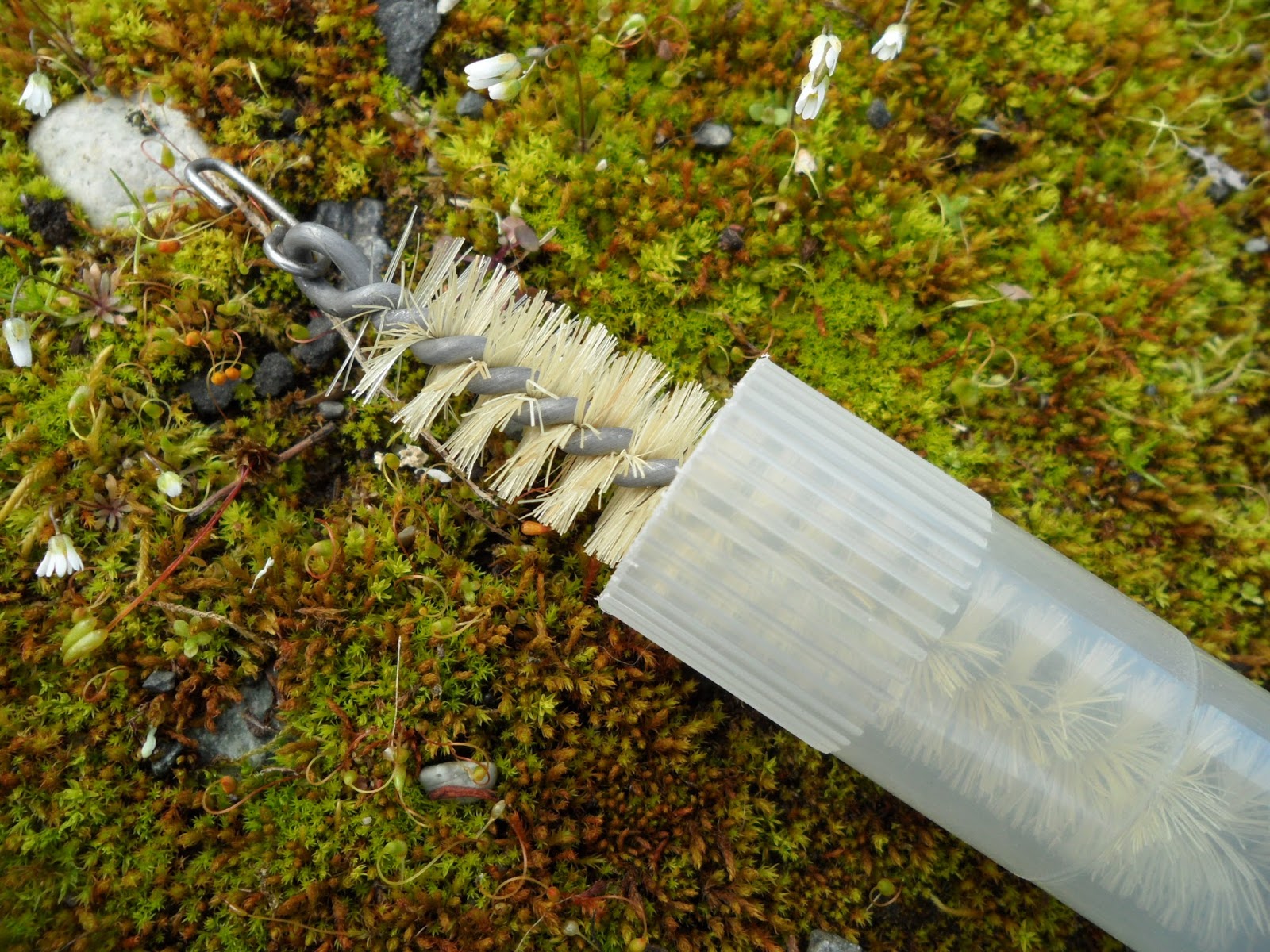
The kits contain a bore brush, chamber brush, small gas port cleaning brush, "broom" brush, combo tool for firearm disassembly, weighted pull cord, and a very cool little metal oil can.    The oil can is made of stamped metal with a combination spout - cap.  No provision is made for cleaning fluid in these kits, only oil.  There is also a plastic tube that holds the bore and gas port brushes so they don't get crushed.  


These cleaning kits are quite small and compact compared to the West German Rg34 tins.  Here is a comparison of the two.  
Here is a link back to the West German Rg34 posting (the larger tin kit):  http://sharky-fourbees.blogspot.com/2015/07/west-german-rifle-cleaning-kits.html


Before we jump int the photo album, here is a great photo of some East German Army soldiers cleaning their rifles with these kits. You can see the kits on the table.


Now let's take a look at the album.


Saturday, March 12, 2016

German Rescue Axe - Combo Tool, Ziviler Bevölkerungsschutz - Bundesanstalt Technisches Hilfswerk, ZB - THW - Civil Defense, circa 1961

Today we'll be taking a look at a new addition to the German tool collection.  This rescue axe - combo tool, is a seldom seen piece of German Civil Defense and rescue equipment that dates back to the 1960's.


This tool and its leather carrying case last saw recent service with a THW unit in Gemany (Bundesanstalt Technisches Hilfswerk).  
Originally it was produced and issued to a unit of the ZB, German Civil Defense (Ziviler Bevölkerungsschutz).  The ZB was started in the early 1950's as a new replacement for the old war-time Civil Air Defense Service (Luftschutz).  The ZB operated alongside the THW, which handled civil emergencies, disasters and rescues.  The ZB was renamed in 1964 as ZS, which was a slight change in the tittle that sounded less "military" in nature.  Eventually the ZB / ZS responsibilities were taken over by the THW, Red Cross, and Fire Services.

Today there are still the last remnants of some of the old Civil Defense equipment that still are used here and there, by units of the THW.  The blue paint marks on this rescue axe indicate THW use (blue is the organization color for the THW).  The tan handle on the Axe is the original uniform and equipment color for the ZB.

Here is a link to one of the THW Berlin units that has some great "action shots & photo galleries".  The site is German, but can be translated, or just enjoy the photos.

http://www.thw-treptow.de/

This rescue axe is original, in its issued leather carry case, that is dated 1961, and is stamped ZB.  The axe head is stamped ZB.


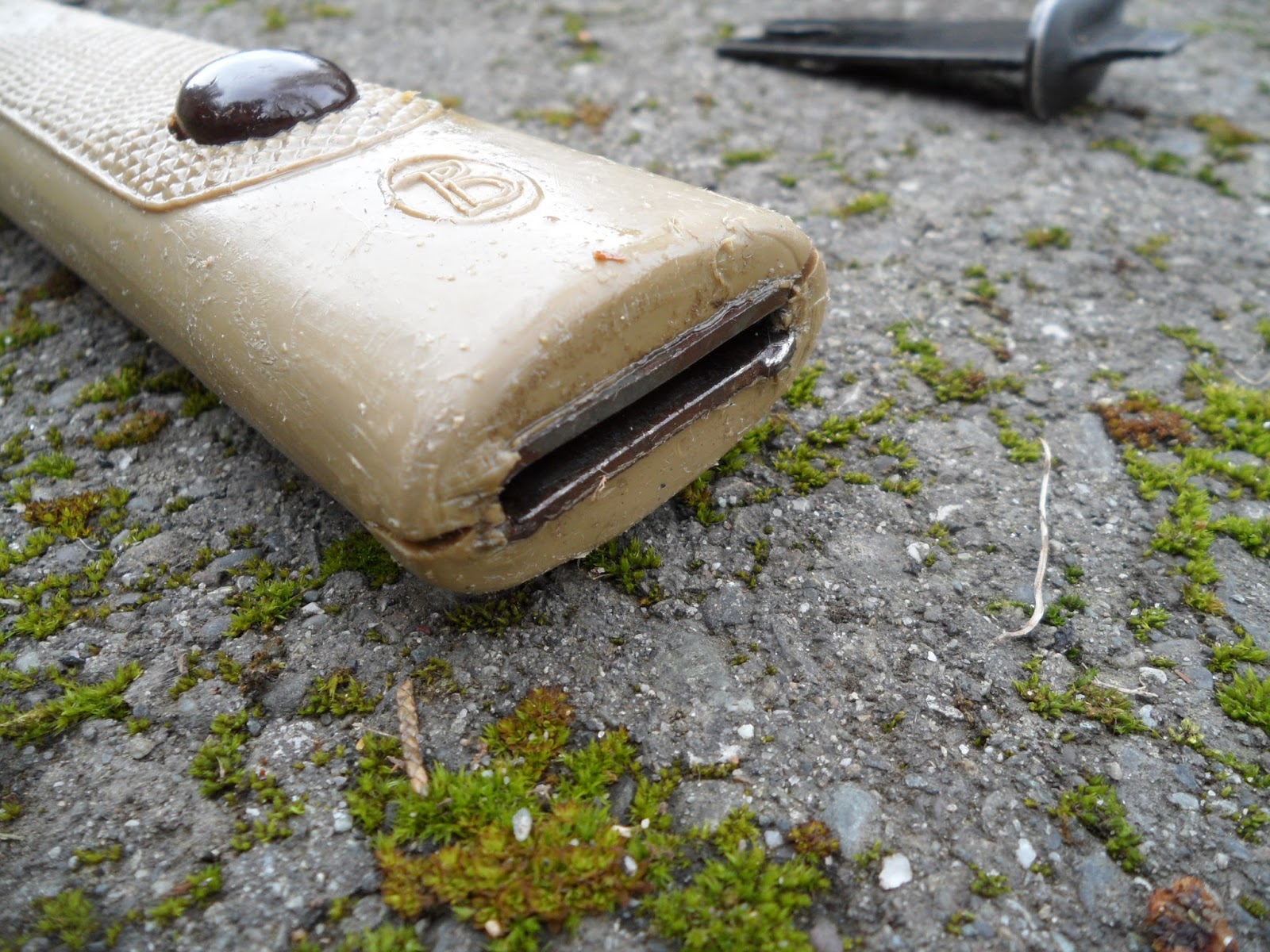
All of the parts nest very compactly in the leather case and can be assembled into different configurations: Axe, Saw, Hoe, or  Pick.  There is a small "screwdriver" plug that normally fills the slot in the handle when the saw blade is removed.  A spring loaded button and internal lug hold the "screw driver" and saw blade in place, when installed.

Measuring stick next to Axe for size scale.

All in all, this is an amazing piece of rescue gear that is built to last!  

NOTE: A good question about weight was asked by one of the blog viewers.  The total weight of the tool and attachments, with the leather case and strap,  is 5 pounds, 5 ounces.

Let's take a closer look at the photos:


Thursday, February 25, 2016

German K98k Mauser Ammo Pouch, WW2 Russian Capture, Wehrmacht - Russian Front

Today we'll be taking a look at a newer addition to the collection and a wonderful piece of WW2 and Cold War history.  It is a very nice, late war, WW2 German K98k Mauser, ammo pouch.


I spotted this pouch on eBay earlier this week and took a gamble on it.  The listing photos were poor and the seller listed it as a 1948 date stamped, vintage, post-war pouch.  I had a hunch that it was actually WW2 production and that the 1948 date was most likely 1943. Needless to say, I won the auction and got a great deal.
When the pouch arrived in the mail, I was more than happy to see that my gamble paid off.  


The pouch has clear stampings on the back side, with an RBN number and the date, "1943", clearly stamped under it.  The pebbled leather and the date stamp line up perfectly to give the illusion of an "8" instead of the stamped "3".   Definitely WW2 vintage German Army!


This is a classic "late war" pouch with riveted straps and pocket corners, with the short, riveted belt loops on the back.  All of the metal hardware has been brushed with black "tar paint".  The "tar paint" was applied by the Russians.  The pouch is a genuine "Russian Capture" pouch!


During WW2, the Russians gathered up all of the German Mausers and ammo pouches from the captured German soldiers and sent them to their armories for overhaul.  At the armories, they "de-nazified" the rifle markings (stamped out the swastikas) and prepped them for long term storage.  The ammo pouches had all of the metal rivets, and often the stitching, painted with he same "tar paint".  The rifles and pouches sat in warehouses until long after the war, waiting for a WW3 that never came.  Some time in the 1990's these Mauser Rifles and pouches were then cleared out and sold as surplus. 

Russian Capture Mausers at the end of WW2
This ammo pouch follows nicely along this story line:  Issued to a Wehrmacht soldier who was sent to the Russian Front, soldier captured by the Russians, pouch sent to the Russian armories, pouch in long term storage, surplussed, and then to eBay and then to my collection.  A very interesting history, unfortunately the known history only covers the high points.  I would love to have all of the "back story", details and circumstances of how the Russians actually picked up this pouch.  We will never know that part of the history, but at least an actual piece of the "Russian Front" is now going to be preserved.  It is also nice to be able to connect it to an actual time and location during the war.

A group of German POW's escorted by a Soviet soldier.

The overall condition of the pouch is quite nice. The condition and wear of the leather gives us a few clues about it's pre-capture useage.  The leather is nicely pebbled in the center areas, and nearly worn smooth on the edges.  The leather is also "softened, worn, and stretched" indicating that it saw extensive field use before capture.  It is a fire-tested veteran of the Russian Front.  


These pouches normally have a rawhide dividing strip inside each pouch pocket.  These strips keep the two stripper clips of ammo separated.  These strips are missing from this pouch.  You can see were the ends are still riveted in place, but the main strip has been cut away.  For some reason the Russians cut out all of these dividers when they were paced into long term storage.  This is another clear indicator that this pouch was captured by the Russians.


On the back of the pouch, we can see the "RBN" number.  These numbers were instituted in 1942 and were meant to replace the old "3 Letter Code" that was being used previously.  These numbers all follow the same format:  RBN  x / xxxx / xxxx.  They are always 9 digits long, in number groups of 1-4-4, each separated by back-slashes.  No one knows for certain what the numbers mean exactly, as the records were lost at the end of the war.  It is however, widely believed that the second set of numbers x / XXX / xxxx, is a city code, and the last set of numbers x / xxxx / XXX, is the manufacturers code.  There is normally a year date stamped under the RBN number.  You can see the "1943" stamped on this pouch.
The number on this pouch is:  RBN 0/0390/0069


This pouch is a wonderful new addition to the "Russian Front" part of my collection.  Now the hunt continues for a companion pouch!

Here is the photo album of this wonderful pouch: