Saturday, February 20, 2016

German Army Tire Pump, WW2 Wehrmacht, Heer, or Early Post War, for vehicles or bicycles

Well I'm back to "The Blog" after a break for the holidays and business...............  I have a backlog of good stuff to get posted, so stay tuned!


Today I'd like to show off an extremely rare, German Military tire pump.  I say rare, but that may actually be an understatement.  There are "tons" of the old truppenfahrrad, bicycle tire pumps floating around, but one type of pump that you may never find, is one of these "floor pumps" that can trace its roots back to the German Military.

I just happened to be browsing one of my favorite surplus sources for new and unique deals, and stumbled on these pumps.  They were being sold as "vintage, surplus German Army" pumps, at a price I could not pass up (not that I can ever pass up rare, authentic, military bicycle items!).  I took a chance and ordered one up.  After a couple of order glitches, the pump arrived.  It was more than I could have hoped it would be!


This pump is old.  I would date it as WW2 vintage, or early Post-War vintage.  There has been a lot of the "bottom of the bucket" and "back of the warehouse" surplus hitting the market lately, as Germany clears out the last of the old storage warehouses (the Old Stuff).  I think that this small batch of pumps fits into that category (the batch was so small that they sold out almost instantly with no more available).

First off, lets get a good look at this pump and then we'll take a look at why I think it may be WW2 vintage, or at least very early Post-War.

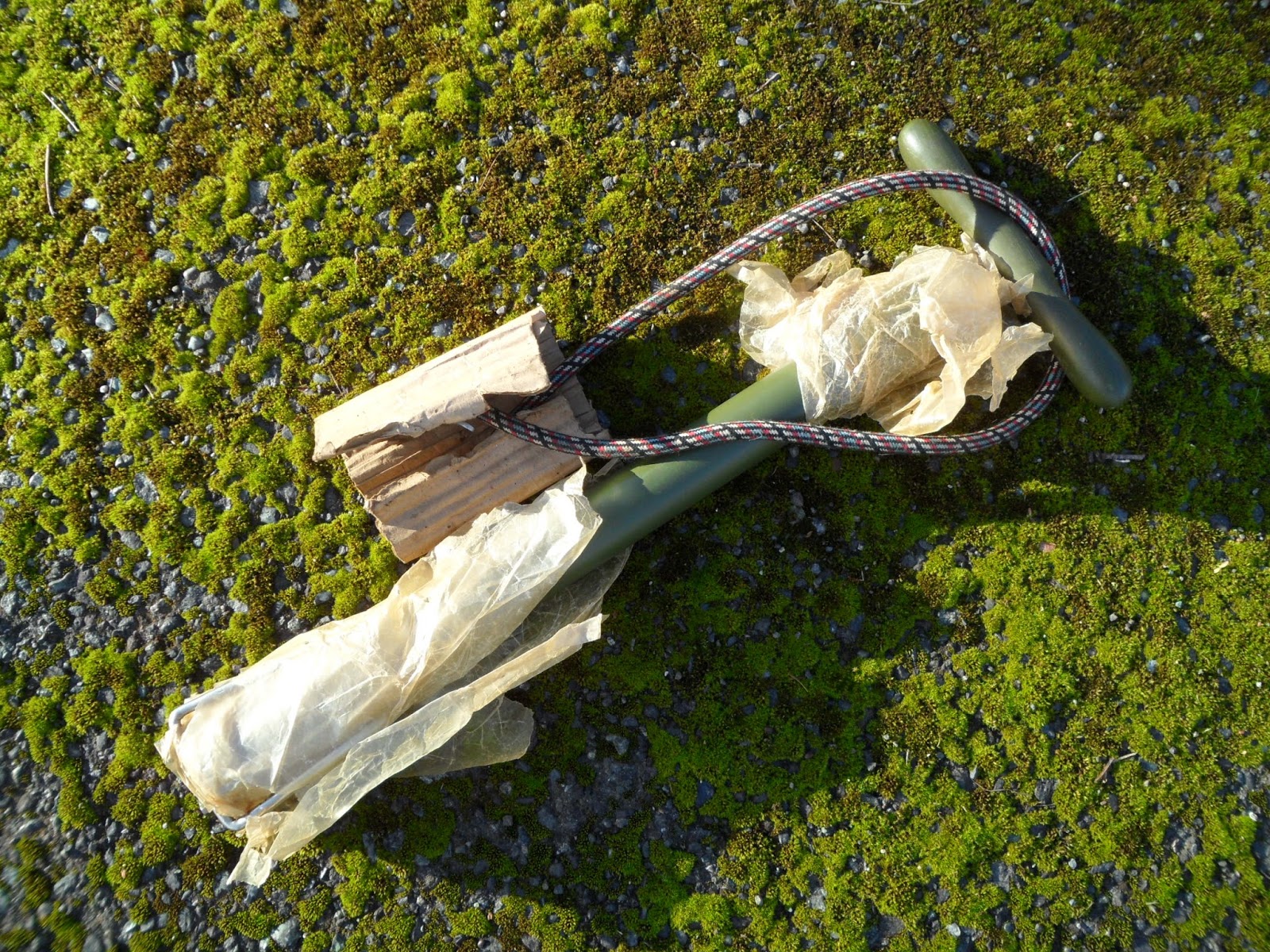
The pump is in new condition and does not appear to have ever been issued or used.  The paint is nearly perfect.  The wood handle shows no wear, no corrosion, no rust, etc. 

When it arrived, it was still wrapped in the old preservative paper with some very old cardboard around the fill nozzle.  This style of preservative paper is the old type,1950's and prior.

The hose is the old cloth covered rubber with a real leather gasket on the threads of the pump end.  The fill nozzle is the old style with the old pink rubber inside.  All of this puts it in the WW2 or 1950's time frame.


One of the best clues as to the age of this pump, is the makers decal on the pump tube.  On the tube of the pump, there is a diamond shaped decal with the brand name "SUDAG".  


A bit of research revealed that the SUDAG name and emblem was used by the German tool and manufacturing company, Suckow-Duisberg.  

Old 1927 paperwork from Suckow-Duisberg.

From what I can tell, Suckow-Duisberg was manufacturing in full force in the 1920's and through WW2.  After WW2, it seems to have disappeared with no further "hits" mentioning it in any of the records.  If this is in fact correct, then the pump dates to the WW2 era.  (Possibly the factory was destroyed and never rebuilt after the war?).

The decal itself also gives us an important clue as to age.  The decal has a metallic gold background.  This gold background has a very "grainy" surface and appearance.  The metallic printing on the old WW2 and pre-WW2 decals have this grainy appearance.  The post-war decals have smooth surfaced metallic printing.  Another strong indication the pump is from WW2 !

The cast metal base of the pump has the initials PWO cast into it. During the WW2 years, Germany started assigning random three letter codes to manufacturers to protect the locations of the German factories (so the Allies couldn't figure out who and where to bomb).  If these initials are the three letter, war-time code for the company, then this would indicate that the pump was manufactured during the war, or was assembled after the war from war-time parts.  There is not a complete list of all of the three letter codes used, as all of the records were lost or destroyed at the end of the war.  I have not been able to find PWO to confirm that it was the code name for Suckow-Duisberg.  If the PWO code is a war-time, three letter code for the SUDAG company, then it would make perfect sense that the two would be totally unrelated.


Another strong clue is the green paint.  The color seems to match the WW2 military paint color, RAL6003 "Olivgrün", used by the Wehrmacht on many of their vehicles.  It would make sense for the pump to be painted this color if it was intended to be carried in the tool kit of military vehicles.  The base of the pump has fold-up feet, and the wood hand is threaded with a metal insert to make it removable, which would also indicate that it was intended to be carried in a more compact form on a vehicle.

After WW2, Germany did not have an army until the Bundeswehr was created in November of 1955.  That is 10 years after the end of WW2.  In 1951, the Bundesgrenzschutz (Federal Border Police) was created, however they used a much, much darker green, (schwarzgrün), for their vehicles and equipment.  The early Bundeswehr, German Army, used an Olive Drab Green color, darker than the pump's green color.  More circumstantial evidence that the pump is actually WW2 issue.

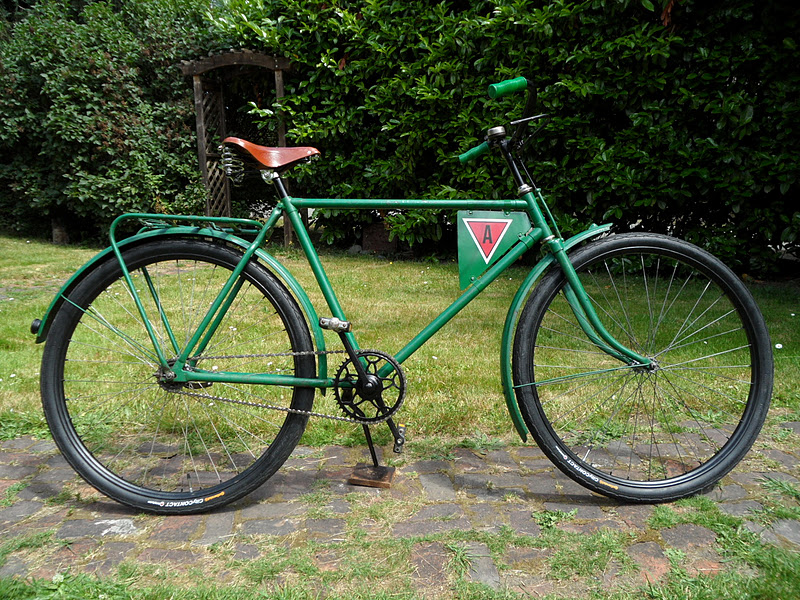
I may never know the true age of the pump, but I can say that it fits perfectly for WW2, or very early post-war production.  I will be adding the pump to the bicycle gear that I have collected for my old Bundesgrenzschutz Dienstfahrrad bicycle.  It's a perfect fit. 

http://sharky-fourbees.blogspot.com/2011/12/bundesgrenzschutz-truppenfahrrad.html 

Here are a few pages from a couple of old bicycle parts catalogs from the pre-war years.  You can see how this pump fits with the parts listed and illustrated.


Lets finish things up and take a look at the photo album of this amazing pump.


Friday, December 11, 2015

Landing Craft Tank Mk6( LCT 6 ) #1094, WW2 Photo of Lt. JG William B. Brashears, 1945 Philippines

On December 7th, we observed the 74 year anniversary of the the Japanese attack on Pearl Harbor that propelled the US into WW2.  As my tribute to the men and women, of all of our armed forces, who answered the call of duty after that fateful day, I would like to present a personal photo that reminds us that all history is personal.  There were real people, who experienced that "musty old history" first hand.  Many of them never lived to tell their stories, and many more came home after the war and "got on with the business of living".  We only have a small number of our WW2 veterans still with us and their stories of that great conflict are more important than ever.  When no one is left to tell the stories first hand, then we can only hope that some of them were documented in writing and photos.  It is one of those photos that I would like to present today.

I recently purchased a bundle of WW2 photos off of eBay.  None of them were related to each other, but each one had a story to tell.  Unfortunately, the stories have taken a bit of detective work to bring out.  I will never have much, or any, of the personal details of the people in the photos, but I have documented a bit of the circumstances and details that the photos are telling us.

The photo presented today, depicts the commanding officer of the WW2 ship , Landing Craft Tank #1094.
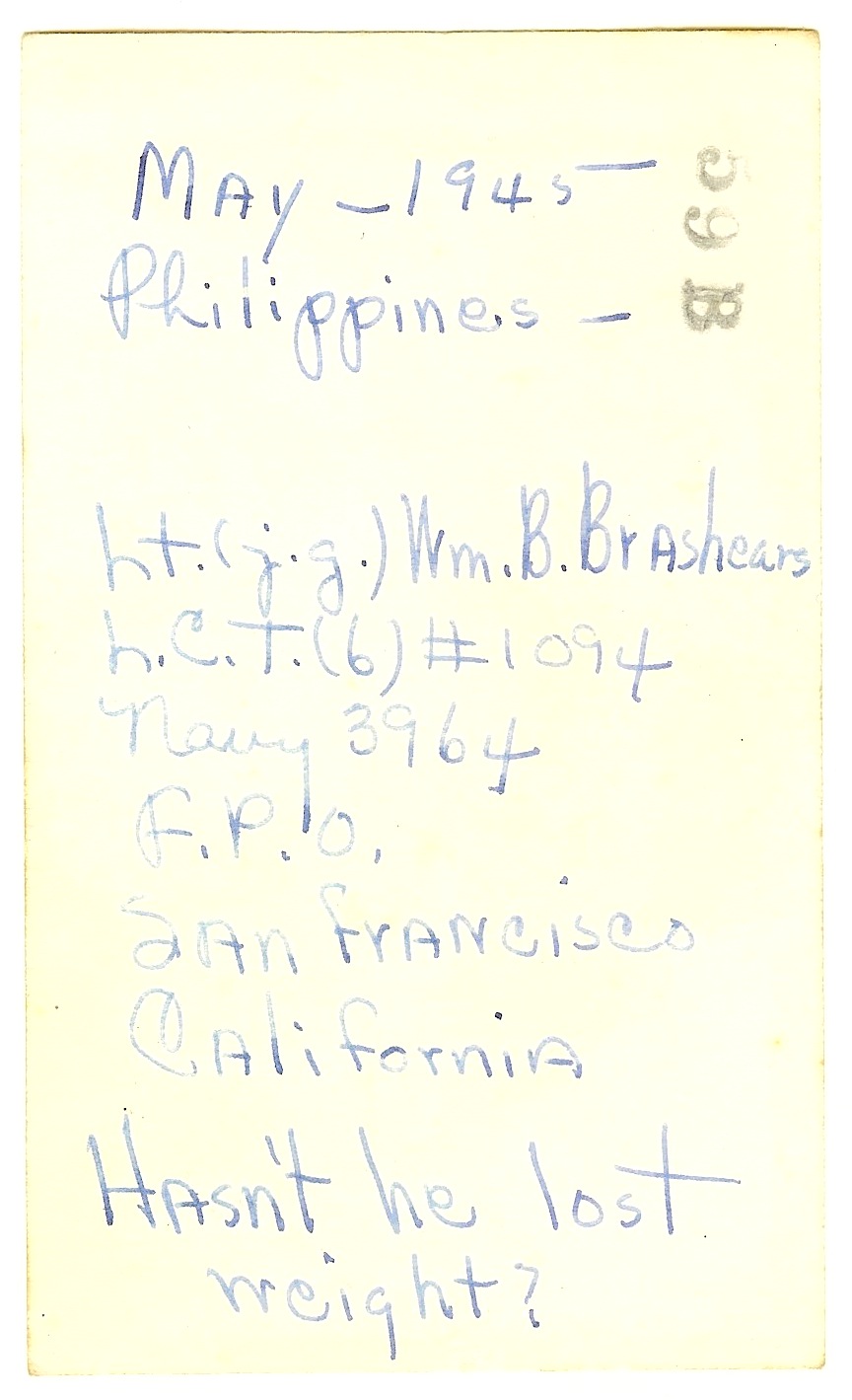
When I received this photo, I was thrilled to find that it had some amazing information noted on the back.  Notations like this are rare on these old photos.  When photos like this are marked, it gives a whole new picture to explore!  History really starts to come to life!


On the back of the photo, we find the following notations:

May-1945 
Philippenes
Lt.JG Wm B. Brashears
L.C.T.(6) #1094
Navy 3964
F.P.O.
San Francisco
Hasn't he lost
weight?


With the information noted, we can really start to fill in the background on this photo.  Here is what it tells us.

L.C.T. (6) #1094 tells us the ship is a Landing Craft Tank Mk6, with the hull ID number of 1094.  A little bit of research revealed that this particular ship was launched on May 24, 1944, and was delivered to the US Navy on June 29, 1944.  It was built by the Quincy Barge Builders of Quincy, Illinois.
The LCT 1094 is not listed as "Lost" on any of the WW2 ship records, so it is safe to say it survived the war.  I can find no record of the LCT 1094 specifically, regarding the locations it served, however all of the LCT ships in the 1080 and 1090 ranges seem to have been assigned duty in the South Pacific.  
We are very lucky to have this photo dated specifically, May 1945, with the location somewhere in  the Philippines.  Notations like this are rare on these old photos! 


We are also given the name and rank of the person in the photo:  Lt. JG Wm. B. Brashears.  On these Landing Craft, there would have only been one commissioned officer, and he would be the Officer in Charge, or Captain.  Since William Brashears is noted as a Lieutenant Junior Grade officer, we know we are looking at a photo of the ship's captain!
Based on the background features of the ship, and the location he is standing, we can deduce that he is standing on the open command bridge, on the starboard  side, of the ship.  There is a signal-light on the bridge and we can see the "M" signal flag flying.  This flag signals "My vessel is stopped and making no headway".  In other words, it is at anchor.

When we look closer at Lt.JG William Brashears, we can see some very interesting uniform and equipment details.  First off, he is dressed VERY casually and informally.  It appears that he is dressed for the South Pacific weather.  He is wearing what appear to be civilian leather, "penny loafer", slip-on shoes!  He is wearing the 1911 .45acp pistol in it's issue leather holster, on the web pistol belt.  He is wearing the ammo pouch on the front, with the belt latch on the far left side.......Definitely NOT regulation!
This is definitely a casual captain!

It is photos like this that really make the research fun and exciting.  When you can start with a small snapshot and end up with a "story", it makes the time invested more than worth it!  I hope you have enjoyed this little detective story, and the wonderful photo!

NOTE:  I have forwarded a copy of this photo to the folks at WW2 LCT Flotillas for their records and research.  WW2 LCT is a non-profit group dedicated to keeping the history of the the LCT's alive.  Check them out at this link:
http://ww2lct.org/

To end this longer than expected blog post, let's take a look at a few photos of LCT's in service during WW2.  They are "sister ships" to the LCT in my photo.


Sunday, December 6, 2015

German Field Hospital, Invasion of France WW2, Wehrmacht Phanomen Granit 25H Ambulance & Opel Kadett K38 Staff Car, Original Photo

Today we'll be continuing along with a another one of my original WW2 German military photos.

This photo was taken sometime during the Invasion of France in 1939.  It depicts a group of Wehrmacht medics having a big meal behind a French barn.  There are bits of black paper and some glue on the back of the photos where it was removed from the original veteran's album.  Unfortunately, we will never know the complete story behind this photo.

 Note:  Click on the photo and it will open its larger scanned size for better viewing.

The most interesting thing about this photo, is the amazing variety of unique and iconic, WW2 Wehrmacht items that are shown.  
First off are the vehicles.  In the background to the left, we can see a Phanomen Granit 25H field ambulance.  The ambulance has a red cross flag on a short mast.  These ambulances were first produced in 1931, and the Wehrmacht put them into service with the military in 1936.  They served the German military in Spain during the Spanish Civil War and then continued their service throughout WW2. 
On the right side of the photo, we can see an Opel Kadett K38 staff car with the sliding rag-top open.  The Opel is marked with a red cross on the door and has two bundles of firewood tied to the front bumper.  These Opel Kadett's were produced from 1937-1940 and again in 1942-1943.  

When we look close at the soldiers seated at the table, we can see that there are open mess tins all over the place, including on the ground beside the benches.  There are buckets placed around the table, and the soldiers appear to be eating something like chicken or corn (just my speculation, but the buckets could be for the bones or cobs).  The soldier nearest to us, on the left, is wearing the early style Model 1936 (M-36) trousers with suspenders.

All in all, this is an amazing snapshot of "daily life" for a Wehrmacht Field Hospital Company during the early Invasion of France days.  It is also a wonderful addition to my collection of photos depicting various items in my collection.

Here is a link to one of my previous posts showing off a WW2 German Luftschutz First Aid Pouch that my grandfather brought back home from his service in the US Army, in Germany during WW2.  It is not the same type of kit that the Wehrmacht medics would carry, but very similar.

 http://sharky-fourbees.blogspot.com/2011/04/luftschutz-sanitatstasche-air-raid.html

I also have a WW2 issue, Sturmabteilung Field Medic First Aid Pouch that I will be showing off later.  Stay tuned!


Friday, December 4, 2015

Reicharbeitdienst Soldat, RAD, German Labor Service Soldier, WW2 era Original Photo

Since we are still on the heels of our vintage military shovel and tool series, let's take a look at a vintage "shovel photo".  I have been on the lookout for good, original photos that show the various shovels in use.  When I saw this one for sale, I couldn't pass it up!.  It is an original, WW2 era photograph of a German Labor Service soldier.


This photograph is actually quite amazing when you look at it closely.  The photo shows a Labor Service soldier on guard duty, at the entrance to one of the German Labor Service camps.  
I say "soldier" even though the Labor Service troops did not carry weapons in the pre-WW2 and early WW2 years.  Even while they were working and doing labor for the Third Reich, they were training to be "future soldiers".  They drilled and marched with shovels instead of rifles.

You can read more about the German Labor Service (RAD) here:
https://en.wikipedia.org/wiki/Reichsarbeitsdienst 

The Reicharbeitdienst, or RAD, German Labor Service in English, was started by the Nazi Party in the 1930's as a way to indoctrinate and organize the labor workforce of Germany.  It was a way to combat the devastating effects of economic depression and unemployment that was plaguing Germany after WW1.  It is interesting to note that the US did nearly the same thing with the CCC, or Civilian Conservation Corps. The CCC even wore military type uniforms, like the RAD.

The RAD was also a "work around" method that the Nazi's used to train future soldiers while Germany was still banned from having a military force after WW1.  When Germany defied the Allies in the 1930's and started reactivating and rearming their military, the pre-trained RAD men were ready to trade their shovels for rifles.

The RAD built roads, maintained public infrastructure, helped build the Atlantic Wall defenses, and after the war began, supported the military with moving supplies and rebuilding infrastructure damaged and destroyed by combat.  At this time some of the RAD troops were actually armed.  In the final days of the Third Reich, many of the RAD troops were fully armed and thrown into the doomed defense of Berlin.

This particular photo was most likely taken in the pre-war years.  If you look closely at the photo, there are some very interesting details that will emerge.  The photo shows some amazing uniform details as well as construction details of the Guard Shack and barracks building.  In fact, if you removed the WW2 insignia, this trooper could very well be a post-war Bundesgrenzschutz trooper! (German Border Police, BGS).

All of the RAD photos that I have seen, show the troopers carrying the same square spade-type shovels with a T-handle.  It is interesting that they had RAD unique shovels and not the "standard issue" military ones.

Let's finish things up with a front and back view of this wonderful photograph:


Tuesday, December 1, 2015

Technishes Hilfswerk Bergungssäge, German THW Salvage Saw, circa 1950's to 1960's

Today we'll be taking a look at a vintage hand tool that I have in my THW collection.  This is a Salvage Saw that would have been part of a field kit for the Bundesanstalt Technishes Hilfswerk, known in English as the German Federal Agency For Technical Relief, or THW for short.  This is Germany's "do everything" civil defense organization.  https://en.wikipedia.org/wiki/Technisches_Hilfswerk


This saw dates to the 1950's or 1960's time period and saw service with one of the THW field units.  The saw was a very generous gift from a good friend of mine in Germany, who acquired it directly from a THW field unit as surplus stock.

THW Rescue Team, 1952

This saw would have originally have been issued with a wooden box containing extra blades of various types.  The saw handle is very unique.  It can be placed in various angled settings to allow it to be used in odd or extreme angles that are often encountered in rescue operations.


The handle is painted in the old "THW Tan" color that was used back in the 1950's and 1960's.  Since the 1990's, "THW Blue" is the standard color, for both equipment and uniforms.  

THW Unit in Berlin, 1960's

There is a stripe of THW Blue paint on the handle, which would indicate that it saw continued service into the 1990's or later.


Before we get to the photo album of this unique saw, I would like to present a vintage THW photo with some very interesting details.  If you click on the photo, you can enlarge it for more detailed inspection.  

THW Rescue Team and Truck, 1955

It is very interesting to note that the truck is equipped with two of the old WW2 style shovel types.  The long handled shovels are the standard WW2 style Pioneer Spades, and the smaller, square bladed spades, (mounted on the door), are the old, early WW2 Trench Spade style.  It would be very interesting to know if these were WW2 surplus or if they were post-war manufactured.  The rescue saw would have been found on trucks of this type.

Here is the photo album.  Enjoy!