Here is one of the most recent additions to the canteen and mess kit part of my collection. They are a pair of Czechoslovakian Vz.60 canteens, also known as the Model 1960 canteens.
Both of these canteens are officially the last model of Vz.60 canteen style that was issued from 1982 until some time in the early 1990's. In 1982, the specifications for the canteens were changed, doing away with an old cork cap and replacing it with a plastic cap-cork. The only difference between the first model 1960 and the second model 1960/82, is the cap. Other than that they are the same.
Even though both of my canteens are both the same model, there are differences. Each one has a slightly different leather harness. The difference being the rivets and the buckle type. I believe the harness with the roller buckle is from the earlier Model-1960 era, and the flat, plain buckle is from the later Model-1960/82 period. This is just a guess based on Czech leather gear and hardware that I have observed through the years.
The rough felt covers are held in place with a series of snaps, in the same manner as the old German canteens. Each cover is marked on the inside, along the top trim area. One canteen cover is marked with the date 1982 with some other illegible markings. The other cover has the Czech crossed swords acceptance stamp and other illegible markings. Unfortunately the markings are small and faint, and do not show up well in the photos. Here is a shot of the trim areas with the printing............in case your eyes are better than mine!
The covers on my canteens are grey, but they were sometimes issued in "Czech Brown" as well. It seems that both colors were interchangeable. The felt is very coarse and seems to have been made with a crazy assortment of recycled fiber.
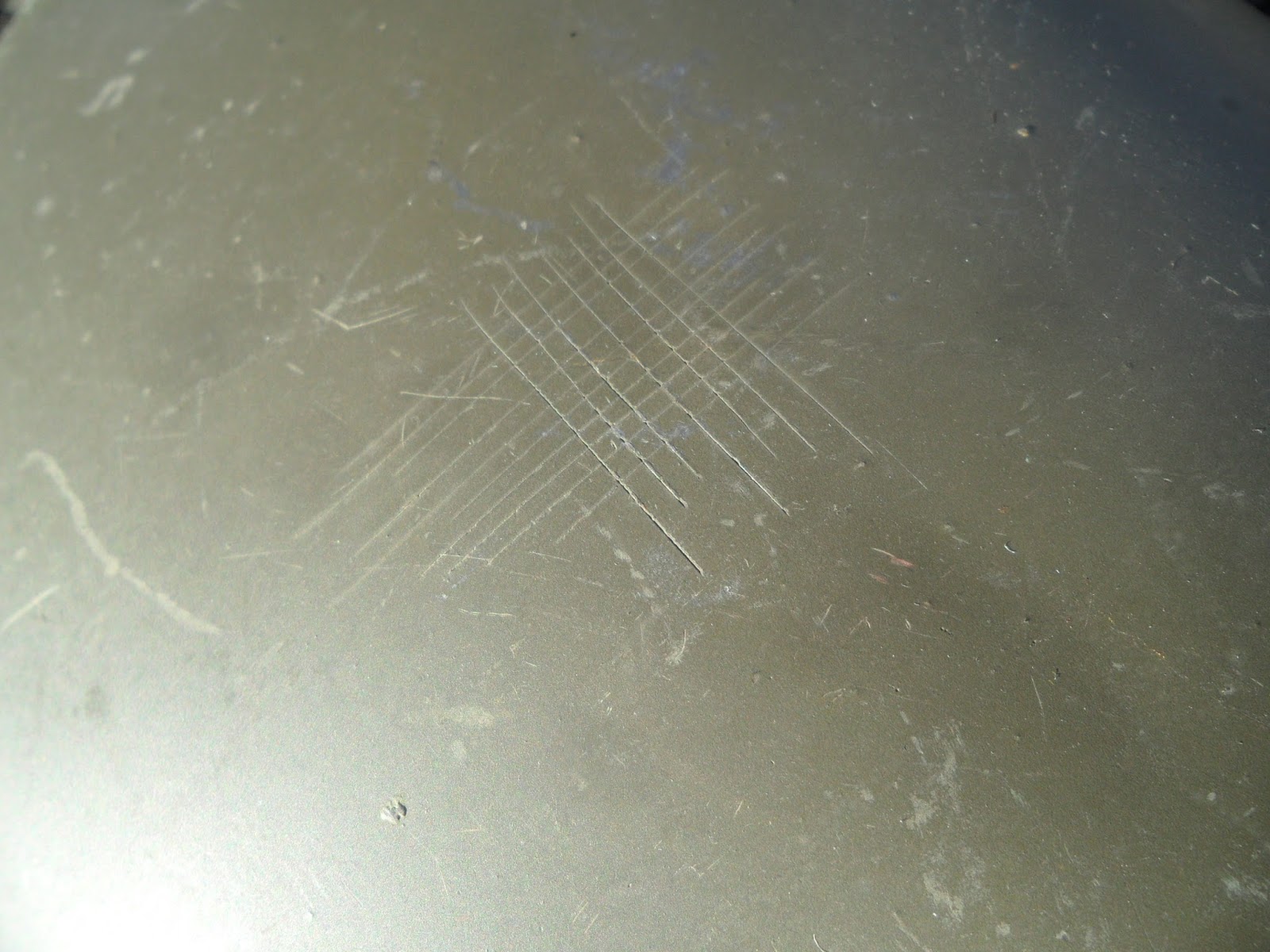
One of the canteens is stamped with the makers mark of FAX on the neck (double stamped actually). The other canteen has no makers stamp, but does have an odd cross hatching on both sides in the center of the canteen, front and back. I have no idea if this was originally applied at the factory or was scratched in later and then the canteen was repainted.
One canteen is painted in a gloss green and one in a flat green.
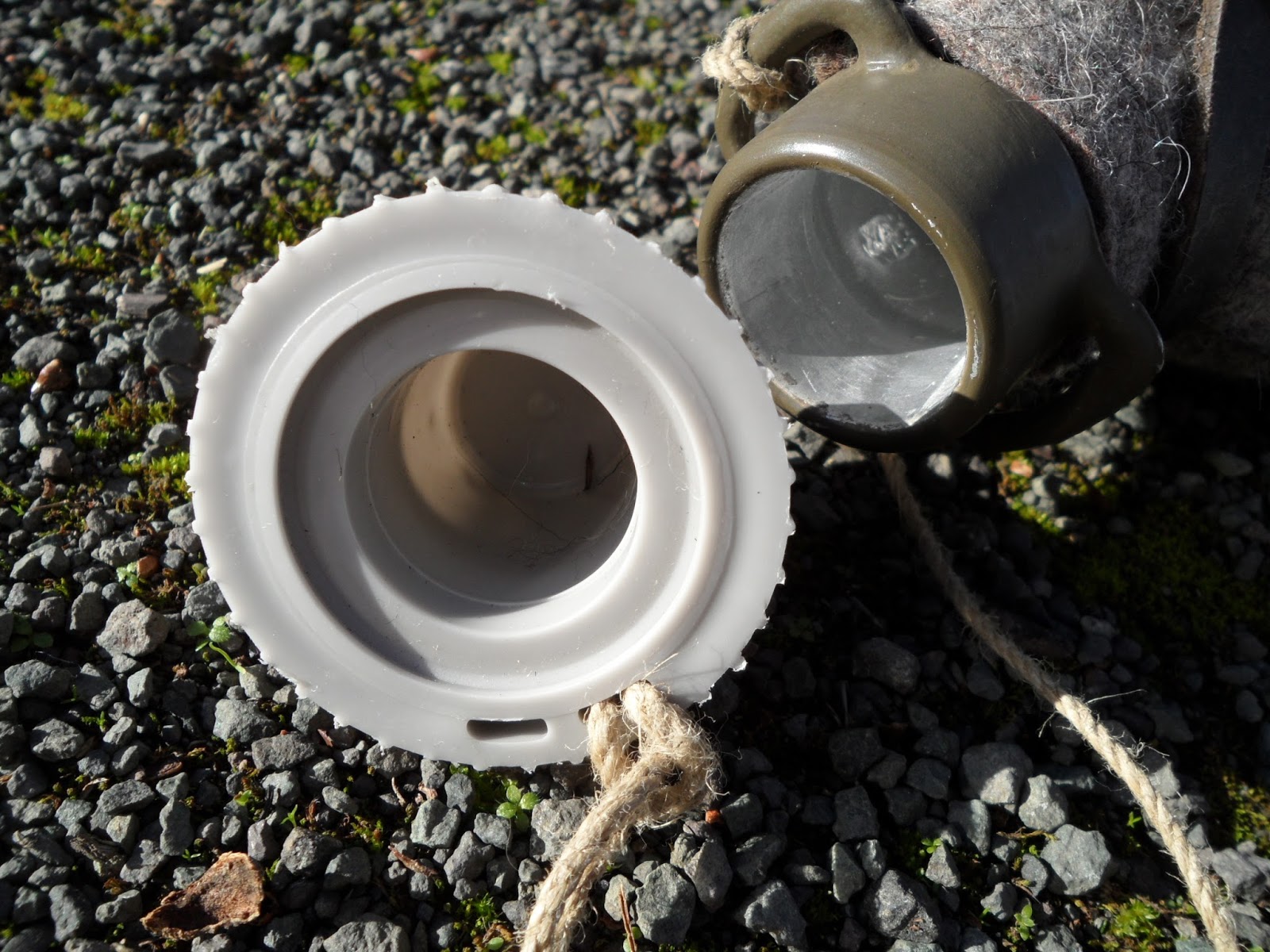
The plastic caps are slightly flexible and fit quite tightly when pressed into the neck. The caps have a recessed area in the top that I understand was used to store water purification tablets of some sort. The caps are secured to the canteen body with a length of "hemp" cord. It is interesting that Czechoslovakia continued to use a cork style cap long after the rest of the "military world" had moved on to screw caps.
The canteen was meant to be attached to the soldiers belt when carried, but they were more often carried in the pack or bread-bag. To attach the canteen to the belt, there is a "belt loop" area on the back strapping. Neither of my canteens show evidence of having ever been carried on a belt.
These canteens are definitely unique. Only Czechoslovakia used this style and configuration, however the actual body of the canteen is very similar to the WW2 German canteens. The leather harness system for carrying the canteen is unique only to Czechoslovakia. These canteens are out there on the surplus market right now, but I have a hunch they will disappear soon, seldom to be seen again. Grab one or two while you can!
Lets take a closer look at the these canteens:
Tuesday, November 24, 2015
Wednesday, November 18, 2015
Swedish Army Pick - Mattock, WW2 vintage, Made by Gränsfors Bruk, Pickaxe
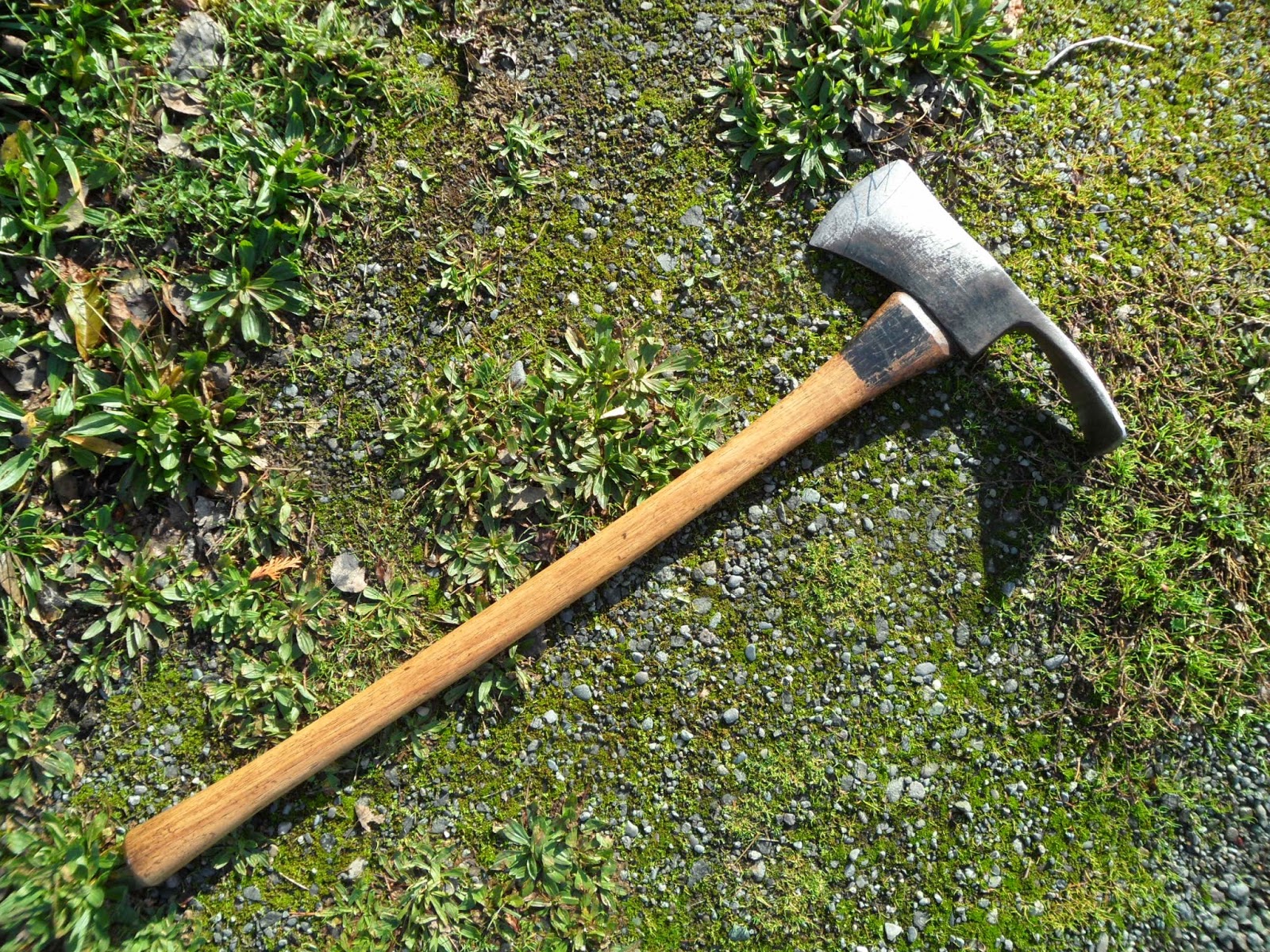
Today we'll be taking a look at a very seldom seen and seldom found, hand tool from the Swedish Army, and the latest addition to my ever growing collection of vintage military hand tools. It is a Swedish Army Pick-Mattock.
This pick dates to the WW2 era, and most likely was actually made during the war years. It is in new and unissued condition. I received the pick with the head separate from the handle, ready for it to be set and attached.
The wood handle is bare, dry, and rough finished. It is very well marked with the Swedish Army 3-Crowns stamping on the lower portion of the handle. The 3-Crown stamp was first used in 1942, so this pick is not older than that. You can read about the 3-Crown stamp in this blog posting:
http://sharky-fourbees.blogspot.com/2010/08/swedish-three-crowns.html
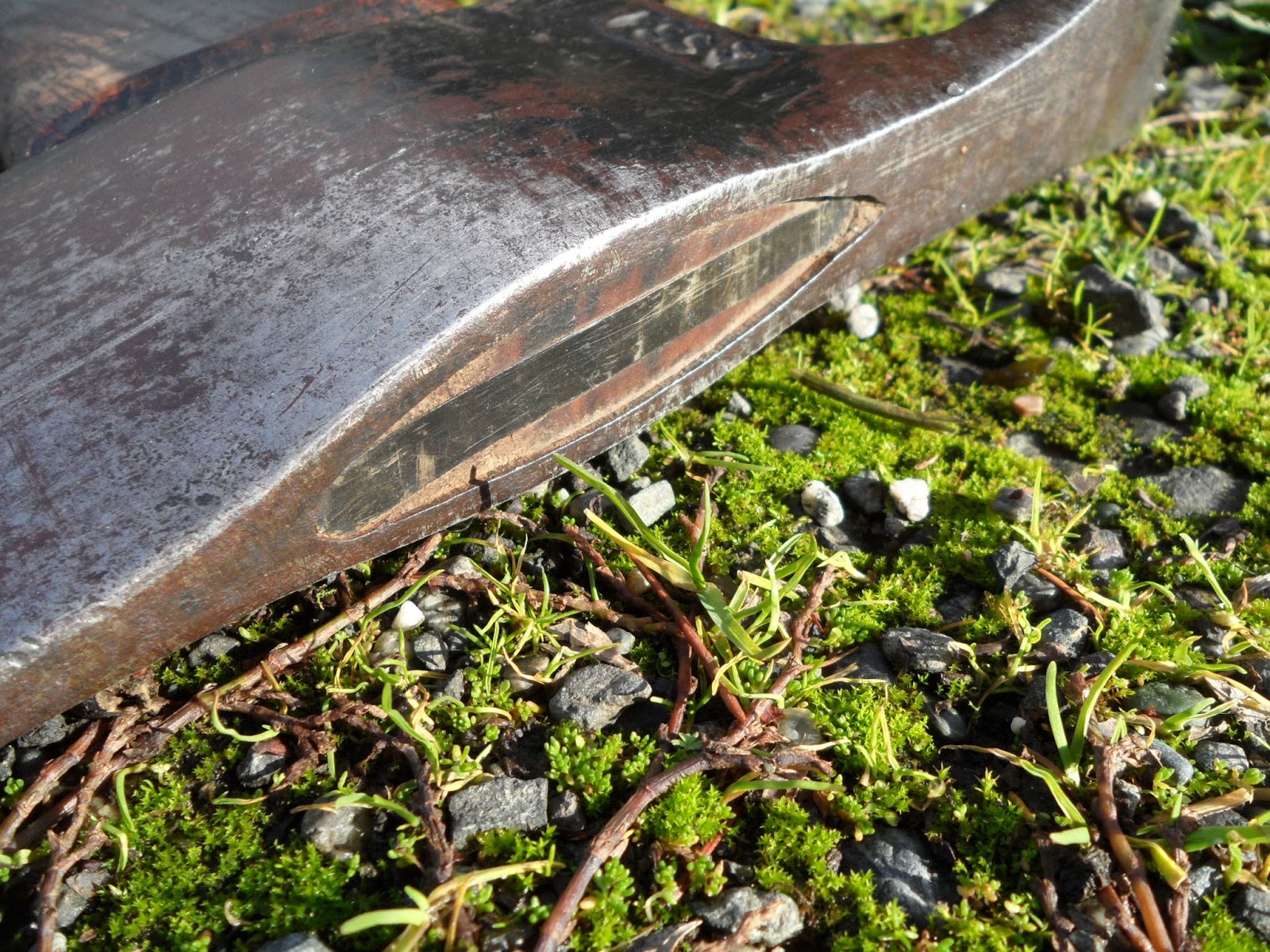
The metal pick head is hand forged and shows small defects and irregularities found in the old forged tools. It is stamped with the 3-Crown stamp and it also has a partial manufacturer's stamp. This manufacturer's stamp is from the famous Gränsfors Bruk company of Sweden!
http://www.gransforsbruk.com/en/home/the-history-of-the-company/
Here is a photo of the Gränsfors Bruk stamp on my new made, Mini-Hatchet, to compare with the partial stamp on the pick.
While researching and verifying the Gränsfors Bruk manufacturer's stamping on this pick, I had the opportunity to compare the stamping on a WW2 issued Swedish Army axe, made by Gränsfors Bruk, to my partial stamping. They matched. I also discovered that nearly all of the axes that were made for the Swedish Army were marked as made by either Hults Bruks or Gränsfors Bruk. It seems that these were the two companies that were supplying the Swedish military with field tools.
NOTE: You can check out a more recent blog posting about two of my new-made Gränsfors Bruk hatchets at this link:
http://sharky-fourbees.blogspot.com/2016/05/gransfors-bruk-wildlife-hatchet-and.html
I consider myself extremely lucky to have found one of these old picks in such amazing condition, not to mention one from the Gränsfors Bruk's company! Now let's take a look at the album for a closer look at some details.
This pick dates to the WW2 era, and most likely was actually made during the war years. It is in new and unissued condition. I received the pick with the head separate from the handle, ready for it to be set and attached.
The wood handle is bare, dry, and rough finished. It is very well marked with the Swedish Army 3-Crowns stamping on the lower portion of the handle. The 3-Crown stamp was first used in 1942, so this pick is not older than that. You can read about the 3-Crown stamp in this blog posting:
http://sharky-fourbees.blogspot.com/2010/08/swedish-three-crowns.html
The metal pick head is hand forged and shows small defects and irregularities found in the old forged tools. It is stamped with the 3-Crown stamp and it also has a partial manufacturer's stamp. This manufacturer's stamp is from the famous Gränsfors Bruk company of Sweden!
http://www.gransforsbruk.com/en/home/the-history-of-the-company/
Here is a photo of the Gränsfors Bruk stamp on my new made, Mini-Hatchet, to compare with the partial stamp on the pick.
While researching and verifying the Gränsfors Bruk manufacturer's stamping on this pick, I had the opportunity to compare the stamping on a WW2 issued Swedish Army axe, made by Gränsfors Bruk, to my partial stamping. They matched. I also discovered that nearly all of the axes that were made for the Swedish Army were marked as made by either Hults Bruks or Gränsfors Bruk. It seems that these were the two companies that were supplying the Swedish military with field tools.
NOTE: You can check out a more recent blog posting about two of my new-made Gränsfors Bruk hatchets at this link:
http://sharky-fourbees.blogspot.com/2016/05/gransfors-bruk-wildlife-hatchet-and.html
I consider myself extremely lucky to have found one of these old picks in such amazing condition, not to mention one from the Gränsfors Bruk's company! Now let's take a look at the album for a closer look at some details.
Tuesday, November 17, 2015
LLLL Membership Pin, Loyal Legion of Loggers and Lumberman, 1917, U.S Army Spruce Division, WW1
Today we'll be taking another slight detour from our hand tool theme. We will only slightly stray though......
This pin is a bit of unique history from the Pacific Northwest and WW1. It is a bronze membership pin from the Loyal Legion of Loggers and Lumberman, or LLLL, issued in 1917.
The LLLL was the U.S. Governments answer to the near constant lumber union strikes and horrible work condition in the logging camps of the Pacific Northwest during WW1.
In 1917, the US was ramping up production of aircraft for use over the battlefields of WW1 Europe. These planes were made of spruce wood. Nearly all of that spruce wood came from the Pacific Northwest of the United States. There was one big problem though. The supply of spruce wood could not keep up with the production rate of aircraft.
In 1917, the logging and timber industry was a miserable place for a man to work. The hours were basically sun-up to sunset, no days off, terrible food, atrocious living conditions in the logging camps, daily deaths and serious injuries in the field. Basically the "Timber Barons" were using the workers like disposable cogs in a money making machine. Not good times if you were a logger!
The main timber industry union of the day was the Industrial Workers of the World. This union and the workers in it were in a near constant state of strike in one area or another. The war was on and the U.S. Military could not have this kind of inefficient going-ons hampering spruce production.
The U. S. Army's solution was to form the Loyal Legion of Loggers and Lumberman. The Army organized a division of 25,000 soldiers and sent them to the Pacific Northwest and into the lumber camps to work alongside the civilian loggers.
All civilian loggers were asked to "join" the new LLLL and take a loyalty oath. If they did not, they were fired and could be arrested. On the surface this sounds like big government doing a bit of "union busting", but the reality is that it really improved things for the workers in the timber industry and set new industry standards going forward.
The 8 hour wok day was instituted, sanitary living conditions in the logging camps were enforced, safety practices were instituted to prevent daily deaths and injuries. In short, it worked. Spruce production skyrocketed and the timber industry was meeting the Army's quota! The soldiers in the Spruce Division even benefited. The soldiers didn't have to fight in the trenches of France and they were paid their regular, low Army salary with additional money paid by the timber companies to bring their wages up to the same level as the civilian loggers. It was a great deal for everyone (except maybe the timber barons).
After the war was over, the U.S. Army Spruce Division was disbanded, but the LLLL continued on until 1938 as the worker's advocate and "union".
The LLLL pin that I have is one of the original pins that would have been given to the new worker who had just swore his oath and "joined".
The pin was made by the Whitehead and Hoag Company of Newark, New Jersey, and issued by the U.S. Army's, LLLL.
Let's take a closer look at this beautiful and amazing bit of WW1 history:
This pin is a bit of unique history from the Pacific Northwest and WW1. It is a bronze membership pin from the Loyal Legion of Loggers and Lumberman, or LLLL, issued in 1917.
The LLLL was the U.S. Governments answer to the near constant lumber union strikes and horrible work condition in the logging camps of the Pacific Northwest during WW1.
In 1917, the US was ramping up production of aircraft for use over the battlefields of WW1 Europe. These planes were made of spruce wood. Nearly all of that spruce wood came from the Pacific Northwest of the United States. There was one big problem though. The supply of spruce wood could not keep up with the production rate of aircraft.
In 1917, the logging and timber industry was a miserable place for a man to work. The hours were basically sun-up to sunset, no days off, terrible food, atrocious living conditions in the logging camps, daily deaths and serious injuries in the field. Basically the "Timber Barons" were using the workers like disposable cogs in a money making machine. Not good times if you were a logger!
The main timber industry union of the day was the Industrial Workers of the World. This union and the workers in it were in a near constant state of strike in one area or another. The war was on and the U.S. Military could not have this kind of inefficient going-ons hampering spruce production.
The U. S. Army's solution was to form the Loyal Legion of Loggers and Lumberman. The Army organized a division of 25,000 soldiers and sent them to the Pacific Northwest and into the lumber camps to work alongside the civilian loggers.
![]() |
| US Army Spruce Division soldiers and Loggers at work together. |
All civilian loggers were asked to "join" the new LLLL and take a loyalty oath. If they did not, they were fired and could be arrested. On the surface this sounds like big government doing a bit of "union busting", but the reality is that it really improved things for the workers in the timber industry and set new industry standards going forward.
The 8 hour wok day was instituted, sanitary living conditions in the logging camps were enforced, safety practices were instituted to prevent daily deaths and injuries. In short, it worked. Spruce production skyrocketed and the timber industry was meeting the Army's quota! The soldiers in the Spruce Division even benefited. The soldiers didn't have to fight in the trenches of France and they were paid their regular, low Army salary with additional money paid by the timber companies to bring their wages up to the same level as the civilian loggers. It was a great deal for everyone (except maybe the timber barons).
After the war was over, the U.S. Army Spruce Division was disbanded, but the LLLL continued on until 1938 as the worker's advocate and "union".
The LLLL pin that I have is one of the original pins that would have been given to the new worker who had just swore his oath and "joined".
The pin was made by the Whitehead and Hoag Company of Newark, New Jersey, and issued by the U.S. Army's, LLLL.
Let's take a closer look at this beautiful and amazing bit of WW1 history:
Sunday, November 15, 2015
U.S. Forest Service Pulaski, FSS, Woodings Verona Took Works, circa 1980's-1997
Here is another interesting field tool that I've had banging around the bunker for a few years. It is a U.S Forest Service, Pulaski, Firefighting tool.
I picked this particular Pulaski up at a local yard sale a few years ago and just recently got around to cleaning it up. I didn't do much to it other than clean up the wood handle and give it a good coat of oil and clean some old mud off of the head.
You can check out another one of my fire service Pulaski's here:
http://sharky-fourbees.blogspot.com/2018/05/true-temper-flint-edge-kelly-works.html
These Pulaski tools were originally designed by Ed Pulaski, an Assistant Ranger with the U.S. Forest Service, back in 1911. After a near tragic firefighting accident in Idaho, in 1910, where 45 firefighters almost perished, Ed Pulaski realized that there was the need for newer and better designed firefighting tools and equipment. The Pulaski Tool was his design. The Pulaski began to be put into service in 1913. In 1920, the U.S. Forest Service began contracting to have the tool commercially produced. By the 1930's, the Pulaski became a nationally issued firefighting tool. It is still produced and used widely for wildland firefighting, on the national and regional levels.
The Pulaski that I have is marked FSS, which stands for the Federal Supply Service. The FSS is the U.S. Government's supply agency, and the source for the U.S. Forest Service's equipment and specifications.
Next to the FSS stamp is the trademark stamp for the Woodings Verona Tool Works.
This is the company that manufactured this particular tool. Woodings Verona Tool Works was bought out in 1997 and ceased production of tools at that time. The Pulaski I have dates from some time in the 1980's time period, up to 1997.
According to the FSS specifications, the handle is to be made of hickory, the head painted black that extends a short distance onto the wood, the FFS and manufacturer's logo are to be imprinted no more that 1/4 inch high, and the head wedged onto the wooden handle with a polymer wedge. This Pulaski definitely meets those spec's!
These FSS Pulaski's were (and are) used by many other U.S. Federal departments than just the U.S. Forest Service. These tools can often be found on vehicles used by the Bureau of Land Management, Border Patrol, Department of the Interior, National Park Service, and any number of other State and Federal Departments.
This Pulaski Tool is a wonderful addition to my vintage military and firefighting tool collection.
I picked this particular Pulaski up at a local yard sale a few years ago and just recently got around to cleaning it up. I didn't do much to it other than clean up the wood handle and give it a good coat of oil and clean some old mud off of the head.
You can check out another one of my fire service Pulaski's here:
http://sharky-fourbees.blogspot.com/2018/05/true-temper-flint-edge-kelly-works.html
These Pulaski tools were originally designed by Ed Pulaski, an Assistant Ranger with the U.S. Forest Service, back in 1911. After a near tragic firefighting accident in Idaho, in 1910, where 45 firefighters almost perished, Ed Pulaski realized that there was the need for newer and better designed firefighting tools and equipment. The Pulaski Tool was his design. The Pulaski began to be put into service in 1913. In 1920, the U.S. Forest Service began contracting to have the tool commercially produced. By the 1930's, the Pulaski became a nationally issued firefighting tool. It is still produced and used widely for wildland firefighting, on the national and regional levels.
The Pulaski that I have is marked FSS, which stands for the Federal Supply Service. The FSS is the U.S. Government's supply agency, and the source for the U.S. Forest Service's equipment and specifications.
Next to the FSS stamp is the trademark stamp for the Woodings Verona Tool Works.
This is the company that manufactured this particular tool. Woodings Verona Tool Works was bought out in 1997 and ceased production of tools at that time. The Pulaski I have dates from some time in the 1980's time period, up to 1997.
According to the FSS specifications, the handle is to be made of hickory, the head painted black that extends a short distance onto the wood, the FFS and manufacturer's logo are to be imprinted no more that 1/4 inch high, and the head wedged onto the wooden handle with a polymer wedge. This Pulaski definitely meets those spec's!
These FSS Pulaski's were (and are) used by many other U.S. Federal departments than just the U.S. Forest Service. These tools can often be found on vehicles used by the Bureau of Land Management, Border Patrol, Department of the Interior, National Park Service, and any number of other State and Federal Departments.
This Pulaski Tool is a wonderful addition to my vintage military and firefighting tool collection.
Subscribe to:
Posts (Atom)