Tuesday, November 10, 2015

Swiss Army Alpine Snow Shovel, 1939

Today we'll be taking a bit of a backwards trip to show off a shovel I picked up several years ago, but never got around to documenting.


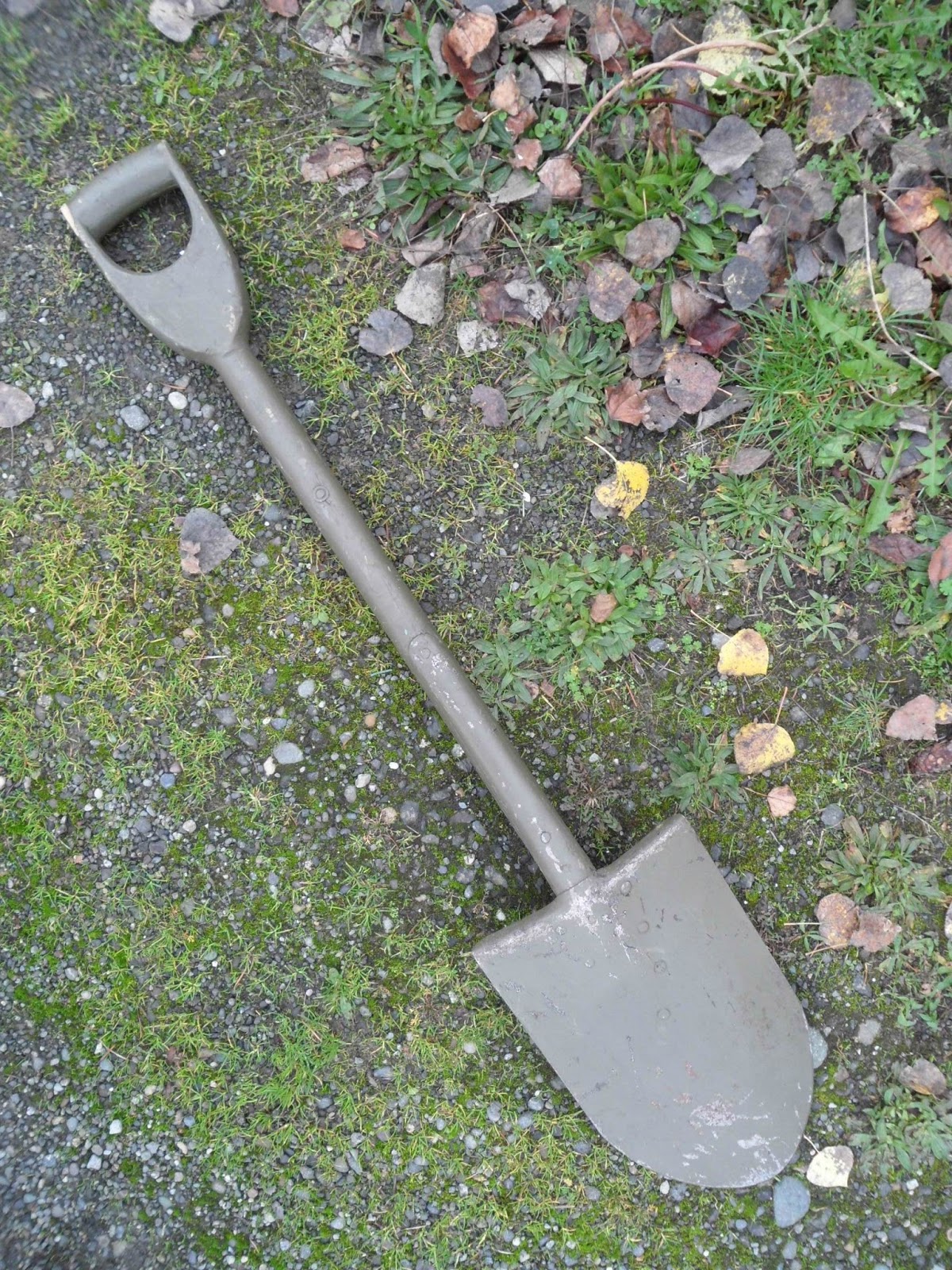
This shovel is a near mint condition, Swiss Army Alpine Snow Shovel.  It was a generous gift from my daughter.


These shovels were used by the Swiss Army Alpine troops that were stationed in the Swiss Alps during WW2.  This shovel has the manufacture date of 1939, the Swiss Military acceptance "cross" stamp, and the manufacturer's marking of "ASS".  
It is interesting to note that all of these alpine shovels that I have seen, all have the manufacture date of 1939, with the same manufacturer indicated as "ASS".  The Swiss Army must have made a large, one-time purchase, of these alpine shovels back in 1939.  Nearly all of them that have found their way onto the surplus market are also in the same, near mint condition.


These shovels have a removable wooden handle, but they seem to have been carried in a fully assembled configuration from what I can tell from old Swiss documentation and photos.


There is a knurled ring that slides down the shank of the shovel, that releases the clamping pressure on the wooden handle, allowing it to be easily removed.  There is a stamped-in bump inside the shank that aids in retaining the wooden handle when it is installed with the ring slid up until it is tight.


The metal shovel blade is made of aluminum that appears to have some sort of high gloss coating or paint on it.

These shovels are quite light and very well made.  If it wasn't for the 1939 date on it, you would swear that it was a very high-end, high-tech, modern alpine shovel!

Enjoy the photos:


Monday, November 9, 2015

Swedish Trench Shovel, Model 1906 -12, I.18, 18th Infantry Regiment, Västmanland Regemente circa 1912 - WW2

On my last posting I reviewed my recently acquired, Model 1906 Swedish Pioneer Shovel.  Today we'll be reviewing its smaller companion, the Model 1906-12 Trench Shovel.


I picked up this beautiful trench shovel off of eBay a couple of months ago for an insanely low price, It was mis-listed and incorrectly described.  I spotted it and won the bid.  One of the most amazing things about it, besides its near mint condition, is the fact that it is marked with the original Swedish Army regiment that used it!

It is marked on the wooden handle portion with I.18, which indicates that it was issued to the 18th Swedish Infantry Regiment, better known as the Västmanland Regemente.
The Västmanland Regemente was designated I.18 from 1628 until 1927.  In 1928 it was renumbered as I.27, or the 27th Infantry Regiment.  Since this shovel dates to the I.18 period (1906-1927), it is safe to say that it continued service after the regiment was renumbered I.27 in 1928.


What really got me excited about this regimental marking is that it means that it would have been used by the same regiment as my restored Swedish Mauser Carbine!  You can read about that rifle here:

http://sharky-fourbees.blogspot.com/2010/08/model-1894-swedish-mauser-carbine.html

This trench shovel still has its original finish of natural wood and black painted metal.  Most of these old shovels were repainted around the WW2 era in Olive Drab Paint.  Luckily this one missed the paint brush treatment!

In 1912, the Swedish military punched a hole in the blade of the shovels so they could be carried on a belt snap-hook.  There was a hook version that was on a belt loop and one that was incorporated into the multi-pocketed ammo belt.  This gave these shovels the new designation of Model 1906-12.  Prior to that time, they were carried strapped to the side of the field packs.


The wooden handle production shovels continued until WW2 when they were transitioned over to the metal yoked handles.

There are quite a number of these shovels, as well as the metal yoke handle versions, that are presently on the surplus market that have recently been surplussed from Finland.  From what I can tell, Sweden supplied the shovels to Finland for use in the Winter and Continuation War during the WW2 years.  Nearly all of the Finish issue shovels are stamped with an SA on the blade, but not all.  The fact that my shovel is stamped with I.18, and there is no SA stamp, would indicate that it was in Swedish service.

This shovel makes a fantastic pairing with my Model 1906 Pioneer Shovel that I showed in the last posting. You can see it here:

http://sharky-fourbees.blogspot.com/2015/11/swedish-pioneer-shovel-pre-ww2-circa-ww1.html

And now, here is the much awaited photo album.  Enjoy!


Sunday, November 8, 2015

Swedish Pioneer Shovel, Pre-WW2, circa WW1 Model 1906

Today we'll be getting back to our shovels.............
I recently had the opportunity to purchase a vintage Swedish Pioneer Shovel from one of my favorite surplus sources.   As usual, it was "luck of the draw" as to what exactly I would receive.  As luck would have it, I scored another major "shovel victory"!  


When I opened the shipping box, I was thrilled to see that the shovel I received was not the more recent and common version with the metal handle yoke.  I received the old version that pre-dates WW2 !  In all likelihood, this all wood handle version of the Swedish Pioneer Shovel was made in the pre-WW1 era, and definitely before WW2.  (The shovels that were originally advertised from the company were the more common, metal handle yoke type, like the Danish Pioneer Shovels I reviewed in a previous post.)

In fact, here is a comparison of the Swedish Pioneer Shovel to my Swedish Field Spade, Model 1906 -12 that I will be reviewing in my next post.  
http://sharky-fourbees.blogspot.com/2015/11/swedish-trench-shovel-model-1906-12-i18.html 

You can definitely see the distinct similarities between the two.  On close inspection, the original black paint finish on the Pioneer Shovel shows in the area of the "scrapes", where the Olive Drab Paint has been removed.  To get an idea about how this Pioneer Shovel appeared when it was first issued, you can just picture it finished in the same manner as the smaller spade.


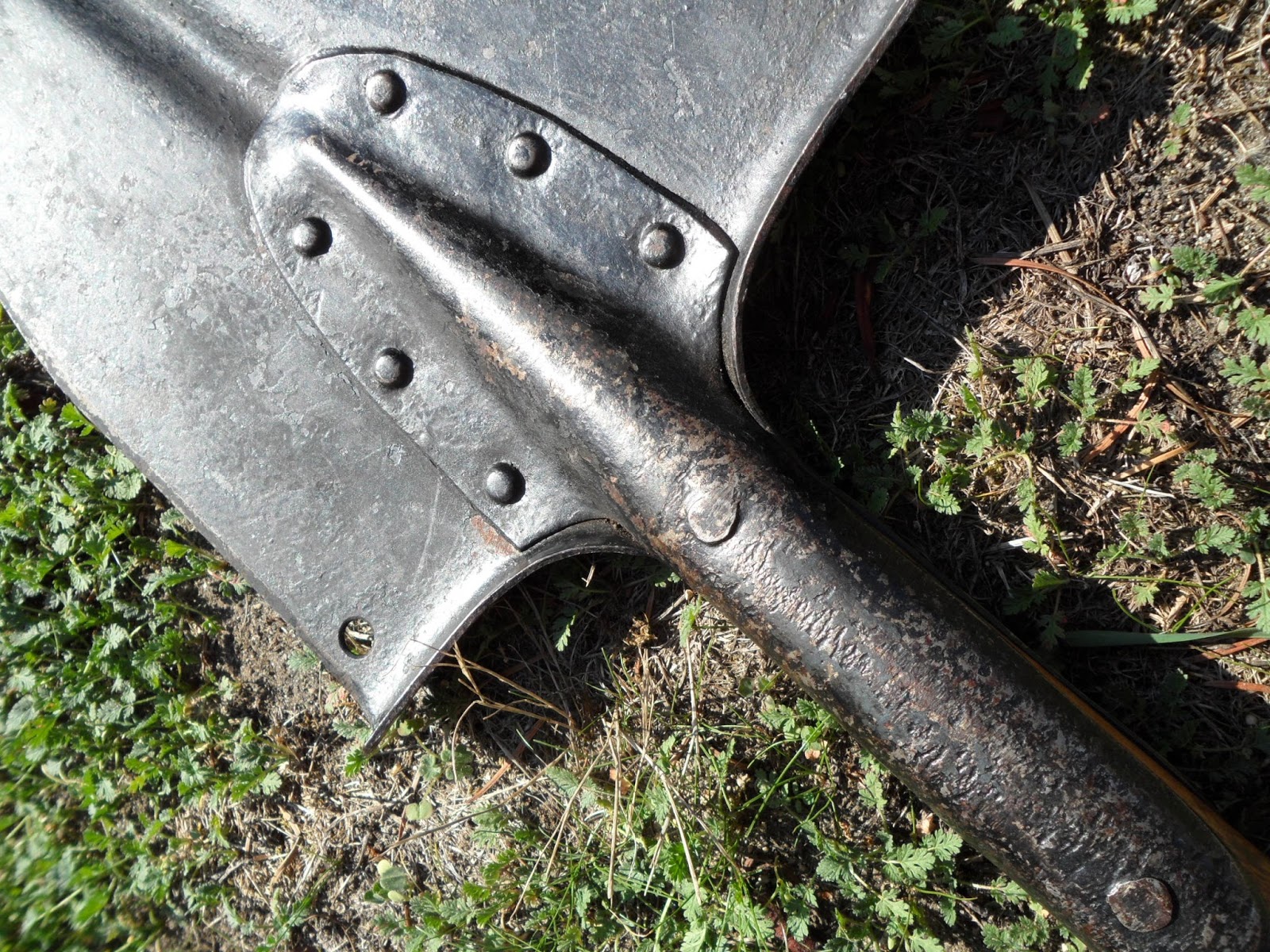
These pioneer shovels are built heavy and made to last.  The heavy blade is riveted to the shank and the wood shank is massively reinforced with long metal extensions on the front and back.


The handle is the old style, all one piece, wood type.  There is a reinforcing rod that goes through the grip portion and is peened in place.  There is a small piece of wood that has been split off, most likely when these shovels were "tossed" into the surplus bin.


The blades on these Swedish Pioneer Shovels are the longest I have ever seen!  The Swedes always had their own idea about design, and it is apparent in these shovels!


Originally this shovel would have been left in the natural oiled wood finish.  Around WW2, the Swedish Army began painting their shovels in the typical Olive Drab Green.  This shovel may have been painted during that time period, or it may have been painted just before it was placed into more recent reserve storage.  There are some "permanent ink marker" numbers written on the blade which would tend to back up this last speculation.

With all of that said, let's take a closer look at this unique and rare shovel.


And to finish things up, here is a photo of a 1951 Swedish Army truck.  This shovel would most likely have been carried on these vehicles.
1951 Volvo TLV 141 Swedish Army Military Truck

Friday, November 6, 2015

Texas Highway Department Workman Badge, Division 4, circa 1920's - 1930's

Today we'll be taking a little break from the long line of shovels and spades (don't worry, more shovels to come!).  In keeping with the "digging tool" theme of things, I have an interesting bit of Texas history to show off.


This extremely rare and unique badge was made and issued by the Texas Highway Department, back in the 1920's.  It is a Workman's badge that would have been worn by a "rank and file" Highway Department employee, most likely a road construction worker.

Before the 1920's, Texas highways were basically non-existent.  Most of the state roads were dirt and driving across the state was nearly impossible to do in one trip.  The US Government established the "Federal Aid Road Act" in 1916 to provide funding to the US states so that a formal and reliable highway system could be constructed.  Texas founded the Texas Highway Department in 1917 to take advantage of these funds. Real road construction did not begin until the 1920's and continued at a "break-neck" pace through the 1930's.  This is the era this workman's badge dates to.

The badge is round, which was an extremely common shape at the time for public employee type badges.  It interesting to note that Texas officially kicked off the "modern law enforcement era" during this same time and adopted round badges for the Texas Rangers and Highway Patrol as well.  

This badge has the old style pin pack that is attached with a silver soldered flat plate.  The pin is worn flat on the high spots, indicating that it had been worn for many years, most likely an entire career.
The main badge is made of heavy brass and then nickel plated.  The employee badge number and Highway Department Division  has been hand stamped after the badge was formed.  This would indicate that individual numbered badges were issued to each employee in all of the highway divisions.  The nickel plating has worn off on the high spots of the badge face, again indicating very long and hard use.  You can see "Division 4" on the official Texas Highway Department map below, published in 1918.


There seems to be very few original photos that were taken of the highway work or department employees during this "roaring 20's construction boom", but there are a few.  Here are a couple of historic shots that were taken in the 1920's and 1930's, back when Texas was still a "wild west" state for all intents and purposes!


To finish things off, lets take a closer look at this amazing and very unique badge.