Today I'll be showing off a pair of early 1970's vintage Swiss combat jackets with packs that I recently picked up. These jackets are the ultimate camo combat jackets........ TONS of pockets, integrated pack system, heavy weight, sniper veil, in short, an amazing bit of military field clothing from the cold war era.
UPDATE NOTE 12-01-15: I received some additional information about these wonderful Swiss combat outfits in a reader's comments below. I am reprinting it here so that the details are not missed:
"I realize this is an older post but being Swiss I'll be glad to clear a few things up ;)
Firstly, although in 1983 the army changed to the M83 (TAZ 83 as we call it in Switzerland) uniform sets, the RS (recruit school) continued to,use TAZ 70 jackets up until 1993 (RS is where all men aged 18-27 do their compulsory 21 weeks service, they are usually Ives the old gear)
Now I have a photo of my father doing his service in 1982 (unfortunately I don't seem to be able to post the photo) and along with the m70 jacket he also wears the ww2 service belt which they made until the mid-70s. Although most things could fit in the pocket the only reasons the service belt was worn was to keep the jacket closer to your body as well as to carry the STGW 57 bayonet with its leather frog as can be seen in my fathers photo. The service cap by the way up until 1983 when they began using the Swiss camo (Alpentarn) cap was actually the ww2 M43 wool field caps which are very similar in design to German ww2 mid was service caps"
Here is a couple of shots of the jacket and the attached pack. We'll take a closer look at the various details a bit further on in the posting.


 |
| With pack attached. |
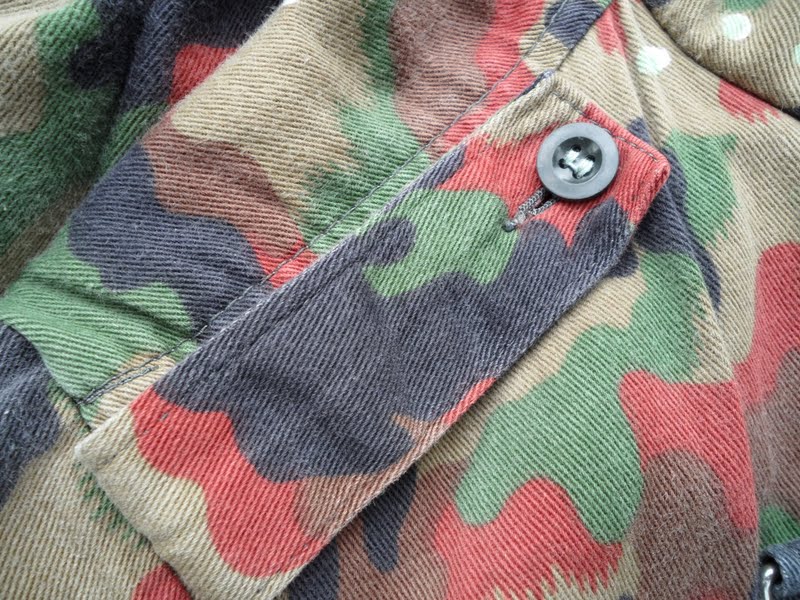
The Swiss Alpenflage camo was printed over various base colors through the years. The two jackets that I have a quite different in their appearance for this exact reason. One jacket is printed over a light colored fabric and the other over a darker brown fabric. It's interesting to see much difference this small detail makes:


The jackets are loaded with details and features. One of the very cool features is the integrated sniper's veil. The veil rolls up into a special compartment in the leading edge of the hood. It is very effective when rolled down and tucked in around the face. I'm surprised that this sort of veil has not been adopted by the various modern military units around the world. The hood has a series of buttons and a tab that allows one to fix the hood flat against the jacket when it's not being worn and to shorten the leading edge for a smaller hood.

The rear pack straps are designed to be attached to the square "rings" on the front chest of the jacket with the attached clip-hooks. The lower straps are wrapped around the waist and buckled like a belt in the front.


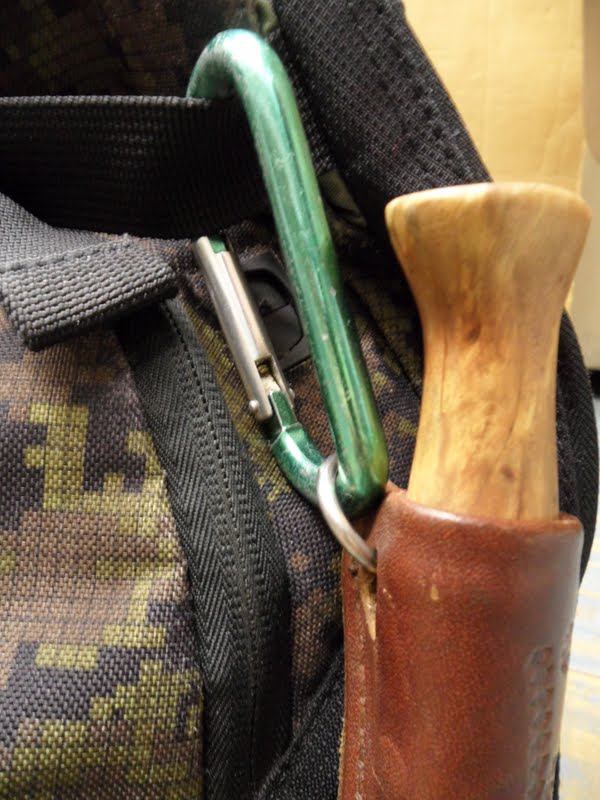
There is a heavy metal clip in the front of the jacket that is used to hang the steel helmet when it's not being worn. I use the clip on my jacket for hanging my survival knife.

The elbow and lower arm area has a clear, heavy, vinyl waterproof section sewn over the camo cloth. I also noticed that the lower arms on both jackets seem to have been cut from a different camo batch as the cloth is a slightly different color!


The jackets have pockets everywhere! Here is a quick diagram and listing of all of the pockets and what they are used for, courtesy of The Swiss Rifle Forum .


Here is the legend that tells what each pocket is for:
56) Magazines for Stgw 57.
57) "White" magazine (for firing rifle grenades), ABC- protection sheet, reflecting leg band.
58 ) Food, toilet paper.
59) Army knife, hearing protection, private items.
60) First aid dressing.
61) Gun cleaning kit, universal cleaning kit.
62) Cooking utensils.
63) Canteen with cup and cutlery.
A gas mask in a carrying pouch and a flashlight (fitted to the waist belt or chest) were carried separately.
65) Stick hand grenades / military manuals.
66) Rain protection and winter utensils, washing in plastic bag, emergency cooker.
67) Rifle grenades.
68 ) fitted to the Combat pack; the shovel or/and pick.
To finish up the posting, here is an album of photos of both of these jackets...........