Wednesday, May 4, 2016

Gränsfors Bruk Wildlife Hatchet, and Mini-Small Hatchet, My Favorite Bushcraft Hatchets!

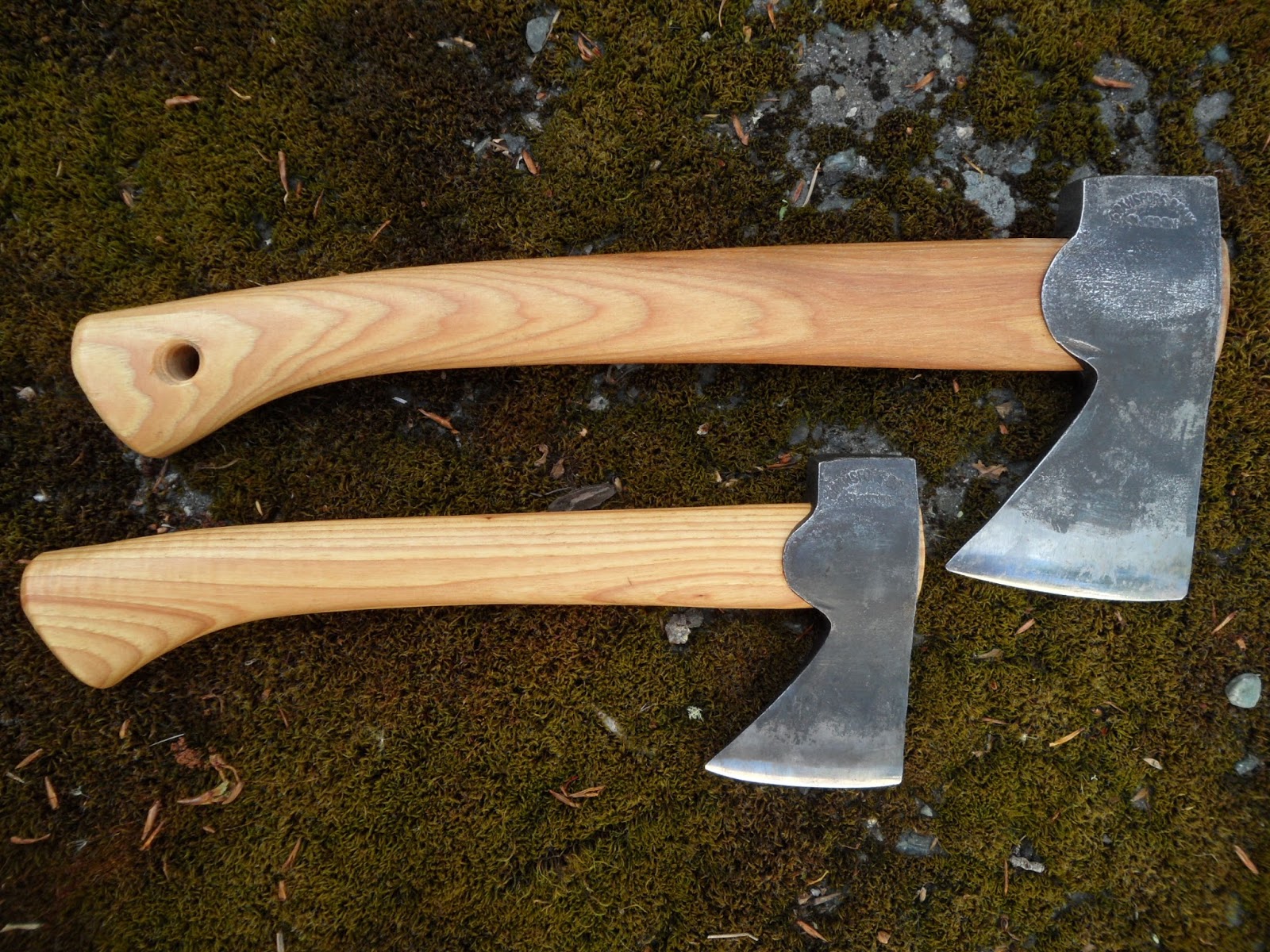
Today we'll be taking a bit of a side detour from all the military tools we've been looking at, and venturing over to the "civilian world".  Specifically, I"ll be showing off my two favorite hatchets, both made by Gränsfors Bruk of Sweden.

They are the Wildlife Hatchet and the Mini-Small Hatchet, both hand forged at Gränsfors Bruk.


When it comes to axes and hatchets, Gränsfors Bruk makes the best that can be bought. 
They are definitely not inexpensive, but worth every penny!  Each axe and hatchet is forged by hand, by one blacksmith, finished by hand, hafted by hand, using vintage tools, techniques, and equipment, and finished to old world standards.  In short, each axe and hatchet is a timeless work of art that can trace its roots back to the age of the Vikings. 


Before we go further, I'd like to post a couple of links to the Gränsfors Bruk website, where you can read about the forging process, and about their history.  They are dedicated to making traditional handmade axes, of the highest quality, using only the best Swedish steel, and wood, using the old school, traditional methods and equipment.  How often do you see that these days!


Here is a link to an amazing video documentary about the forge and the blacksmiths that work there.  It's about eight minutes long and definitely worth watching!


By now I think you've figured out that I am completely sold and hooked on these beautiful Swedish hatchets.  They are traditional, the best quality that I have ever encountered, and have a very real connection to actual craftsmen and history.  In fact, each axe and hatchet head is hand stamped by the blacksmith who forged it, with his initials.  


My Wildlife Hatchet was forged by Mattias Blixt-Pettersson, and my Mini-Small Hatchet was forged by Kjell-Åke Sjölund, stamped MB and KS, respectively.

The balance on these hatchets is perfect, and they arrive honed razor sharp and perfectly ground.  They chop and split wood like a dream!  The wood hafts are oil finished and each axe or hatchet comes with an oiled leather head cover.


They are absolutely top notch. There is nothing that you need to do to fine tune or finish on these tools......... they are grab-and-go, out of the box!

The Wildlife Hatchet is my go-to, utility chopper, that is perfect for camp use.  My Mini-Small Hatchet is my favorite though.  This little hatchet is amazing.  It is small enough to fit in a small day pack and still packs a wicked edge and ability to process small wood for camp. The Mini-Small Hatchets that are forged by Gränsfors Bruk are some of the smallest hand forged hatchets ever produced.  There are only a few blacksmiths in the world with the skill to forge a bit this small, and two of them work at Gränsfors Bruk!

Even though these little hatchets are "modern", they have an interesting link back to the military side of things.  Many of the military axes, hatchets and forged tools of the Swedish military were made by Gränsfors Bruk.  In a previous post I reviewed a WW2 vintage Swedish Army pick-axe that was forged by Gränsfors Bruk.  You can check out that blog posting here: 
http://sharky-fourbees.blogspot.com/2015/11/swedish-army-pick-mattock-ww2-vintage.html

And now, without further delay, here is the album of these two wonderful little hatchets:


Tuesday, May 3, 2016

WW2 Model 1910, US Military Hatchet, Plumb 1944, with 1945 Benton Harbor Awning & Tent Company, Canvas Cover

Today we'll be taking a look at an old hatchet that I've had hanging up in the shop for a number of years.


This hatchet is a "post-war resurrection" of an original WW2 issued, Model 1910 service hatchet.  The head was manufactured by the Plumb Company in 1944 for the US Military.  The original wood handle is long gone, and has since been re-hafted with a "Craftsman Hunter or Scout" handle.


From the look of the wood, Craftsman label style, and the amount of time I've had the hatchet, I would say it was re-hafted sometime back in the 1960's.


The official US Military designation for these old hatchets was Model 1910.  They were produced and issued during WW1 and again in WW2.  The WW1 issue hatchets are only marked with US on the head.  The WW2 issued hatchets are marked with US, the manufacturer's name, and the year date.  The WW1 hatchets were not painted.  The WW2 issued hatchets can be found in both Olive Drab painted finish and natural unpainted finishes.  
This hatchet head appears never to have been painted.

In the years following WW2, these old hatchets were sold by the thousands at surplus stores all over the US in the years following WW2.  I suspect that this hatchet found its way into civilian hands and was used hard as a camping or Boy Scout hatchet.  It was obviously valued enough by its owner to take the time and money to re-haft it with a new wood handle.  In the configuration it is in now, it is an excellent representation of an early post-war, camp or scout hatchet.  

The canvas carrier-cover is original.  It was made by the Benton Harbor Awning & Tent Company in 1945.


With the late date of 1945, and the excellent overall condition of the cover, I suspect it never saw military field service.  There was such a huge surplus of unissued equipment at the end of WW2, that many small items like this were sent directly to the civilian surplus market.  
These old hatchet covers are getting quite difficult to find these days and can often be worth more than the hatchet that it covers!

Since this is a historical bit of US military equipment from WW2, I thought I'd add a fascinating photo I uncovered of one of these hatchets (with the original handle) about to be carried into France by a member of the 82nd Airborne.  This photo shows a number  of the 82nd soldiers "gearing up" for D-Day.  You can see the handle of a hatchet peaking out from under the pack flap on the soldier on the right side of the photo.  I love shots like this!


With all of that said, here are the rest of the photos of this interesting little hatchet.


Sunday, May 1, 2016

US Military, WW2 Shotgun Shot Shells, M19, Brass, 12 gauge 00 Buckshot, Remington Arms Company, box of 10

Today we'll be taking a look at one of the newest "treasures" that I just picked up at a local garage sale.  It's a vintage box of US Military, WW2 vintage, shotgun shells.


The 12 gauge shotgun was standard issue to many of the US Marines that served in the Pacific Theater during WW2.  


They were also issued and used occasionally, in the European Theater, mostly for prisoner guard duty.

When the US Marines first hit the beaches of the Pacific, shotguns in hand, they were issued the old, paper husk, shot shells.  They soon discovered that the wet and humid environment ruined the paper shot shells.  The US military then decided to go back to the old style, brass cased, shot shells for field combat use.  After switching back to brass, they never experienced problems again.
Huge quantities of the brass cased shells were produced at the end of the war and when the war was over, they had enough stockpiled to last through the Korean war and into the early days of the Vietnam War.  In the 1960's, they switched to the new plastic husk shells.  The age of old-school brass was over.

The box of shells that we are looking at today, was manufactured by the Remington Arms Company, and are standard 12 gauge, 00 Buckshot, shells.  They are in the original issue, cardboard box. The box is missing the lot number stamp (appears to have been scratched off for some reason), and one of the shells is missing. These boxes originally held 10 rounds.

There is not much more to say about them, other than the fact that they are a rare item to find these days!  I will let the photos speak for themselves.  


Monday, March 28, 2016

US Model 1943 Entrenching Tool, M43 Shovel, Ames 1945, Post-War Re-Paint with 1953 Shovel Cover (Intrenching Tool)

Today we'll be continuing on with another folding shovel.  This shovel is another "version" of the Model 1943 Entrenching Tool. or better known as the "folding shovel".


This shovel is dated 1945 (WW2), and was made by the Ames Company.  The difference between this 1945 Ames shovel, and the 1945 Ames shovel in the previous post, has to do with the paint.


This shovel has two layers of paint visible.  The first color is the WW2 OD Green and the second shade of green is the 1950's OD Green.  This indicates that this shovel was re-issued after WW2, with an update and touch-up to the paint.  

Both the WW2 and Korean War shades of OD Green paint.
This shovel is a very good example of a 1950's "version" of the WW2 folding shovels.  In this paint scheme, the shovel most likely was issued for the Korean War (1950-1953).  Both the Model 1943 and Model 1951 folding shovels would have been issued during this time period.

This shovel is also paired with a post-war, canvas shovel cover.  This cover is dated 1953, and is correct for the later paint scheme on the shovel.  These 1950's styled covers would have been used with the Model 1943 shovels and the early issued Model 1951 shovels (a new style canvas shovel cover, that was specifically designed for the Model 1951 shovels was issued in 1956).
This cover is marked "Intrenching Tool, Combination" , which is the official nomenclature for the Model 1951 shovels. 


Let's take a closer look at the shovel and the shovel cover.  Here is the photo album.