Today we'll be taking a look at a very unique folding shovel that has one foot in the WW2 era, and the other in the Cold War era. The shovel is a Polish Paratrooper Folding Shovel.
These very unique shovels are not commonly encountered these days, however, if you keep your eyes open, you may run across one! If you do, I highly recommend picking it up.
These shovels were officially made for the Polish Paratroops, and for issue to special assault units. They were adopted in 1971 and are still seen in use by the Polish military today.
At some point along the way, some of these shovels found their way into the Hungarian military. The Hungarians issued these to their paratroops as well. In Hungary, there seem to be two versions of this shovel. The first is the Polish version that I am showing today, and the second is a flat, smooth blade version that may have been made domestically in Hungary. Another possibility is that there are two versions made in Poland...........
The most interesting thing about these shovels is the fact that the shovel blade and hinge mechanism, were copied directly from the WW2 German Feldspaten! The handle is shaped to mimic the old German shovels as well. It almost makes me wonder if there was a Polish factory that had been making German shovels during WW2, that still had some of the old tooling set up after the war. More research is needed on this point.
The handle on this shovel is made of heavy metal tubing, with a screw joint in the center. The handle is also marked indicating which direction is "ON" and which direction is "OFF".
The handle parts are kept together with a cable that runs inside, so that the parts are not lost when disassembled.
When I received the shovel, it was broken down into two pieces (the handle). At first I thought that the threads must be damaged, because, try as I might, I could not get it to thread together. After quite a bit of fiddling with it, I realized that the threads are reversed! I am guessing that the handle threads are reversed so that the handle does not loosen when the blade nut is turned. They both turn opposite.
The blade is marked with a KT and 22 inside a circle. This is the Polish military acceptance marking that means "Kontrola Techniczna". The 22 must be an individual inspector number.
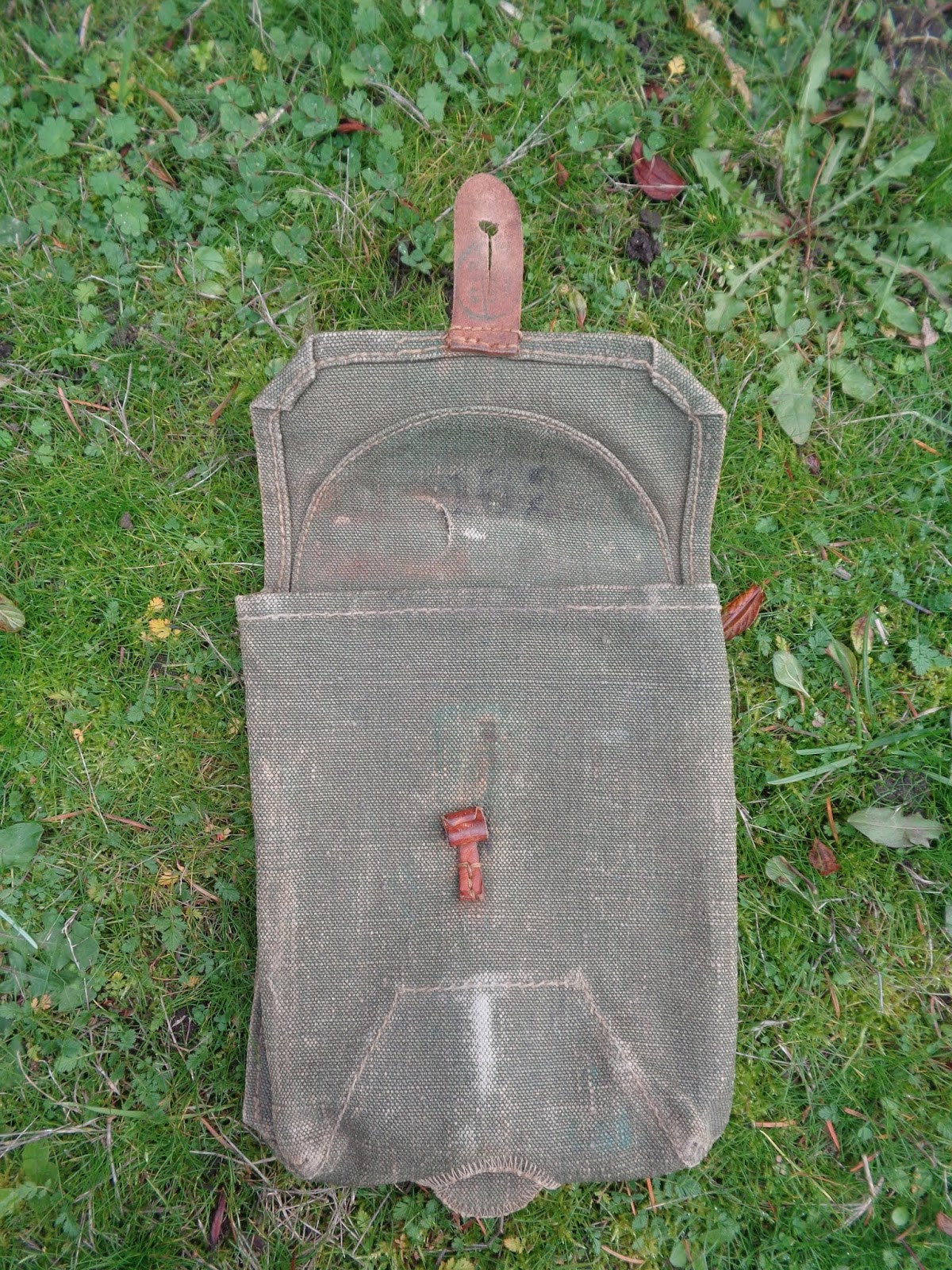
The canvas cover is made with classic Polish canvas from the 1960's to 1980's era and appears to have originally been issued with the straight handled spade. Since the cover has the handle hole in the bottom, it enables the shovel to be carried folded with the handle disassembled, or folded with the handle assembled.
One thing I love about these Polish covers is the rolled leather button tab. Very nice!
I find it quite fascinating that the WW2 German folding shovel blade, and complete shovel style, continued to find its way into service with various countries after the war.
Here is a link to one of the other "German Clones" that I have showcased. I will be showing off a Norwegian issued shovel from the Cold War that also has the classic German blade soon, so stay tuned.
http://sharky-fourbees.blogspot.com/2017/03/dutch-army-shovel-entrenching-tool.html
Now let's take a closer look at this very unique Polish / Hungarian shovel.
Tuesday, December 18, 2018
Tuesday, November 13, 2018
Imperial Russan Trench Spade - Shovel, 1916, К Ш, Saw Tooth - Serated Blade Edge, WW1, Karl Spiegel (Карл Шпигель) KW
I recently received an early birthday gift from my mother............ and I must say, it's the PERFECT gift for a dedicated "Shovel Collector" like myself!
This shovel is a WW1 vintage trench spade from the Imperial Russian Army, and if that wasn't good enough, it is also a rare saw-tooth version!
My mother picked this up at an antique mall down in Northern California. She sent me a few photos of it on the shelf and asked me if I was interested. Of course my answer was "YES!". It took a while to find its way up north, but it finally arrived by "mom's special delivery". Thanks Mom!
This shovel is dated 1916, and has the maker's mark of the "Karl Spiegel" company of Saint Petersburg Russia. The shovel also has another stamp with a Cyrillic "K" in an octagon. This "K" mark is an inspectors stamp that was assigned to Captain Krapivin.
The Karl Spiegel makers mark is in the Cyrillic letters К Ш.
The Karl Spiegel (Карл Шпигель) factory was founded in 1888, and closed up after the Russian Revolution in 1917. The factory was the largest in the Saint Petersburg, industrial manufacturing sector.
The blade is nicely serrated along one edge. I can not tell if this an original feature, or if it was filed in by a previous owner. No matter how the serrated edge was applied to the shovel, it is definitely old. My guess is that it was manufactured like this at the factory. These serrated blades are more often seen on German shovels from this time period, and very rarely seen on the old Imperial Russian shovels.
NOTE: The photos of the "saw teeth" on the edge of the blade were inspected and by two prominent and knowledgeable collectors and Russian shovel historians. It is of their opinion that the shovel may be a rare prototype of some sort, or a conversion done at a civil, or military workshop. There are no documented Imperial Russian shovel that were made and issued with this serrated edge. They both agree, that the serations appear to be original to the shovel and are too uniform and finely done to have been hand filed by a field soldier. The shovel is a rarity! The research continues...........
There are a couple of shades of green paint on the blade, so it saw at least one re-paint in its earlier life. The paint only remains in the protected areas around the blade rivets. the first layer of paint is a blue-green, and the top layer of paint is an olive green.
The handle has what looks like the Cyrillic letter "П" carved into it. This letter is the Russian equivalent of the letter "P" in english. The letter is most likely a personal marking standing for the owner's first or last name.
All in all, this is a beautiful example of a WW1 vintage, Imperial Russian spade that more than likely saw service on one of the fronts of WW1.
It makes a very nice companion to my other Imperial Russian shovels. You can check them out here:
https://sharky-fourbees.blogspot.com/2015/10/imperial-russian-finish-re-issue-trench.html
https://sharky-fourbees.blogspot.com/2017/03/finish-army-engineer-sapper-shovel.html
Let's take a closer look at this wonderful, and rare little shovel:
This shovel is a WW1 vintage trench spade from the Imperial Russian Army, and if that wasn't good enough, it is also a rare saw-tooth version!
My mother picked this up at an antique mall down in Northern California. She sent me a few photos of it on the shelf and asked me if I was interested. Of course my answer was "YES!". It took a while to find its way up north, but it finally arrived by "mom's special delivery". Thanks Mom!
This shovel is dated 1916, and has the maker's mark of the "Karl Spiegel" company of Saint Petersburg Russia. The shovel also has another stamp with a Cyrillic "K" in an octagon. This "K" mark is an inspectors stamp that was assigned to Captain Krapivin.
The Karl Spiegel makers mark is in the Cyrillic letters К Ш.
The Karl Spiegel (Карл Шпигель) factory was founded in 1888, and closed up after the Russian Revolution in 1917. The factory was the largest in the Saint Petersburg, industrial manufacturing sector.
The blade is nicely serrated along one edge. I can not tell if this an original feature, or if it was filed in by a previous owner. No matter how the serrated edge was applied to the shovel, it is definitely old. My guess is that it was manufactured like this at the factory. These serrated blades are more often seen on German shovels from this time period, and very rarely seen on the old Imperial Russian shovels.
NOTE: The photos of the "saw teeth" on the edge of the blade were inspected and by two prominent and knowledgeable collectors and Russian shovel historians. It is of their opinion that the shovel may be a rare prototype of some sort, or a conversion done at a civil, or military workshop. There are no documented Imperial Russian shovel that were made and issued with this serrated edge. They both agree, that the serations appear to be original to the shovel and are too uniform and finely done to have been hand filed by a field soldier. The shovel is a rarity! The research continues...........
There are a couple of shades of green paint on the blade, so it saw at least one re-paint in its earlier life. The paint only remains in the protected areas around the blade rivets. the first layer of paint is a blue-green, and the top layer of paint is an olive green.
The handle has what looks like the Cyrillic letter "П" carved into it. This letter is the Russian equivalent of the letter "P" in english. The letter is most likely a personal marking standing for the owner's first or last name.
All in all, this is a beautiful example of a WW1 vintage, Imperial Russian spade that more than likely saw service on one of the fronts of WW1.
It makes a very nice companion to my other Imperial Russian shovels. You can check them out here:
https://sharky-fourbees.blogspot.com/2015/10/imperial-russian-finish-re-issue-trench.html
https://sharky-fourbees.blogspot.com/2017/03/finish-army-engineer-sapper-shovel.html
Let's take a closer look at this wonderful, and rare little shovel:
Tuesday, August 28, 2018
Swedish Mess Kit, Model 1940 M40, Stainless Steel, Enmanskök Kokkärl
In my last posting, I compared the old WW2 style Swedish mess kit, the M40, to the later, post-war, aluminum mess kit, the M40/44. Today we'll take a closer look at the Model 1940 stainless steel kit.
You can read more about these mess kits in my previous posting. For now we are going to cut to the chase, as they say, and take a closer look at this one.
Here are a few links to some previous blog postings on the Swedish Mess Kits:
https://sharky-fourbees.blogspot.com/2011/07/swedish-m40-mess-kit-svea-stove.html
https://sharky-fourbees.blogspot.com/2018/08/swedish-mess-kits-m40-and-m44.html
http://sharky-fourbees.blogspot.com/2011/07/swedish-m40-mess-kit-svea-alcohol-stove.html
You can read more about these mess kits in my previous posting. For now we are going to cut to the chase, as they say, and take a closer look at this one.
Here are a few links to some previous blog postings on the Swedish Mess Kits:
https://sharky-fourbees.blogspot.com/2011/07/swedish-m40-mess-kit-svea-stove.html
https://sharky-fourbees.blogspot.com/2018/08/swedish-mess-kits-m40-and-m44.html
http://sharky-fourbees.blogspot.com/2011/07/swedish-m40-mess-kit-svea-alcohol-stove.html
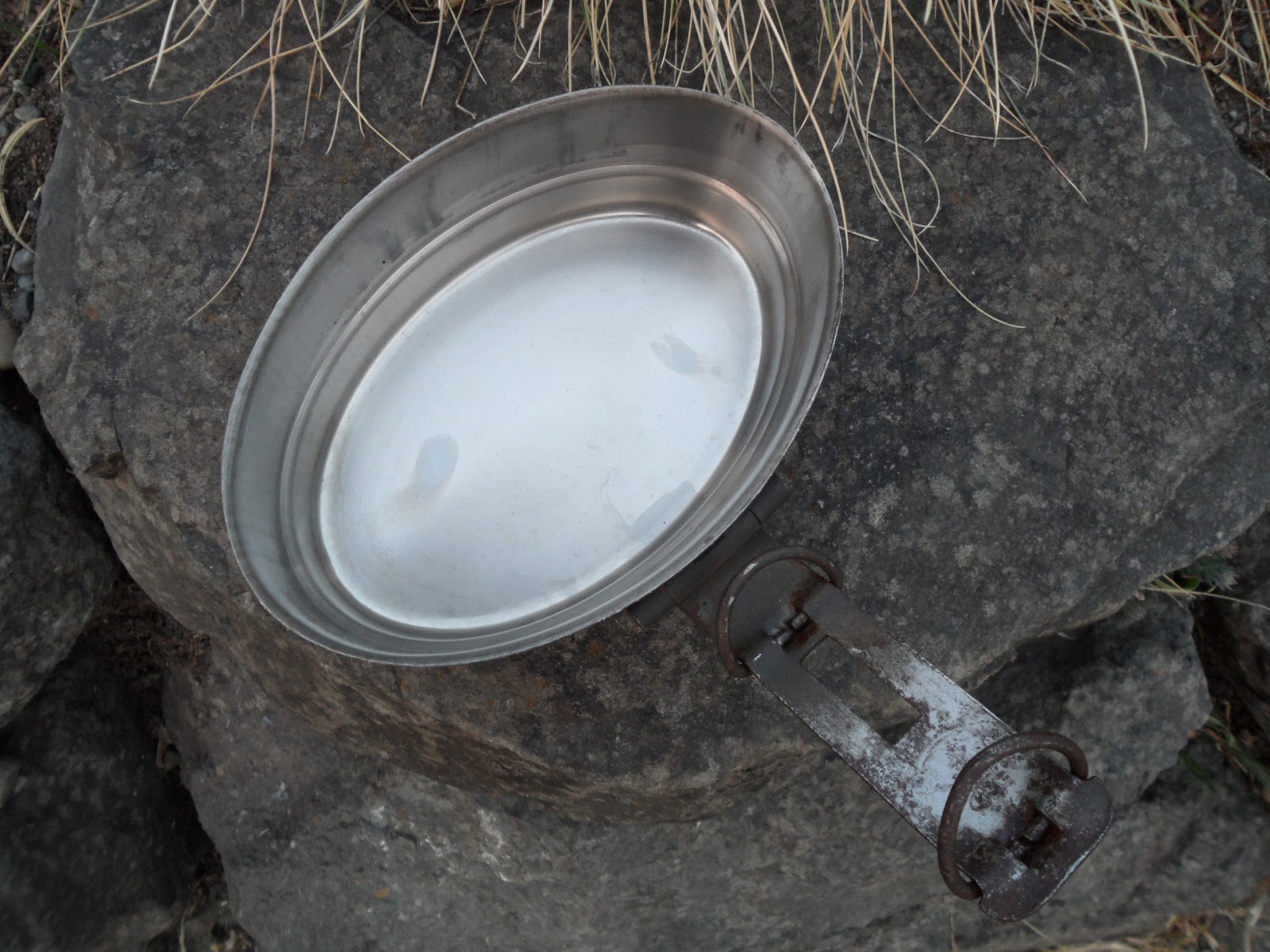
Swedish Model 1940, Stainless Steel Mess Kit:
| Clip used to hold handle down. |
Friday, August 24, 2018
Swedish Mess Kits, M40 and M44 Comparison, Stainless Steel and Aluminum Versions, Model 1940 & Model 1944 Enmanskök Kokkärl M40/44
I recently added a Model 1940, stainless steel, Swedish Mess Kit to the collection, both for display, and to use in the field. I already have several of the Model 1944 aluminum versions from the 1960's, but I was really interested to see if the earlier stainless steel versions were comparable.
In this blog posting, we'll be taking a side-by-side look at both versions. We'll take an inventory of the differences, and the similarities. I hope you find it illuminating.
First off, I have to say that I absolutely love the Model 1944 aluminum versions of these mess kits, especially when they are paired with the windscreen and alcohol burner set-up. This is my go-to, compact "one kit does it all", bushcraft pack stove and pot set. I haven't found anything better. There are lighter weight civilian set-ups, but nothing that is as easy to use, compact, versatile, and durable (in my opinion).
The prices for the aluminum version (model 1944) have sky rocketed, in the last 10 years. At one time you could pick up these aluminum kits for a few dollars each, now I see them selling for upwards of $65 to $100 US Dollars! I guess that is a testament to how great these integrated stove-pot sets are, and an indication of how a limited supply, and high demand, can drive a market........even a seemingly tiny market like Swedish Mess Kits!
If you think the Model 1944, aluminum versions are expensive these days, then you are in for a surprise when you decide to shop for the older, Model 1940, stainless steel versions. The prices for these stainless steel kits (without a stove set) can rise to around $100 US Dollars! Is it worth the price? Let's take a look at the two and see if there is anything that makes these stainless steel mess kits any better, (or worse), than the aluminum versions.
First off, I personally love mess kits, so having one of each version is reason enough of a reason to buy one of each. If you are a collector, then read no further, and get out there and buy both! If you are a "bushcrafter" looking for a single mess kit to add to your kit, then this may help you decide on which one to purchase. You can't really go wrong with either one, but there are a few differences between the two.
For our comparison, we'll be setting the "stove set" aside and just looking at the two mess kits. The wind screen, stove sets were added in the 1960's, and prior to that, the mess kits were used as stand alone cookware. I'll dedicate another blog posting to the history of the stove sets later.
With the exception of the metals that these are each made off, both of these mess kits are the same, and different................ The overall dimensions of the two are the same. The same height and the same oval footprint. They both share the same basic configuration and features. The differences are in the details.
The first big difference you will notice, when you pick them both up, is the weight. The stainless steel kit is HEAVY ! I put it on my trusty scale and weighs in at just under 3 pounds! If you are going to be packing a significant number of miles, and you are trying to keep your kit weight down, then weight alone may be a deciding factor for you. If it is, then go for the aluminum version. With the stove set and fuel included, the aluminum version is just about the same weight! Without the stove set, the aluminum version is "half the wight".
When it comes to the years and models that you will encounter out there, it comes down to WW2 stainless steel versions, or post-war aluminum. From what I have seen, the stainless steel kits were all produced from 1940 through 1944. Then there is a big gap in mess kit production. The next block of kit years I have seen start in the 1960's. It is my guess that the specifications for the mess kits were changed in 1944 to aluminum, but since there were a ton of the stainless steel kits in circulation, production of the new models was not started until the 1960's. After the big production run in the 1960's, production seems to stop again.
***NOTE*** Please see the first two comments responding to this post. One of my blog follower's, and fellow collector, "Inupiat" , has added some very relevant information on these kits. Great information on years produced, painted colors, markings, etc. Thanks!
Trangia invented the small alcohol burner in the early 1950's and produced a version of the alcohol burner with the mess kit windscreen set-up for the Swedish Army from 1964 to 1976. This matches up pretty good with the 1960's dates on the aluminum mess kits.
It should be noted that either mess kit will fit in the windscreen-stove kit. You will often find a mix of both styles of kits paired with the stove-kits when you start shopping around. This is why it is essential that you can tell the difference between both mess kit versions!
DIFFERENCES:
The easiest way to immediately tell the difference between the two kits is to look at the "groove" around the top of the lower pot. The stainless pots have one, and the aluminum ones have two.
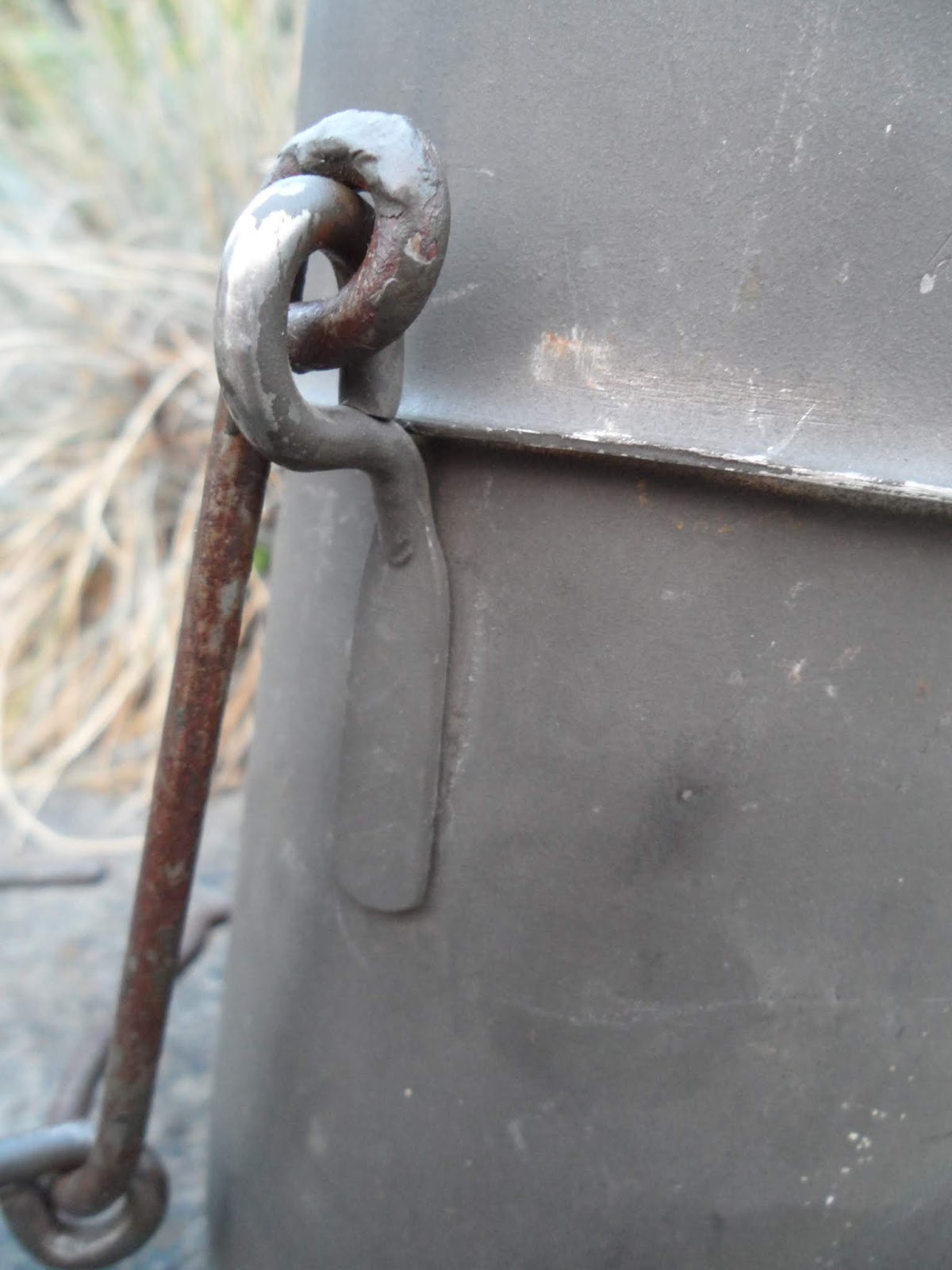
The bails are a different shape. The aluminum kit has a flat curved bail, and the stainless one has a squared bail with an offset.
The bail mounting lugs are different.
The handles are attached differently. The stainless steel handle mount is pinch welded on and the aluminum kit handle is riveted. The shape of the handle mounting plate is also different.
The angle that the handle sits at, when open, is different. The stainless one is a steeper angle.
The side profile of the cup-lid is slightly different. The "top oval" shape of the aluminum cut-lid is smaller.
The aluminum kits are stamped with the Swedish "Three Crowns" and a date. The stainless versions have various maker's marks or makers names, and no dates (no dates that I have seen).
The stainless steel version fits VERY tightly together. The aluminum version is a bit smoother and looser fit. ( Lid-cup to pot fit).
You will find these kits both "in the bright" unpainted, and in painted conditions. From what I understand, these kits were often issued out to the units unpainted and then painted, and repainted in the field, but that is unconfirmed. I will say that every "new and unissued" kit with 1960's dates that I have seen, are bright and unpainted.
We'll take a closer look at the WW2, stainless steel, M40 mess kit in an upcoming blog posting, but for now this should give you a good idea about what you are getting in both kits.
For bushcrafting and camping, you can't really go wrong with either one. If you want a steel "tank" of a mess kit, that is virtually indestructible, but HEAVY, go with the M40 stainless. If you want a lightweight "sport scar" version, go with the M44 aluminum. Choices, choices, choices......or just get one of each! Either way you can't go wrong!
In this blog posting, we'll be taking a side-by-side look at both versions. We'll take an inventory of the differences, and the similarities. I hope you find it illuminating.
First off, I have to say that I absolutely love the Model 1944 aluminum versions of these mess kits, especially when they are paired with the windscreen and alcohol burner set-up. This is my go-to, compact "one kit does it all", bushcraft pack stove and pot set. I haven't found anything better. There are lighter weight civilian set-ups, but nothing that is as easy to use, compact, versatile, and durable (in my opinion).
The prices for the aluminum version (model 1944) have sky rocketed, in the last 10 years. At one time you could pick up these aluminum kits for a few dollars each, now I see them selling for upwards of $65 to $100 US Dollars! I guess that is a testament to how great these integrated stove-pot sets are, and an indication of how a limited supply, and high demand, can drive a market........even a seemingly tiny market like Swedish Mess Kits!
If you think the Model 1944, aluminum versions are expensive these days, then you are in for a surprise when you decide to shop for the older, Model 1940, stainless steel versions. The prices for these stainless steel kits (without a stove set) can rise to around $100 US Dollars! Is it worth the price? Let's take a look at the two and see if there is anything that makes these stainless steel mess kits any better, (or worse), than the aluminum versions.
First off, I personally love mess kits, so having one of each version is reason enough of a reason to buy one of each. If you are a collector, then read no further, and get out there and buy both! If you are a "bushcrafter" looking for a single mess kit to add to your kit, then this may help you decide on which one to purchase. You can't really go wrong with either one, but there are a few differences between the two.
For our comparison, we'll be setting the "stove set" aside and just looking at the two mess kits. The wind screen, stove sets were added in the 1960's, and prior to that, the mess kits were used as stand alone cookware. I'll dedicate another blog posting to the history of the stove sets later.
With the exception of the metals that these are each made off, both of these mess kits are the same, and different................ The overall dimensions of the two are the same. The same height and the same oval footprint. They both share the same basic configuration and features. The differences are in the details.
The first big difference you will notice, when you pick them both up, is the weight. The stainless steel kit is HEAVY ! I put it on my trusty scale and weighs in at just under 3 pounds! If you are going to be packing a significant number of miles, and you are trying to keep your kit weight down, then weight alone may be a deciding factor for you. If it is, then go for the aluminum version. With the stove set and fuel included, the aluminum version is just about the same weight! Without the stove set, the aluminum version is "half the wight".
When it comes to the years and models that you will encounter out there, it comes down to WW2 stainless steel versions, or post-war aluminum. From what I have seen, the stainless steel kits were all produced from 1940 through 1944. Then there is a big gap in mess kit production. The next block of kit years I have seen start in the 1960's. It is my guess that the specifications for the mess kits were changed in 1944 to aluminum, but since there were a ton of the stainless steel kits in circulation, production of the new models was not started until the 1960's. After the big production run in the 1960's, production seems to stop again.
***NOTE*** Please see the first two comments responding to this post. One of my blog follower's, and fellow collector, "Inupiat" , has added some very relevant information on these kits. Great information on years produced, painted colors, markings, etc. Thanks!
Trangia invented the small alcohol burner in the early 1950's and produced a version of the alcohol burner with the mess kit windscreen set-up for the Swedish Army from 1964 to 1976. This matches up pretty good with the 1960's dates on the aluminum mess kits.
It should be noted that either mess kit will fit in the windscreen-stove kit. You will often find a mix of both styles of kits paired with the stove-kits when you start shopping around. This is why it is essential that you can tell the difference between both mess kit versions!
DIFFERENCES:
The easiest way to immediately tell the difference between the two kits is to look at the "groove" around the top of the lower pot. The stainless pots have one, and the aluminum ones have two.
The bails are a different shape. The aluminum kit has a flat curved bail, and the stainless one has a squared bail with an offset.
The bail mounting lugs are different.
The handles are attached differently. The stainless steel handle mount is pinch welded on and the aluminum kit handle is riveted. The shape of the handle mounting plate is also different.
The angle that the handle sits at, when open, is different. The stainless one is a steeper angle.
The side profile of the cup-lid is slightly different. The "top oval" shape of the aluminum cut-lid is smaller.
The aluminum kits are stamped with the Swedish "Three Crowns" and a date. The stainless versions have various maker's marks or makers names, and no dates (no dates that I have seen).
The stainless steel version fits VERY tightly together. The aluminum version is a bit smoother and looser fit. ( Lid-cup to pot fit).
You will find these kits both "in the bright" unpainted, and in painted conditions. From what I understand, these kits were often issued out to the units unpainted and then painted, and repainted in the field, but that is unconfirmed. I will say that every "new and unissued" kit with 1960's dates that I have seen, are bright and unpainted.
We'll take a closer look at the WW2, stainless steel, M40 mess kit in an upcoming blog posting, but for now this should give you a good idea about what you are getting in both kits.
For bushcrafting and camping, you can't really go wrong with either one. If you want a steel "tank" of a mess kit, that is virtually indestructible, but HEAVY, go with the M40 stainless. If you want a lightweight "sport scar" version, go with the M44 aluminum. Choices, choices, choices......or just get one of each! Either way you can't go wrong!
Subscribe to:
Posts (Atom)