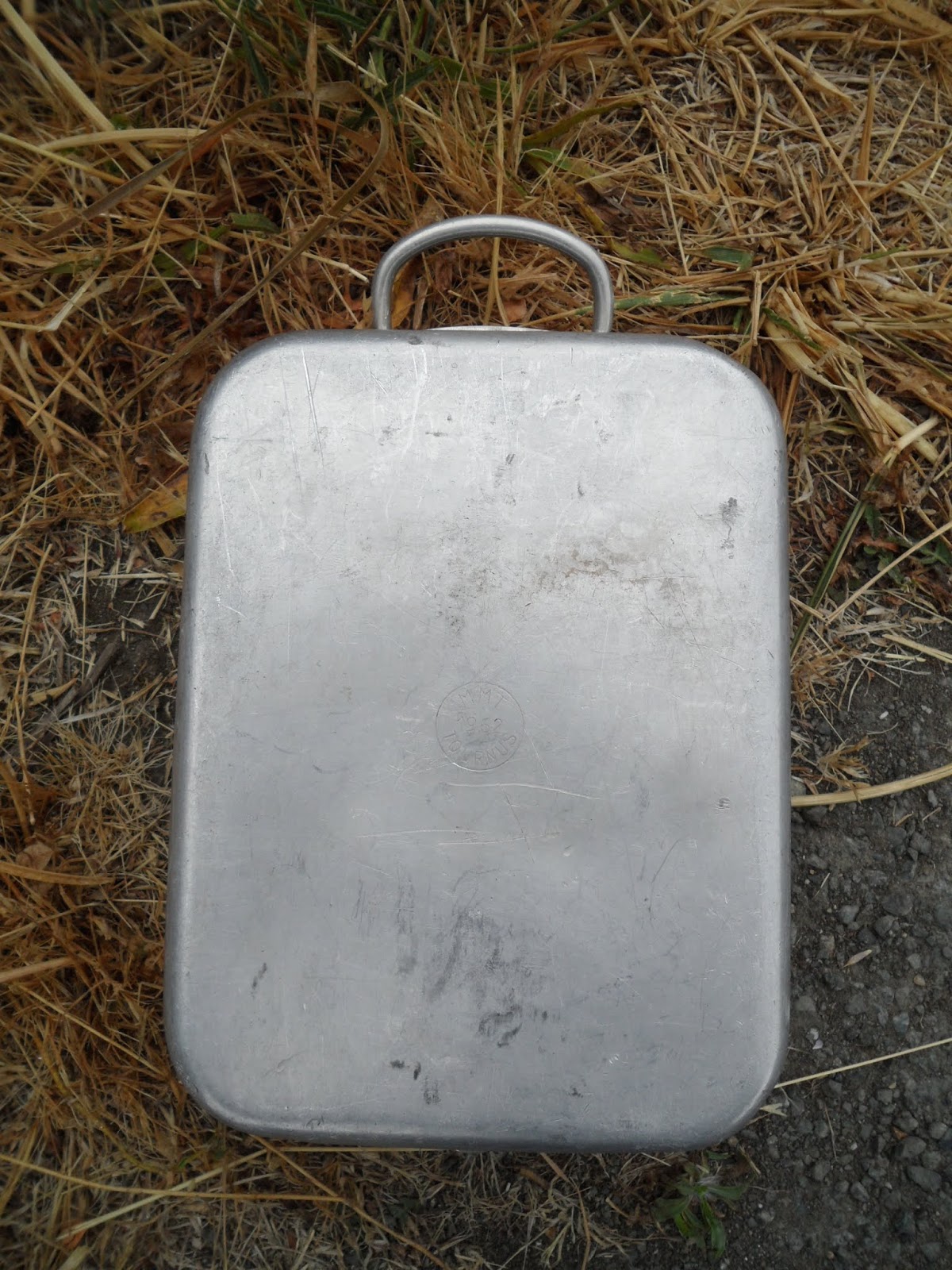
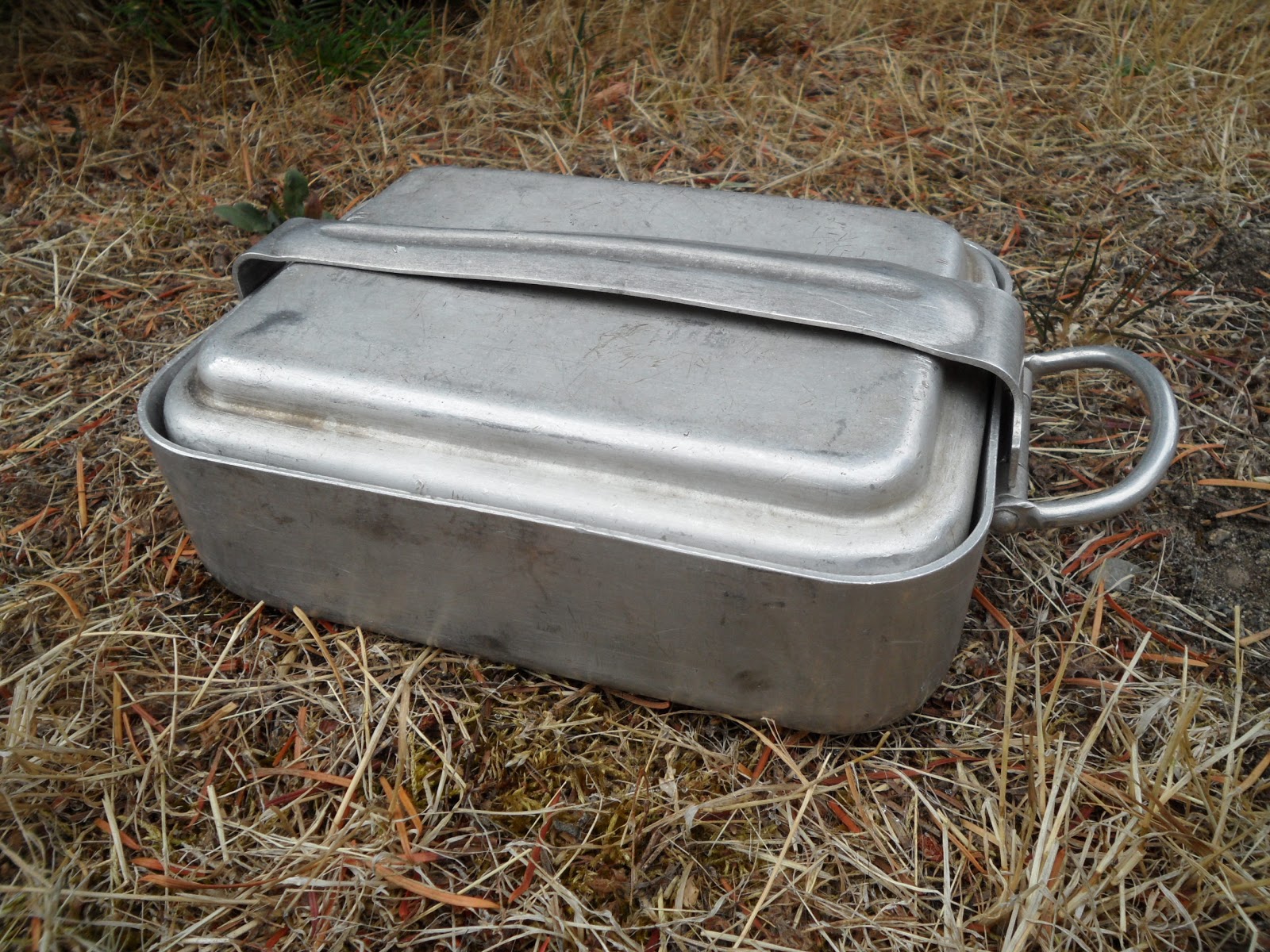
Since we seem to be on a French road right now, in regards to field gear, I figured I ought to dig out another French mess kit and show it off.
Today we'll be taking a look at the Gamelle Armée Française Modèle 1952, or in English, the French Army Mess Kit Model 1952.
This mess kit was introduced in 1952, and replaced the old, pre-WW2 Model 1935 mess kit (I'm still looking for one of the old WW2 kits to add to the collection). Basically the French took the rectangular mess kits of the United Kingdom, and made it much better!
They added a heavier handle on the main pan, built the entire kit out of heavier aluminum, and added a third inner bowl-plate.
A three of the pieces nest together perfectly, into a compact unit.
This is the mess kit that was issued out to the French soldiers fighting in Algeria, during the Algerian War of 1954 - 1962. These kits were also issued out to the troops fighting in Indochina during the Vietnam War era. These kits were used all the way up through the 1980's and early 2000's. In 2009, the Model 1952 kit was replaced with a stainless steel kit that is very similar to the old US "meat can" mess kits.
My kit is marked with the manufacturer mark of MMT, from the town of Tournus. Dated 1962. MMT is for the manufacturing firm of Manufacture Métallurgique de Tournus.
As far as modern, "bushcraft", and camping kits go, I think these French Model 1952 sets have them all beat.......... with the exception of the Swedish Mess Kits with the integrated stove set. If you get the chance to pick one of these up, then jump on it while you can!
Thursday, August 9, 2018
Tuesday, August 7, 2018
Le Bouthéon, French Army, WW2 Squad Mess Kit, 5 liter Cook Pot, 1945, MMT, MNS, Tournus, Corps D'Armée
Today we will be continuing along our "French Thread". We'll be taking a close look at an iconic French "Le Bouthéon", or Squad Mess Kit.
I had the unique opportunity to pick a couple of these up a few weeks ago, at a price that could not be passed up!
These "mess kits" are known in French as "Le Bouthéon", or roughly translated as "camp pot".
These are HUGE! They hold approximately 5 liters of liquid!
These pots were issued out, one to a "squad" of French soldiers. These first appeared in the French military kit back in the 1880's. The pot was used primarily to transport hot food from a field kitchen, to the front, for the soldiers to eat. There were may trips made with hot coffee, soup, or stew, in these pots. From what I understand, the food was often cold when it arrived back at the squad, and had to be eaten cold, or re-heated.
The lid of the pot is equipped with a socket on the side that was used with a field-made handle for cooking, over a stove, or fire.
Originally these pots were made in a tinned steel, and later, starting in the 1930's and during WW2, in aluminum.
My particular pots are the aluminum, WW2 versions.
The most notable of my two pots is dated 1945 on the bottom, with the maker's name of "MMT" from Tournus.
MMT is for the manufacturing firm of Manufacture Métallurgique de Tournus.
The second pot is marked as made by "MNS", with no date.
The 1945, MMT pot has the stenciled letters: C A, with a M under them. The C A means "Corps D'Armée", or Army, in plain English. The "M" most likely indicates a company, but I am not sure about that.
These camp pots were used by the French Army all the way into the 1980's, and possibly later.
They were normally carried, strapped to the back of the field pack.
If you are looking for an amazing "bushcraft pot" or field pot for your field kitchen, then grab one of these beasts when you can! You won't be sorry!
I had the unique opportunity to pick a couple of these up a few weeks ago, at a price that could not be passed up!
These "mess kits" are known in French as "Le Bouthéon", or roughly translated as "camp pot".
These are HUGE! They hold approximately 5 liters of liquid!
| US $20 bill for size comparison! |
These pots were issued out, one to a "squad" of French soldiers. These first appeared in the French military kit back in the 1880's. The pot was used primarily to transport hot food from a field kitchen, to the front, for the soldiers to eat. There were may trips made with hot coffee, soup, or stew, in these pots. From what I understand, the food was often cold when it arrived back at the squad, and had to be eaten cold, or re-heated.
The lid of the pot is equipped with a socket on the side that was used with a field-made handle for cooking, over a stove, or fire.
Originally these pots were made in a tinned steel, and later, starting in the 1930's and during WW2, in aluminum.
My particular pots are the aluminum, WW2 versions.
The most notable of my two pots is dated 1945 on the bottom, with the maker's name of "MMT" from Tournus.
MMT is for the manufacturing firm of Manufacture Métallurgique de Tournus.
The second pot is marked as made by "MNS", with no date.
The 1945, MMT pot has the stenciled letters: C A, with a M under them. The C A means "Corps D'Armée", or Army, in plain English. The "M" most likely indicates a company, but I am not sure about that.
These camp pots were used by the French Army all the way into the 1980's, and possibly later.
They were normally carried, strapped to the back of the field pack.
If you are looking for an amazing "bushcraft pot" or field pot for your field kitchen, then grab one of these beasts when you can! You won't be sorry!
Monday, July 2, 2018
French Alpine Snow Shovel, circa 1950's - 1960's, Le Grand Tetras, Bellegrarde AIN, France, Aluminum
While rummaging through the bunker, I ran across this old French alpine snow shovel that I picked up last year. I haven't shown it on the blog, so here it goes.
This shovel is an early, post-WW2 shovel that was made for civilian use. It was manufactured by the Raul Pautry Aluminum Household Goods factory in Bellegarde, France. It was most likely made in the 1950's, or 1960's.
After WW2, civilian camping started to catch on in France and a number of manufacturers started making camping gear for the masses. Aluminum was all the rage and was promoted as the best, and most modern material for camp gear. The Raul Pautry company was one of the biggest manufacturers of aluminum camp gear. They marketed their gear under the brand name of Le Grande Tetras. The majority of the gear they produced was aluminum canteens and cookware, however it appears they also made a line of Alpine shovels.
The Raul Paultry factory was located in Bellegarde, Ain, France, which is right on the border of Switzerland. (Ain is the equivalent of a county in France). I believe the full, and official, name of the town is Bellegarde-sur-Valserine.
Most of the early, post-war, aluminum camping gear that was made in France, was basically copied from existing military gear from the 1930's and 1940's. This shovel appears to be based on a Swiss military shovel that was produced during WW2. You can read about the Swiss version on my blog page here:
https://sharky-fourbees.blogspot.com/2015/11/swiss-army-alpine-snow-shovel-1939.html
This French version is slightly longer and slightly larger than the Swiss WW2 shovel, but is essentially the same.
The wooden handle is inserted into the blade shank socket, and a sliding tube is then slide over the spit shank to clamp the handle in place. The tube is removable, but it is not a comfortable, or easy thing to do. On the Swiss version, the handle is very easily removed by sliding the clamping tube. I am not sure if this difference is a poor design element on the French shovel, or if the handle was not meant to be easily removable.
There do not appear to many of these Le Grand Tetras shovels around, so I would imagine that they were not very popular, or very few were produced. No matter though, it has found a home with the other shovels in the bunker!
3/30/2019 Update: A blog viewer posted a link in the coments section, to a YouTube video that shows a similar shovel that was found in an abandoned camp up on Mount Everest. It's a very interesting clip. You can see the shovel at 1:19 and 2:07 minutes into the video. Here's the link:
https://youtu.be/S3auMLZZ2KU
Let's take a closer look at the shovel.
This shovel is an early, post-WW2 shovel that was made for civilian use. It was manufactured by the Raul Pautry Aluminum Household Goods factory in Bellegarde, France. It was most likely made in the 1950's, or 1960's.
After WW2, civilian camping started to catch on in France and a number of manufacturers started making camping gear for the masses. Aluminum was all the rage and was promoted as the best, and most modern material for camp gear. The Raul Pautry company was one of the biggest manufacturers of aluminum camp gear. They marketed their gear under the brand name of Le Grande Tetras. The majority of the gear they produced was aluminum canteens and cookware, however it appears they also made a line of Alpine shovels.
![]() |
| Photo from a 1950's Le Grande Tetras catalog. |
The Raul Paultry factory was located in Bellegarde, Ain, France, which is right on the border of Switzerland. (Ain is the equivalent of a county in France). I believe the full, and official, name of the town is Bellegarde-sur-Valserine.
Most of the early, post-war, aluminum camping gear that was made in France, was basically copied from existing military gear from the 1930's and 1940's. This shovel appears to be based on a Swiss military shovel that was produced during WW2. You can read about the Swiss version on my blog page here:
https://sharky-fourbees.blogspot.com/2015/11/swiss-army-alpine-snow-shovel-1939.html
| Swiss Military Alpine Shovel dated 1939 |
The wooden handle is inserted into the blade shank socket, and a sliding tube is then slide over the spit shank to clamp the handle in place. The tube is removable, but it is not a comfortable, or easy thing to do. On the Swiss version, the handle is very easily removed by sliding the clamping tube. I am not sure if this difference is a poor design element on the French shovel, or if the handle was not meant to be easily removable.
There do not appear to many of these Le Grand Tetras shovels around, so I would imagine that they were not very popular, or very few were produced. No matter though, it has found a home with the other shovels in the bunker!
3/30/2019 Update: A blog viewer posted a link in the coments section, to a YouTube video that shows a similar shovel that was found in an abandoned camp up on Mount Everest. It's a very interesting clip. You can see the shovel at 1:19 and 2:07 minutes into the video. Here's the link:
https://youtu.be/S3auMLZZ2KU
Let's take a closer look at the shovel.
Subscribe to:
Posts (Atom)