Tuesday, February 22, 2011

1963 Popular Boating Magazine and Boating Advertisements


Well it seems that William James Bookseller book shop is back on the radar......... Sweet Pea and I stopped by and checked out the free book box out in front of the store this last weekend and I picked up a great, vintage, boating magazine.  It is a a copy of Popular Boating Magazine from June, 1963.  Not only does it have some great boating "how-to" articles that I can use with my own boat projects, it has some fantastic boat advertisements as well!  I did a few quick scans to give you an idea about the ads that are in it.  Here's a photo list of the more prominent boat company ads that are mixed throughout the pages:   "Bon Voyage" and enjoy the pictures!

Cris Craft Boats 1963
Owens Boats 1963
Starcraft Boats 1963
Century Boats 1963
Traveler Boats 1963
Trojan Boats 1963
Aristo-Craft Boats 1963
Cutter Boats 1963
MFG Boats 1963

Pacemaker Boats 1963
Pearson Boats 1963

There are even a couple of pretty good outboard motor ads....... plus a ton of other advertisements that I will still need to get around to scanning into my archives.

Homelite Boat Motors 1963

Johnson Boat Motors 1963

Friday, February 18, 2011

U.S. Military Shoulder Patches of the United States Armed Forces

I picked up a fantastic reference book yesterday while I was down on Water Street at the William James Bookseller book store trading in some books for credit.  (There goes the credit!).

U.S. Military Shoulder Patches of the United States Armed Forces 3rd Edition, copyright 1981.


This book is a pre-internet reference book of all the US military shoulder patches used from WW1 through the 1970's, and includes not only the military, but also R.O.T.C., Civil Air Patrol, and NASA patches.  It is laid out in a great format with glossy group photos of actual patches and a list below the photo to identify them.  The book is spiral bound and published by the small independent publisher of M.C.N. Press of Tulsa, Oklahoma.  The book was written by Jack Britton and George Washington Jr..


I have found the internet to be one of the most amazing research resources ever, and it has enabled me to learn about, document, and research so many of the items in my collection, but I have discovered that it does have its limitations when trying to identify an unknown patch, button, pin, etc.  With a printed book like this patch book, I can just flip through the pages, and scan the photos, until I spot the patch......... then I can go to the internet and find more in depth information on the item.  A book like this is like a locksmith's book of key codes.  Once you have the code, you can unlock the vault.  In this case the vault is the internet, and the "codes" let me find and access the addresses!


I would highly recommend this book and I noticed that copies are available on Amazon.com and most likely on eBay as well.  Now I'm inspired to start digging out that pile of old patches and see what I can identify! Stay tuned..........

Wednesday, February 16, 2011

Model 1917 Remington Bayonet


Today's post is on a WW1 vintage bayonet that I picked up at a garage sale near Portland, Oregon about 30 years ago.  The bayonet is a Remington Model 1917 manufactured for the Model 1917 Rifle, officially designated as the "United States Rifle, Caliber of .30, Model of 1917".  When I originally purchased the bayonet, it was still packed in cosmoline grease and wrapped in the original grease coated paper.

These bayonets were manufactured by the Remington and Winchester firearms companies of the United States (Each manufacturer stamped their own name on the blade.  Mine is a Remington).  This model of bayonet and the Model 1917 rifle saw service all through WW1 and even during early WW2 with some of the US troops in the South Pacific.  After the Model 1917 rifle was replaced, these bayonets continued to be issued with the Winchester Model 1897 Trench Shotgun.  The shotgun was standard US military issue all through WW1, WW2, and the Vietnam War.  In the 1920's and 1930's, a number of shotguns were sold to various US police and sheriff's departments.  I'm not sure if the bayonets were sold with the shotguns though.
  

This bayonet was very similar to the British Pattern 1907 Bayonet, so it was decided to mark the Model 1917 bayonet with two distinctive vertical grooves on the wooden grips to uniquely distinguish it.


Here's a few pictures of my bayonet.  Unfortunately I do not have a scabbard for it....... I'm still looking. 


Here are a few "technical pages" and a picture of the original rifle manual cover:


And as usual, here are a couple of historic shots:


Tuesday, February 15, 2011

French Army Double Buckle Boots,


Here is another piece from my collection........ my 1960's vintage, French Army / French Foreign Legion boots. These boots are a piece of history that I wear "every day", well not every day, but whenever I need a good pair of boots to go with one of my kilts or retro-outfits.

I purchased these boots about 5-6 years ago in brand new, unissued, condition. They were still tied together with a piece of hemp twine and had the original cotton laces in them. The laces were brittle and quickly broke, so i replaced them with oiled leather laces. The only other thing I've done to the boots is to treat them with Hubbard's Boot Oil (really sticky and thick logger boot treatment). These boots are still available used, from time-to-time, through the various surplus outfits, but you don't often find them in unissued condition.

These boots were copied from the original WW2, US Army, double buckle leather boots that were issued to our troops in Europe. These French copies would work great for US reproduction WW2 boots if it were not for the fact that the leather is "inside out". The boots have the smooth side of the leather in which is EXTREMELY comfortable and smooth when walking in them. The soles are really hard and stiff with wide open lugs that will leave black marks on any un-carpeted floors.


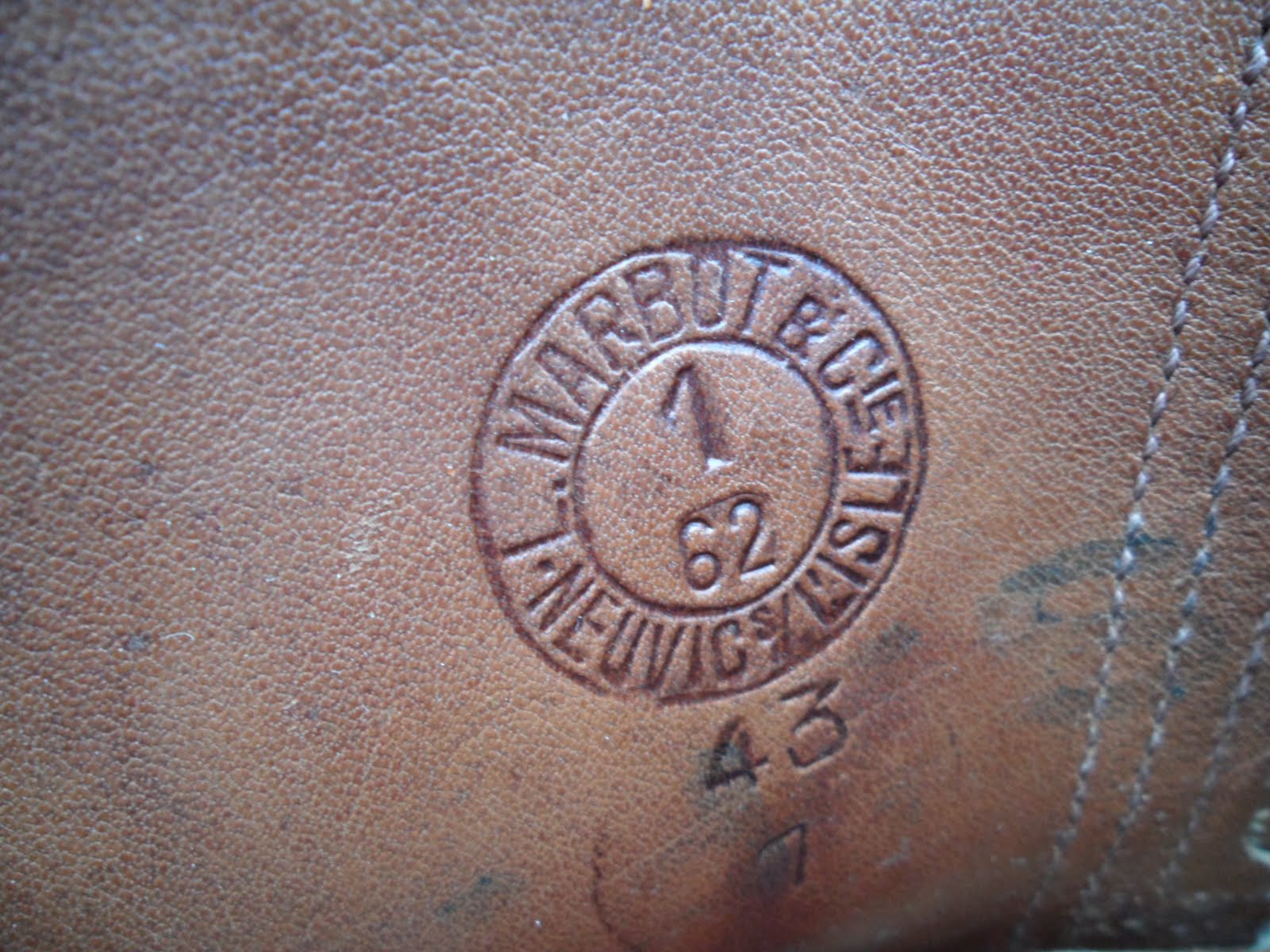
One really cool thing about these boots is the great maker and size stamp that is inside the boot top. These boots are a size 43 and were made in 1962.


Here are a few pictures of some French Soldiers wearing these boots in Algeria back in the 1960's:


Here's a picture of a US Army soldier in France during WW2, wearing the US version of the double buckle boots:

Friday, February 11, 2011

No. 4 MK II & No.4 MK II* Spike Bayonets

Here is another set of unique items out of my collection....... Three spike bayonets made for use on the British Lee-Enfield No.4 rifle, the standard work-horse rifle of the British Army during WW2 and into the 1950's. (N0.4 MK II on the far left and No. 4 MK II* on the far right)

These spike bayonets were a simplified version of the No.4 MK I spike bayonet that had a cruciform type spike. The spikes I have are a simplified version that were designed to be cheaper and easier to produce. The No.4 MK II spikes were forged out of one piece and the No.4 MK II* spikes were made with a cast body and a separate spike that was then pinned and welded into place, an even cheaper method of manufacturing. The scabbards were made of metal or plastic and were carried in a bayonet frog made of webbing. All of the spike bayonets were produced during WW2 by four companies and their subcontractors, with over 3 million spikes produced! Two English companies, one Canadian company and one American company...............

No. 4 MK II* : this is pronounced verbally as "Number four, mark two, star."

Here are some individual shots of my spikes:

No. 4 MK II* spike with scabard. Marked with "Made in England" stamp and possibly a partial "Blocked S in a Square" stamp on spike base. This stamp would indicate that it was manufactured by Savage-Stevens Company of England.


No. 4 MK II* spike marked with the makers marks of Lewisharn Engineering of England. This company produced 84,566 spike bayonets between 1942 and 1943.


No. 4 MK II spike marked with the stamp of Long Branch of Canada.


Here are a few close up shots showing the scabbard and release mechanisms.