Sunday, September 11, 2016

Bulgarian Military Pick-Axe, Pick-Mattock, WW1, WW2, or Cold War era Entrenching Tool Pickaxe

Today we'll be taking a look at a very seldom seen entrenching tool from Bulgaria.


I picked this short pick-axe up this last week to add to my collection of military entrenching tools.  I purchased the pick based on "description only", and I had expected a pick that was quite a bit newer and in much better condition, but this is what I received.  Not all bad though!  A pick in this condition screams "old" and "history"!


These short, belt carried picks, were standard issue to Bulgarian soldiers during WW1, WW2 and even during the post-war era.  The style, shape and size remained the same during this entire time.  

Bugarian WW2 soldiers in the field.
Additional photos and helmet details can be seen in my previous blog posts:

I have seen examples that were date stamped, and manufacturer stamped, and examples that have lacked any markings.  These picks were normally issued with a leather pick cover that had belt loops on the back, for carrying in the field.  Unfortunately, I do not have a cover, yet.

This pick is approximately 22 inches long, and 12 inches wide.  


As you can see from the condition, it is quite old!  The pick head is deeply pitted from rust, and the wood has some dry-rot and powder post beetle holes.  None of the rusting, or wood damage, is recent, which tends to show that this pick dates back to the WW1 or WW2 eras.  There are no date or manufacturer's stamps, so there is no way to know for sure.  Based on the "patina" and damage, it is definitely not post-war though.
I will be restoring and stabilizing this old pick in the coming weeks.  Yu can hear the story about how I do this and some shots of the "finished product".  Here is a link to the posting where I show this:
http://sharky-fourbees.blogspot.com/2016/09/bulgarian-military-pick-axe-2-pick.html


The initials of a previous owner are carved into the handle, which is quite typical for entrenching tools from these old "Eastern Block" countries.  I love it when these old tools have that "personal touch"!


I have a second Bulgarian pickaxe that I have posted on the blog.  You can see that posting here:
http://sharky-fourbees.blogspot.com/2016/09/bulgarian-military-pick-axe-2-pick.html

There is not much more I can say about this pick for now, so let's take a look at the album.  The research continues!


Saturday, September 10, 2016

American Protective Services Badge, Blackington badge company, circa 1980's, Oakland, California

Today we'll be taking a look at another recent addition to the badge collection.


This badge is a "Classic 6 Point Star" badge from the now defunct security firm of "American Protective Services" of Oakland, California.

This style of badge is nearly identical to the badges from the California Bay Area police departments, of San Francisco and Oakland.  These smooth, silver badges, with bold black lettering, were all the rage when American Protective Services started business back in 1945.  It is very likely that the security company choose this style of badge to gain some "respect by association" to the local law enforcement departments in the Bay Area.

American Protective Services was founded in 1945, in Oakland, Californian by Thomas and Mercedes Keating.  The security agency grew into one of the largest security firms in America and was eventually sold to the Pinkerton Detective Agency in 2000.  Pinkerton absorbed American Protective Services and the badge and name were retired at that time.  In 2003, Pinkerton was in turn, purchased by Securitas Security Services USA.

This badge has a "Large Burgess" style of pin catch that was first used in 1960, and is still used today.  Since the American Protective Services company went out of business in 2000, this badge falls into that 40 year time frame.  


From the patina and wear on the badge, I am going to guess that it dates to the 1980's, but there is no way to know for certain.  The number on the badge is a higher number, so it was probably issued in the later years of the company.

The badge is quite dished and is also quite large.  The badge measures 3 inches wide, by 3 1/2 inches tall!  Most modern star badges are quite a bit smaller.  I am sure that this badge would definitely get noticed in the field, and there would be a good chance it could be mistaken for a local cop's badge as well!

The badge was custom made by the Blackington badge company. Blackington has been making custom badges for over a century.   Most of the early badges from APS appear to have been made by the Ed Jones Company of Berkley, California (the city next door to the ABS main office).  The fact that this badge is made by Blackington would also tend to indicate a late badge.


This badge combines the classic look of the traditional Bay Area police departments with the "All American Name" of American Protective Services.  It is a wonderful addition to the collection!

Here is the album.  Enjoy!


Wednesday, August 31, 2016

Emergency Medical Technician, EMT Badge, Sun Badge Company, 7 Point Star, circa 1970's

Today we'll be taking a look at a new addition to the badge collection.  This badge is a vintage, custom made, Emergency Medical Technician badge from the Sun Badge Company of California.


This badge came from a collectors estate sale, and unfortunately, the detailed history of this badge was lost with its last owner.  There are a few clues that the badge holds for us though.

This badge was custom made by the Sun Badge Company of Ontario, California.  The Sun Badge Company started making badges in 1957 and is still custom making badges today.  They are still considered one of the top badge makers in the business.


This Emergency Medical Technician badge is quite unique on several fronts.  First, it is a custom made badge, not a "stock generic" badge.  Second, it is a classic Law Enforcement, 7 Point Star design.  Stars are traditionally used for law enforcement, not medical or fire service. This leads me to believe that this badge was either a private purchase badge, or was an early EMT badge for some department.

We can narrow the age of this badge down by looking at a couple of details.  First is the "Star of Life" center  piece.  The Star of Life was adopted in 1973 when the early EMT programs were essentially coordinated and organized nationally.   Another interesting aspect of this center piece, is the fact that it is actually stamped in the badge metal.  Most badges made today use a "glued on" center piece".  This EMT badge is definitely "old school construction" !


The catch on the back of this badge is a small burgess catch, which was first patented in 1910, but was commonly used on badges into the 1960's.  The catch, combined with the "Star of Life" center, leads me to believe that the badge is a mid 1970's vintage.


I completed the "new",  Emergency Medical Technician 1A program in California, back in the early 1980's, when I was a new firefighter with the Butte County Fire Department in Chico, California.  For now, I'll consider this badge my "Commemorative EMT Badge"  in recognition of that early career milestone!

In my Butte County FD Turn Outs, circa 1984.

Here are the photos of this beautiful badge.
Enjoy!


Saturday, August 13, 2016

Swedish Army Soldier's Book, Inskrivningsbok 1924, Swedish Army Call-Up Postcard Militära tjänstebrevkort (MTjbK) Ing. 2 Göta Ingenjörregemente, Ing. 4 Bodens Ingenjörregemente

Today we'll be adding to our current thread of Swedish Military items.  I recently picked up a very rare Soldier's Book from 1924 and a Call-Up Postcard for the same soldier.  Both items are very seldom seen here in the US!


I am not a Swedish speaker, so I will do my best to explain this little book and how it fits in with the old Swedish Military Conscription System.  There is very little information published about these little books and even less that explains what is included inside them.  I did however, find a wonderful genealogy website that is published in both Swedish and English, that has a very good description of a couple of similar books (1907 and 1940).  It also does a great job of explaining the old Swedish Conscript System.  I encourage anyone who is interested to check it out:

http://www.hhogman.se/swegen.htm

http://www.hhogman.se/enrollment_book_conscripts_1907.htm


These little books were given to each soldier when he first reported for his mandatory military service.  The book was his personal military record and it was expected to be kept by the soldier at all times as proof and record of his service.  These books were known as the Inskrivningsbok.

This particular book was issued to Bengt Vilhelm Dahlen, born in 1904.  Inside the book, it notes that he first served with the Göta Ingenjörregemente Ing. 2, in 1922 (Göta Engineer Regiment 2), and then served with the Bodens Ingenjörregemente Ing. 4 in 1924 (Bodens Engineer Regiment 4).

https://en.wikipedia.org/wiki/G%C3%B6taland_Engineer_Regiment

https://en.wikipedia.org/wiki/Boden_Engineer_Regiment


It is interesting to note that the Model 94/14 Carbine Ammo Pouch that I covered in a previous post, was also issued to the Göta Engineer Regiment 2,  Ing. 2.  Who knows, this very same soldier may have actually carried that ammo pouch..........

http://sharky-fourbees.blogspot.com/2016/08/swedish-m9414-mauser-carbine-ammo-pouch.html

The personal information listed in the book for Bengt Dahlen, shows that his civilian occupation was Forestry Worker, "Skogs Arb".  The fact that the hand written notations in the book are in Swedish, and they are written in a "difficult to read cursive", I will have to leave things there.  If anyone reading this can shed some more light on the information inside the book, please contact me!

UPDATE 10/10/16:  Thank you to Hans Högman in Sweden, for the following additional information.   http://www.hhogman.se/hem.htm
 
“Korp.skola” in the enrollment book is short for “korpralskola” which literally means corporal school. So, this person had been to a training class to become a corporal.
On the same page, to the left we have the phrase “Fast anställning” (split on two lines) which means “regular employment”. I looks like Dahlén was enlisted as a professional soldier (not a draftee) between January 8,1922 and October 31, 1924.
Dahlén was born on April 5, 1904."

The person I bought this book from, also had his US passport that was issued in 1964.  He told me that he acquired a bundle of personal papers at an estate auction, and these were in that purchase.  From what we can determine, he immigrated to the USA in the early 1960's, married, and became a naturalized US citizen.  It appears that he lived in New York City, in one of the predominantly Swedish neighborhoods at that time.  I did not acquire the passport, but I do have a few photos of it.

US Passport

In the back of the little Soldier's book, there is a pocket that contains a "Conscription Call-Up Post Card".  These were know as Militära tjänstebrevkort (MTjbK).  These cards were mailed out to notify each soldier of the time, place and unit that he was to report to for his annual or special service.  The postmark on this card is 1925, with Bengt Dahlen's name.


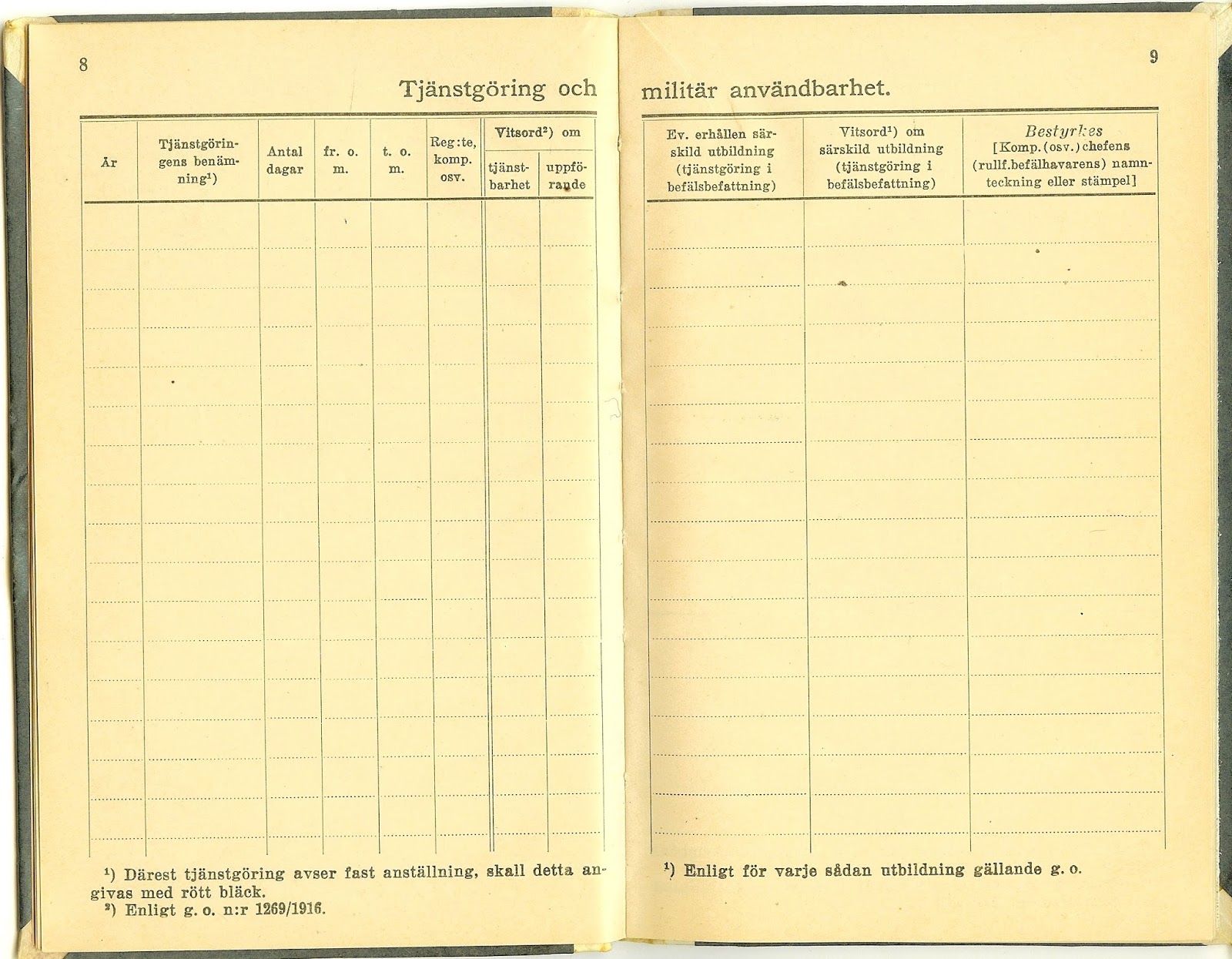
That is about all I can tell about this little Soldier's Book right now, so I will let the photos and scans of the pages speak for themselves.  In the interest of historical documentation, I have scanned and included ALL of the pages in this album!  Enjoy!


Entries showing service with Ing.2 in 1922, and Ing.4 in 1924.


Pocket in back of book with "Call-Up Card".