Friday, July 15, 2011

WW1 U.S. Engineer Corps. Marching Compass, Cruchons & Emons, Berne, Switzerland


Today's posting is a beautiful little compass that I picked up at a yard sale several years ago.  


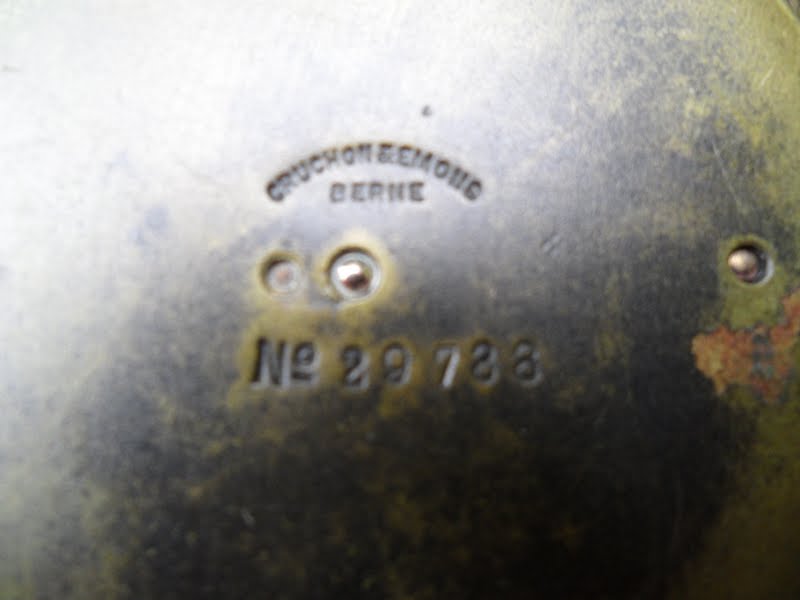
 The compass is a U.S. Engineer Corps. marching compass that dates to WW1.  It is of exceptionally high quality and is quite heavy for its size.  The compass was manufactured for the U.S.Government by the firm of Cruchons & Emons, of Berne, Switzerland.  


The compass body is machined from a solid block of brass with a jeweled card pivot.  The face of the card, and interior of the lid, are painted with original radium paint.  This type of compass is the first reliable compass that the U.S. Government put into service.  Previous types of  compasses, made in the USA, were quite unreliable.


The lid features a very unique piece that is attached to the lid edge, that moves the locking knob to secure the compass card each time the lid is closed.  The lid also features a brass mirror that is meant to be highly polished so that the bearing on the card can be read while sighting through the V-notch. 


Here is the photo spread on this wonderful gem of a compass:


Here are some WW1 vintage photographs of various U.S. Engineer Corps. soldiers in Europe during The Great War.

Thursday, July 14, 2011

Israeli Defense Force (IDF) 20 liter Fuel Can, Sandrik 20 l Jerry Can


For today's posting I'll be covering my Israeli Defense Force (IDF) 20 liter fuel can.  Most people would think, "It's only an old gas can", but actually it's a pretty interesting bit of military history!

This can was manufactured for the Israeli Defense Force in 1999 by the Czechoslovakian company of Sandrik.  It is painted in IDF light green paint and is labeled as "Diesel Engine", in Hebrew.  The can is imprinted with a Hebrew symbol on one side, which I believe indicates the IDF.  The other side is imprinted with 20 l, Sandrik, and the date of 1999.


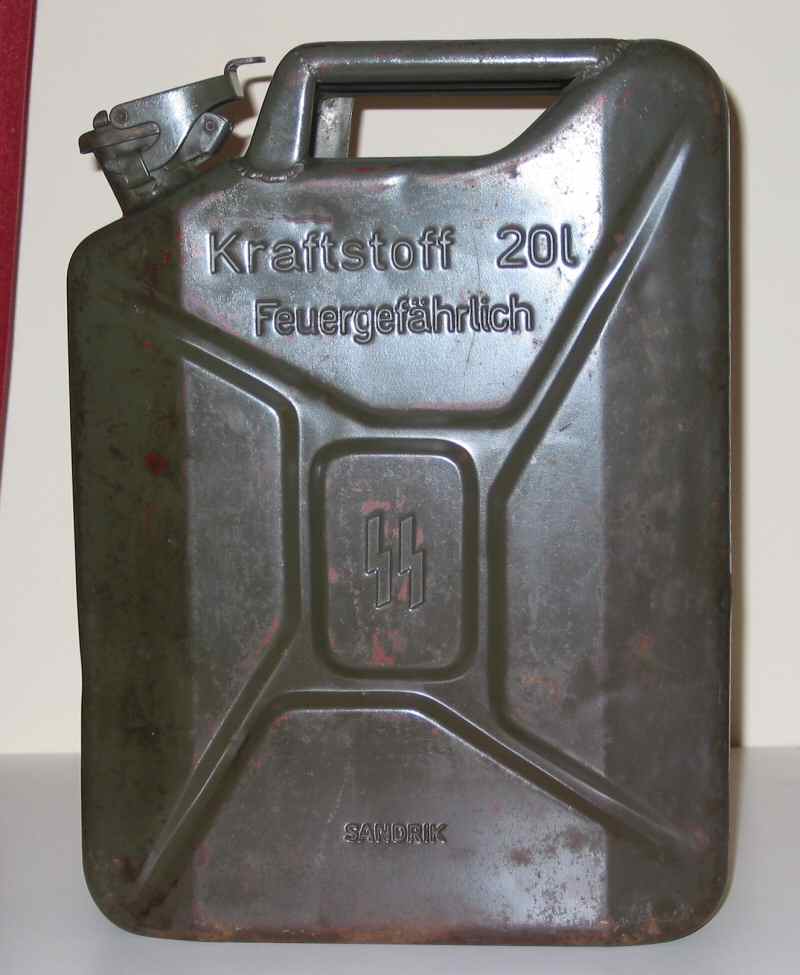
Now here's the interesting part.......... The fuel cans, also known as Jerry Cans by American GI's, are identical to the original WW2 German Wehrmacht Kanister fuel cans!  In fact, the Sandrik company was the sole manufacturer of fuel cans for the Nazi SS during WW2!  After the Germans invaded and occupied Czechoslovakia during WW2, the Sandrik factory was dedicated to pumping out equipment for the German war machine.  After the war, the factory went back into civilian production and was later awarded the contract for fuel cans for Israel.  From what I understand, back in the 1990's, the Sandik company started stamping out fuel cans using their old Nazi SS dies and selling the cans as original, old stock, WW2, SS fuel cans!  It's all a bit ironic that the world's sole Jewish State contracted to have their WW2 German patterned fuel cans manufactured by the same company that made the fuel cans for the Nazi SS...............

Here's the mechanical specs for the Israeli Defense Force fuel cans and a photo of an original WW2, Sandrik SS can:


Here are the photos of my Israeli Defense Force fuel can:


Here are a few period photos of Israeli Defense Force vehicles carrying the IDF cans.  The first photo shows the same color paint as my can is painted with, coating the inside of an armored transport vehicle (No fuel can in the photo though).


IDF Military Vehicle Museum

Tuesday, July 12, 2011

Swedish M/40 Mess Kit & Svea Alcohol Stove, Fuel Selection and Burning Tips M40/44 Enmanskök Kokkärl


To follow up on the original post for the Swedish M/40 mess kit and Svea alcohol stove stet up, let's take a minute and go over the fuel options and a few burning tips.


The Svea alcohol burners are designed to burn, well, alcohol.  But, not all alcohols are equal........... These burners fire best on denatured alcohol and pure methanol alcohol, even though just about any alcohol will work.  Denatured alcohol is basically grain alcohol that has be "denatured" or rather made undrinkable by the addition of a poisonous additive like acetone.  Denatured alcohol is available in the paint and thinner section of your local hardware store and is sold a stove fuel and thinner. You get the best value for your money if you buy the gallon can size.  


The other preferred alcohol is methanol, which also easily obtained in your neighborhood.  The easiest way to buy methanol is at the local auto parts store.  The product that you are looking for is HEET fuel treatment. HEET is actually just pure methanol that is used to get the water out of your fuel tank.  Be sure to buy the HEET in the yellow bottle.......... it is the only type that is additive free.  Methanol burns, clean, hot, odor and smoke free.  The HEET bottle is also a convenient carry bottle to keep with your Svea burner.


Just about any other alcohol will work with your stove, but be advised, anything but the denatured alcohol and methanol will give poorer results.  You can burn isopropyl (rubbing) alcohol, but it has low heat output and smokes.  High proof drinking alcohol like Vodka, etc., will burn as well, but that's a bit of a waste!

I picked up a Swedish canteen awhile back that I will be using as my alcohol fuel transport bottle with my M40 mess kit and stove.  I have painted the cap red and will add a metal tag that indicates the contents as alcohol and poison.  The nice thing about this canteen-alcohol bottle set up is that I will be able to hang the fuel outside of my pack so I won't run the risk of a spill in my gear.  I am also not that keen on storing the fuel inside the cook pots were my food will be!  I'll use that extra space for a set of mess silverware and maybe a small lighter or matches.


I fired up the Svea burner with a bit of the HEET methanol so you could get an idea of what the flame looks like when this burner is up and going.........  but first a couple of cautions.  Do not put out the flames with the burner cap.  It will melt the o-ring gasket in the cap!  It may look like a good idea, but don't do it!  And here's a crucial safety tip....... only fill the burner when it is cool to the touch!  Alcohol burns with a near invisible flame in the daylight and can even be pretty tough to see at night.  You don't want to turn yourself into "the human torch" with your next refill!  I noticed that even after the main burner goes out, there is often a couple of small flames inside the stove, where the feed holes are located at the bottom of the fill chamber.  These flames can burn for a minute or more after the main burner goes out!!!!!


And now for a few "night shots" of the Svea burner blazing away with a bit of HEET methanol fuel.  Remember, these flames are basically invisible in the daylight!