Friday, June 17, 2011

US Union Jack, circa 1912 - 1959, 48 Stars


While Sweet Pea was giving a violin lesson yesterday, I headed out to run some errands........... I stopped by "Waste Not, Want Not", our local used building material and misc. store to see if there was anything I couldn't live without.  There was!  I picked up a vintage, 48 star, Union Jack Flag!  They had no idea what they had.


The US Union Jack flag is flown by the US Navy, US Coast Guard, and other US Government ships.  The Union Jack is flown from the bow of the ship while it is anchored or moored.  The Jack is removed when the ship gets underway.  Since 2002, the US Navy started using the old "Don't Tread On Me" Union Jack from the 1770's instead of the traditional field of stars jack.


Here is a good article on the US Union Jacks:  Union Jack

The Union Jack that I picked up has 48 stars.  The 48 star flags were used from July 4, 1912 to July 3, 1959.  This puts this flag in the WW1, WW2, and Korean War time periods.  The Jack is large, about 2' x 3' (I forgot to measure it exactly), and has four steel grommets.  The fabric is a blue wool with sewn on, white linen stars.  Based on the size and fabric type, I would guess that this was used on a large ship, not a smaller patrol type boat.  There is a very faded, printed label near one of the corner grommets, but it is too faint to read.

There are a few spots of gray paint and a few moth holes on the fabric and the steel grommets have a fair bit of corrosion.  Based on the overall condition, I would guess that this jack dates to the WW2 time period.  A rare flag no matter what!  

Here are the photos:


A few great archive photos:

Thursday, June 16, 2011

Svenska Kavalleriet Film, Livregements Husarer K3, Movie of the Swedish Cavalry - Life Regiment K3 circa WW2 to 1950's

Today's posting is a pair of wonderful old movies that were filmed circa WW2.  

This first film is of the Livregementets Husarer K3, one of Sweden's oldest cavalry regiments.  I do not know the exact date of the film, but it must be before 1955, and most likely after WW2.  In 1955 the regiment was reorganized, and the horse portion of the unit was reduced to 15, from the original 432.  The film shows the regiment loading up and deploying to the field for an attack on an enemy position.  In the first scenes, there are some great shots of some light machine guns being loaded onto the horses.  Great shots of uniforms, helmets, equipment.......... ending with an attack on the the "enemy", complete with the machine guns and Mausers firing...... there's even some explosives!  Enjoy!

Here is a link to the history of this regiment:    
Livregementets Husarer


Here is the second film.  I believe it was filmed in 1942, but that is all I can tell you about it............ again, the Swedish Cavalry.

Tuesday, June 14, 2011

German Sturmabteilung (SA) Dagger, WW2 Veteran Bring-Back with a history.

Today we will continue with another Veteran Bring-Back edged weapon that was brought back home by my grandfather (see previous blog entry) during WW2.  But before I go any further, I would again like to state my stance on the the whole Nazi Party and their views and actions:

As a note to those who do not know me....... I do not subscribe to, endorse or believe in the ideology of the Nazi Party..... in any form, or any way!  I am a collector of military artifacts and history.  I present these items and their associated histories solely for educational and documentation purposes.


With that said, let's get on with today's item.  For presentation today, we have a pre-WW2 Sturmabteilung (SA) Dagger.  This dagger was brought back home to the US from Germany during WW2, by my grandfather, William R. Spannaus, after he was wounded in May of 1945.  As you will read later, it has a very interesting history.


The Sturmabteilung were the original "Storm Troopers" of the Nazi Party.  They were officially formed back in 1921 after a large "Beer Hall Brawl" erupted after one of Hitler's early political meetings.  A band of Nazi thugs proceeded to beat and thrash members of the opposition that were present............... These thugs became the SA, or Sturmabteilung, also known as the "Brown Shirts".  These guys were Nazi's to the core and formed the first Nazi paramilitary units in Germany.  The SA were the official "enforcers" of the twisted and truly evil Nazi doctrine and philosophy.  They officially existed until the war's end in 1945, but were basically finished after 1934........  If you are interested in all of the details, you can read more about them here:  Sturmabteilung History

Here is the story about this dagger as my grandfather told it to me:  In April of 1945, the US 89th Division liberated the Ohrdruf Slave Labor Camp near the town of Gotha, Germany.  This was the first concentration camp that the US forces had discovered and had actually liberated.  My grandfather's unit, the 405th Quartermaster Company was camped just outside Ohrdruf.  My grandfather told me that after the camp was liberated, they were swarmed with ex-prisoners, all wanting help.  He said that there was one Polish prisoner that kept coming up to him and his companions and tugging on their clothes and asking to travel with them and work for them.  He said that he kept bushing this man away until he finally disappeared......... a while later he returned with a Nazi dagger and presented it to him and continued asking for work.  My grandfather accepted the dagger and the Polish ex-prisoner traveled with his unit, working as a mess cook, until they were near the Eastern Border.  The Pole then said his good-byes and took off on his own, to find his way back home.   My grandfather said that he never knew exactly where the Pole got the dagger, but I would imagine that it came from one of the Nazi guards from the camp.......... After my grandfather was wounded, he tucked this dagger in next to him and kept it close while he was transported to a field hospital, to Paris, and then to the US.  If you look close, you will see the dark stains of his (my grandfather's) blood on the handle and edge of the pommel ........  An amazing artifact from one of the darkest chapters of this world's history.


Ex-prisoners from Ohrdruff with an US GI.

Before we get on with the photos of the dagger, here is a little bit of history and some details.  The SA daggers were the most widely produced daggers of the Third Reich.  Over 1 Million were produced by over 200 separate manufacturers.  Each member of the SA was entitled to own and carry one of these daggers, but they had to be privately purchased.  Each manufacturer's version of the dagger was slightly different and as such, the dagger parts are not interchangeable between manufacturers.  This was true up until 1936 when the Reichszeugmeisterei (RZM) was formed, and manufacturing standards were codified and enforced.  After 1936, all official Nazi items had to have an RZM number stamped on it.  After the RZM requirement was instituted, the number of manufacturers dropped to 62.  This dagger does not have a RZM number, which dates it in the 1921 to 1936 time window.  

Each dagger is stamped on the hilt with the initial code for the SA Group that the original owner was attached to.  This dagger is stamped with "Sa", signifying the Sachsen Group.


The dagger was manufactured by Haenel.  The Haenel company was well known as one of the highest quality manufacturers of daggers as well as firearms and even bicycles.  The Haenel factory also produced the famous "Schmeisser" MP40 machine pistol, as well as other firearms.


The SA daggers were inscribed with "Alles für Deutschland", or in English: All for Germany.


 Here is the photo showcase of the dagger..............


To finish things off, here are some archive photos of the Sturmabteilung, Brown Shirts.  In the first photo, you can see the storm trooper on the right wearing one of these SA daggers:


Monday, June 13, 2011

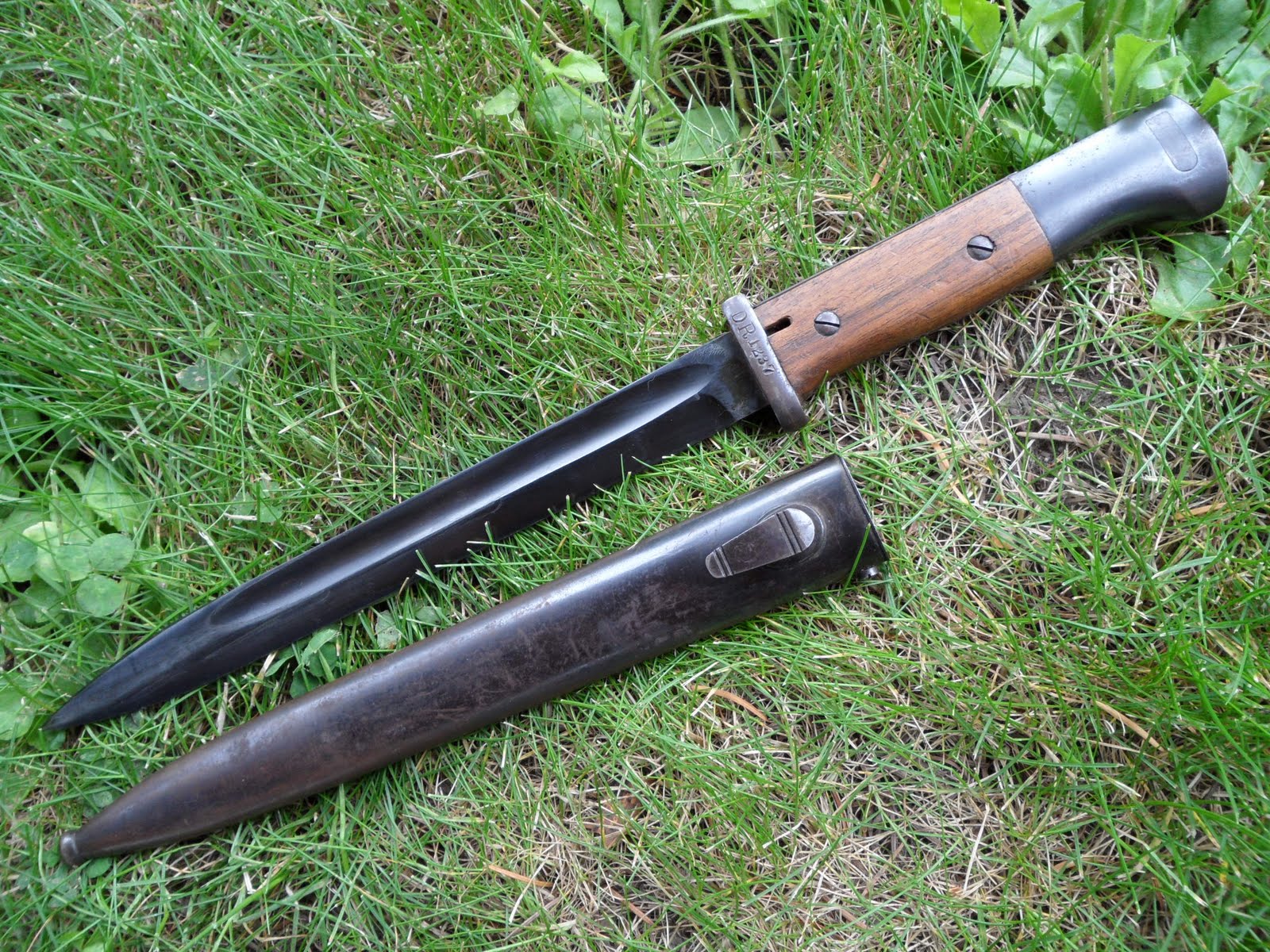
Deutsche Reichsbahn Bayonet, Narrow Pattern Karibiner 98k Bayonet, WW2 Veteran Bring-back

Today's posting is a on a beautiful German Mauser bayonet that I inherited from my grandfather, William R. Spannaus.  The bayonet is a WW2, SG 84/98 III model, for the Mauser Karibiner 98k rifle, (the full name: Seitengewehr M1884/98 III ).

My grandfather served with the US 89th Division, 405th Quartermaster Company, in France and Germany during WW2.  Just before the war was over, he was critically wounded and evacuated to Paris and then later to the US.  His unit buddies tucked this bayonet in with him as a souvenir when he left the unit en route the hospital.

My Grandfather, William R. Spannaus
At this end period of the war, my grandfather said that there were numerous German soldiers that would just walk out with their hands up to surrender. They were tired of the war and just wanted it over.  This bayonet probably came from one of those soldiers.


Here are a couple of great diagrams that show how the bayonet and scabbard are constructed:


UPDATE 9/1/11:
The bayonet has been identified by another collector as having been issued to the Deutsche Reichsbahn, or German Railway.  This was the civil service run, national railway of Germany.  The Deutsche Reichsbahn's primary responsibility in WW2 was the transport of the Wehrmacht troops.  In peacetime it was primarily a civilian railroad.  This bayonet would have been used by the armed railroad police in the service of the Deutsche Reichsbahn.  These bayonets were also used by the various Schutzpolizei units of the State Police, but were marked differently.  This style of Bayonet is actually not an official 98k bayonet because the blades are narrower and were not manufactured for the military, but were still intended for use on the 98k rifles.  These bayonets are often referred to as "Narrow Pattern Bayonets".  Here's a couple of links to good pages that explain the Deutsche Reichsbahn.


Deutsche Reichsbahn


Deutsche Reichsbahn in WW2


Here is the bayonet......as you will see, the only identifying mark is the serial number on the pommel:


Some great archive photos that show the bayonets in use........ look on the rear, left side of the soldier's belts: