Tuesday, February 15, 2011

French Army Double Buckle Boots,


Here is another piece from my collection........ my 1960's vintage, French Army / French Foreign Legion boots. These boots are a piece of history that I wear "every day", well not every day, but whenever I need a good pair of boots to go with one of my kilts or retro-outfits.

I purchased these boots about 5-6 years ago in brand new, unissued, condition. They were still tied together with a piece of hemp twine and had the original cotton laces in them. The laces were brittle and quickly broke, so i replaced them with oiled leather laces. The only other thing I've done to the boots is to treat them with Hubbard's Boot Oil (really sticky and thick logger boot treatment). These boots are still available used, from time-to-time, through the various surplus outfits, but you don't often find them in unissued condition.

These boots were copied from the original WW2, US Army, double buckle leather boots that were issued to our troops in Europe. These French copies would work great for US reproduction WW2 boots if it were not for the fact that the leather is "inside out". The boots have the smooth side of the leather in which is EXTREMELY comfortable and smooth when walking in them. The soles are really hard and stiff with wide open lugs that will leave black marks on any un-carpeted floors.


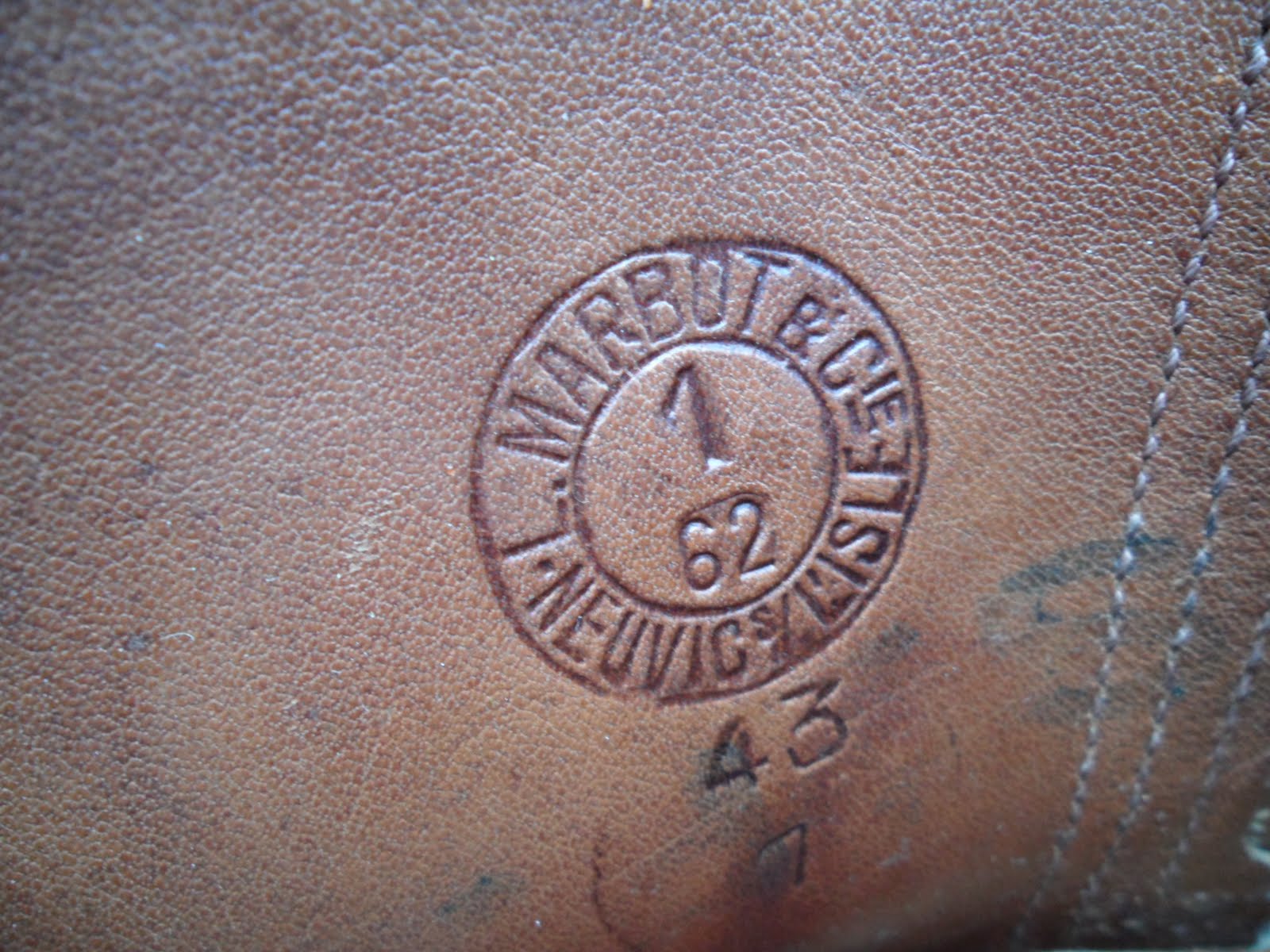
One really cool thing about these boots is the great maker and size stamp that is inside the boot top. These boots are a size 43 and were made in 1962.


Here are a few pictures of some French Soldiers wearing these boots in Algeria back in the 1960's:


Here's a picture of a US Army soldier in France during WW2, wearing the US version of the double buckle boots:

Friday, February 11, 2011

No. 4 MK II & No.4 MK II* Spike Bayonets

Here is another set of unique items out of my collection....... Three spike bayonets made for use on the British Lee-Enfield No.4 rifle, the standard work-horse rifle of the British Army during WW2 and into the 1950's. (N0.4 MK II on the far left and No. 4 MK II* on the far right)

These spike bayonets were a simplified version of the No.4 MK I spike bayonet that had a cruciform type spike. The spikes I have are a simplified version that were designed to be cheaper and easier to produce. The No.4 MK II spikes were forged out of one piece and the No.4 MK II* spikes were made with a cast body and a separate spike that was then pinned and welded into place, an even cheaper method of manufacturing. The scabbards were made of metal or plastic and were carried in a bayonet frog made of webbing. All of the spike bayonets were produced during WW2 by four companies and their subcontractors, with over 3 million spikes produced! Two English companies, one Canadian company and one American company...............

No. 4 MK II* : this is pronounced verbally as "Number four, mark two, star."

Here are some individual shots of my spikes:

No. 4 MK II* spike with scabard. Marked with "Made in England" stamp and possibly a partial "Blocked S in a Square" stamp on spike base. This stamp would indicate that it was manufactured by Savage-Stevens Company of England.


No. 4 MK II* spike marked with the makers marks of Lewisharn Engineering of England. This company produced 84,566 spike bayonets between 1942 and 1943.


No. 4 MK II spike marked with the stamp of Long Branch of Canada.


Here are a few close up shots showing the scabbard and release mechanisms.

Wednesday, February 9, 2011

70th Infantry Division Photos, "The Trailblazers" of WW2

I have had a small photo album for many years, that my grandmother picked up at a yard sale for me down around the Portland, Oregon area. Just recently I took the time to magnify the photos for clues as to the units and places that are pictured in the photos. Considering that the album was only partial (with many photos having been removed, possibly by family before selling) and the photos themselves being quite small, I was lucky to make any identification at all............. But I did identify not only the division, but also the original owner of the album, and what regiment that he served with! I used declassified documents that had been scanned and stored on the 70th Infantry Division veteran's website to deduce and confirm the owner-soldier from notes on the back of a photo of girlfriends! I also worked with the folks over at the "Trailblazers" web site. In fact, here is the photo, front and back, that gave the crucial clue as to the identity of the owner (There was only one officer named Norm (Norman) in the whole division, a lucky break!).


The soldier who owned the album was 1st Lieutenant Norman E. Sims, Jr. of the 274th Infantry Regiment, 70th Infantry Division, U.S. Army. The photos of are from his time in the service, over in Germany during WW2.


I scanned the photos and sent them to the "Trailblazers" and they are now published online in their photo archives and will be published in their magazine. Here is a link to the photo page:

http://www.trailblazersww2.org/photos_99.htm

Here is a link to the main page for the "Trailblazers", The 70th infantry Division Association. This is one of the very best veteran's web sites that I have ever seen! Tons of photo archives, video, audio, unit histories, scanned documents, etc. Be sure to spend some time exploring!

http://www.trailblazersww2.org/home.htm

And here is a selection of photos from the album:


The division band, the "Blues Chasers", giving a field concert.... notice the soldier in the back and to the left that are in full combat gear, and the division emblem on the music stand banners.

The jeep has the markings of the 274th Infantry Regiment and 2nd Battalion HQ. Notice the line of German fuel cans on the front porch........ it looks like wash day in the courtyard!


This soldier is standing next to a German Kubelwagen with no military markings. He is wearing leather driving gloves and has a binocular case on his webbed belt (I haven't seen that before!). The Kubelwagen may have been pressed into US service.

This is a view of the POW camp Stalag XII-A after it was liberated and used as a holding-base camp for the East European ex-POW's. The camp was located near Limburg, Germany. 

*NOTE*  I was contacted by one of the researchers for the Holocaust-Concentration camp museum, located in Sandbostel, Germany, regarding this pohoto of the main gate.
Camp Sandbostel Memorial Site (Gedenkstätte Lager Sandbostel).  Apparently, it is one of the only known photos of the gate during the short time it was it was an ex-POW camp.  The photos is now used in their interpretive display at the museum.

This is a shot of a large pile of helmets that were stacked at an unknown location. The helmets may have been from soldier who were taken prisoner, or possibly were casualties. Notice that all of the medic red crosses appear to have been self-painted on and there are several helmets with nets in the mix.  A very poignant photo.

Well there's the "best of the album". Be sure to go over to the "Trailblazer's" site and read up on the history and check out the photos.............

Monday, February 7, 2011

Weekend Treasure! French Silver, Austrian Bronze


This last Sunday, Sweet Pea and I hit the local Goodwill for the end of the week sale.............. and came home with a little pirate treasure!

As Sweet Pea was in line to check out, I noticed that one of the clerks was pricing necklaces out of a pile of jewelry on the counter. On top of the pile, I immediately noticed a beautiful, silver, 5 franc French coin and a couple of bronze Austrian 1 schillng coins, on a silver necklace. It had not been priced yet. I stood casually by while the clerk carefully scrutinized the necklace and then priced it at less than $2 !!!!! The coins have been drilled and were attached with silver soldered rings. The necklace is made of Mexican silver. I've removed the coins and we'll recycle the necklace.

Did I mention that the French coin is a SILVER issue coin !!!!!! (made from .835 coin silver, .3221 oz, . of silver to be exact).


Here's the rundown on the French 5 franc coin:

The coin was designed by the famous French Art Nouveau artist Oscar Roty. You can see his "signature" on the face of the coin under the "lady". The design for this coin originally dates back to the 1897 - 1919 time period. In 1960, the design was brought back and from 1960 - 1970, the 5 franc coin was minted in silver (after that they went to nickle-brass). The woman on the face is the Sower, la Semuse. This design inspired the early US silver "Walking Liberty" coins as well as the WW1 Victory medals for Great Brittan and the US. The coin has the raised words "Liberte, Egalite, Fraternate" around the outside coin edge. A VERY beautiful coin!


The Austrian schillings were minted from 1959 - 2001. Very beautiful coins as well, with the edelweiss on the back.

All of these cons were made obsolete when Austria and France adopted the Euro around 2000......... and I guess the age of coin-art has died with it.

Friday, February 4, 2011

Knäppetält , Swedish Zeltbahn Update


I have continued to research the Swedish zeltbahns that I have, and I have finally found an actual photograph of them in use and a narrative and reference to them by someone who actually used them while serving in the Swedish Army!

The complete narrative can be found at this Swedish blog: (note: it is written in Swedish, so you can cut and paste it into Google Translator if you don't read Swedish!).

http://www.utsidan.se/blogs/majjens/350-faltjagare-vilse-i-fjallen.htm


It seems that that this gentleman was in the Swedish Army back in August of 1974, and took part in a 350 man "expedition" into the mountains by bicycle and on foot, with full military gear.

Here are a few of the pictures from the narrative:


The search for more documentation continues......................

Tuesday, February 1, 2011

Smartwool Cycling Jersey


This afternoon Sweet Pea and I headed down to Water Street to the local clothing consignment shop, The Clothes Horse, and while my sweetie was dropping off a new batch of clothing, I checked out the men's section........... Just before we were ready to leave, I spotted a great looking red shirt hanging in an inconspicuous corner. It turned out to be a brand new Smartwool cycling jersey!


Brand new with the original tags still attached, in my size, and best of all, it had a "thrift store price"! The jersey is the "Ramped" model with a shoulder pocket and three rear jersey pockets. It fits great, and like all SmartWool products, it's a very high quality merino wool.


Now if it would only warm up a bit, I could get out and give it a try (it's been below freezing for the last few days!).

Bundeswehr Schiffchen, West German Army Garrison Caps


Today's posting is of the grand daddy of all hat hauls............. Ein hundert Schiffchen! One hundred Bundeswehr garrison caps! The "official" German name for these hats are "Schiffchen", translated as , "Little Ships".


I had the opportunity to pick up a HUGE pile of German Bundeswehr garrison caps for the normal price of just a couple of them. How could I pass that chance up? Anyway, the hats arrived yesterday, all 17 pounds of them. They were sold as "original, unissued", but when I started sorting through the bundles, I discovered that there were 20 hats that are in "used but clean" condition. Nearly all of the new hats have a manufacturer date of 1990, with a few from the late 1980's. The used ones range from 1981 to about 1989. I am guessing that this style of hat has been discontinued by the German Army and now the last of the warehouse stock is being dumped on the market.


In looking over these hats, I noticed that there is a wide variation in the color of the cloth linings but the moleskin exteriors seem pretty close together shade-wise. All of the hats are size 60, with many of the used hats originally stamped with larger sizes and then later crossed out and hand written with size 60. I am guessing that the hats shrink with washing and drying and that these hats were bundled for re-issue after they were checked for the "actual size" after shrinking. All of the hats were tied in bundles of 10. Some with rubber bands (which had nearly disintegrated) and some with string.

In this photo you can see the variation in colors in the lining cloth.

These hats are not often seen in photographs of Bundeswehr troops and soldiers, so finding a good historic photo or two has been tough. In the field, it appears that the panzer troops tended to wear them more often, with the occasional field officer as well (for the army at least). Most of the photos that show soldiers wearing the garrison caps are in a barracks setting. The Luftwaffe and German Navy have their own versions and they seem to have been worn much more often while on active field duty.

In the barracks, 1982.Early Bundeswehr panzer troops.


Even Sweet Pea got in on the action! As you can see, we're both on the same team!